Edinburgh weekend 2026: more fun at the Fling

Edinburgh weekend 2026: more fun at the Fling

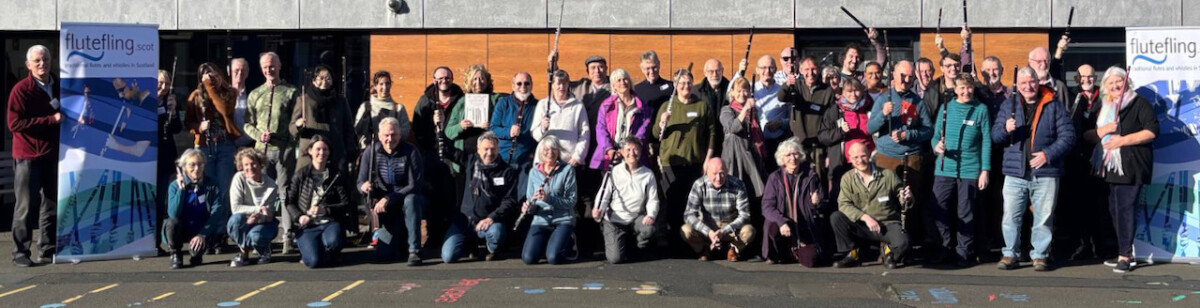
The last weekend of March this year saw traditional flute players gather in Newhaven, on the outskirts of Edinburgh on the shores of the Firth of Forth, for the 2026 Edinburgh FluteFling. Here’s a first account, with photos to come.


Friday

“Is it always as cold as this?” a woman asked me as she hurried wind-blown into the tall atrium space, shaking off rain from her jacket and unravelling her scarf. It was Friday evening at the Heart of Newhaven Community – a Victorian school building that is home to a vibrant and busy community and the Edinburgh FluteFling weekend base for the last four years.

It was the start of what turned out to be a blustery weekend, with the venue set back from the old Newhaven harbour. Events in previous years had seen warm sunny days, or the haar setting in for a fog-bound weekend. Jackets, scarves and hats were needed for this weekend though, as weather drove down the Forth valley whipping up heavy showers, sunshine and rainbows while white horses danced in the Firth of Forth.

In contrast, the atrium was beginning to fill with the warmth of old friends reuniting and newcomers gaining their bearings before finding seats in the main hall for the opening concert.

On such a night, this year’s concert certainly rewarded hard core fans of traditional flute and whistle playing. The lineup of award-winning and award-nominated musicians celebrated a rich array of variety within contemporary and traditional music.

The concert opened with Hammy Hamilton, the celebrated Irish musician, academic, researcher, educator and creator of what has become known as the “Irish Flute”. That design is a modern reworking of the older wooden classical flutes of the 19th Century, adapted for traditional music and taken up the world over.

Scottish flute maker George Ormiston had also been adapting the design in parallel to Hammy Hamilton and has supported the FluteFling. Over the weekend we were blessed with the presence of both influential innovators.

Hammy’s solo performance offered an insight into his influences and interests and he drew the audience in with stories, older tunes and singing. A personal high point was a song from Lough Neagh framed by the melody played on the flute.
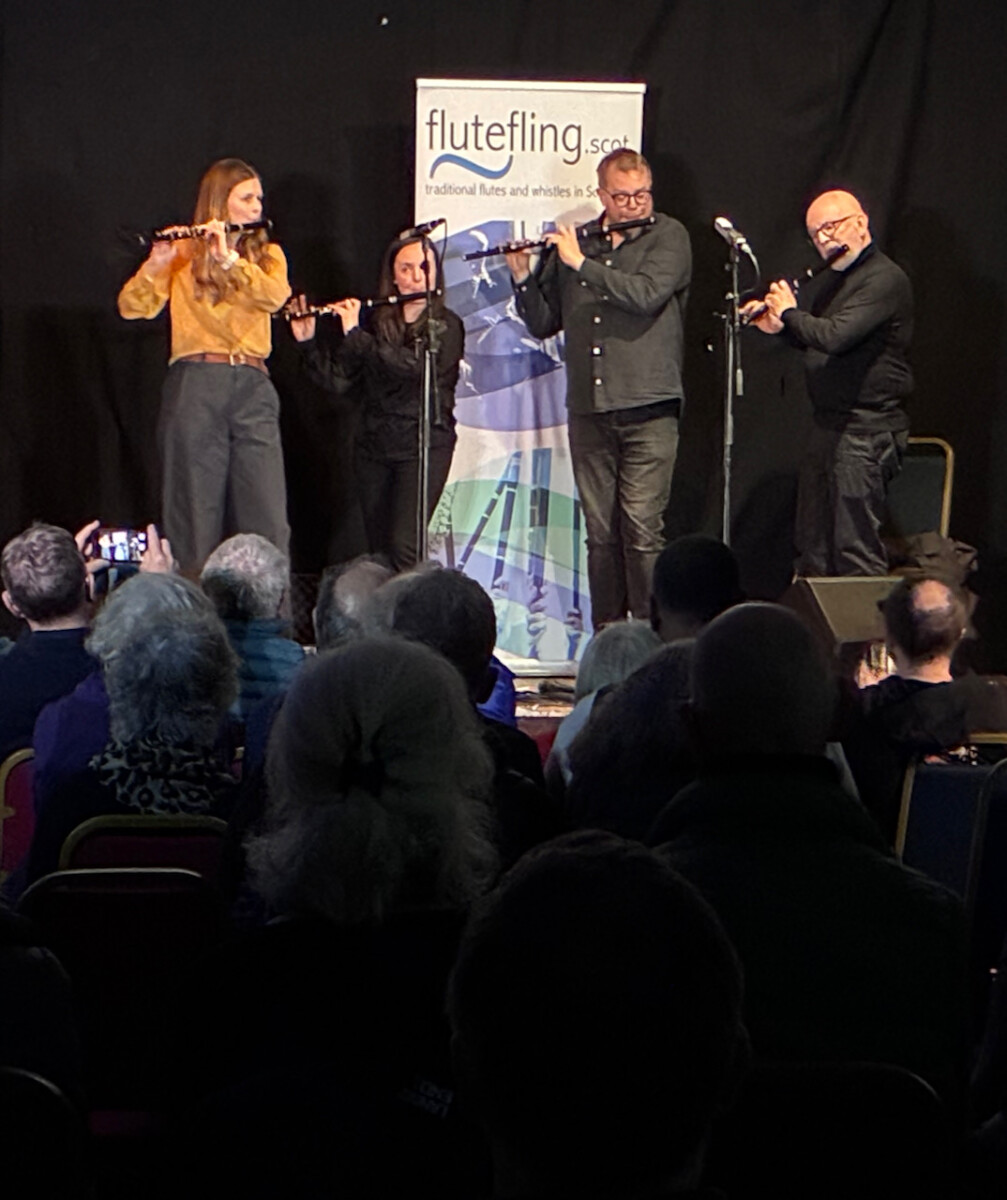
Four fluters: the perfomers gather for a rousing set of tunes to finish the night (c) Gordon Turnbull

Tina Jordan Rees followed on both flute and low whistle, with a mixture of her own compositions and traditional tunes. Tina’s unaccompanied performance highlighted those original melodies, which carry recognisable traditional features but often with a twist such as an unusual time signature, key or rhythmic variation. At a time when many innovations are being explored in traditional music circles, to my ears Tina’s tunes stand tall in a solo setting, remaining accessible to players of flutes and whistles and to audience members alike.

Headliners Claire Mann and Tom Oakes are both multi-instrumentalists but the final hour of the evening was mostly given over to flutes, which made for a very special occasion. With sensitive and lively interplay across a mix of different tunes types, from slow airs to punchy reels and jigs, there were settings in unusual keys and an array of flutes in different pitches

Long-standing friends, there was a natural ease to Claire and Tom’s music, despite this being just the second time they had performed together. Hopefully this is the start of further musical adventures together from them.

Towards the end of their set, they played a set of tunes associated with Cathal McConnell in tribute to him. The Fermanagh flute player, whistle player and singer has long been resident in Edinburgh and is a recognised major figure in Irish traditional music. Cathal has attended and supported FluteFling events over the years but was unable to do so this year.

The evening was rounded off by all performers coming together for a rousing set of tunes to see us all of on our way.


Saturday

This year, the workshops were sold out within just a few weeks, despite increasing class sizes. This made for a busy Hub at the venue, which we took over once more. This year the three teaching groups remained in their rooms and Hammy, Tina and Claire as tutors were the ones that moved around to the different groups.

At FluteFling we create the classes based on current playing situations, which in recent years we have found to be a natural way of grouping people who attend rather than asking them to rate their own ability or how long they have been playing. Overall, people seemed relaxed and comfortable in their groups.

Dropping into one class, I caught Hammy sharing some of the background to the music and the flute before teaching a barndance. In another, Claire was responding to questions on different ways of introducing ornamentation into a tune she was teaching. And in a third, Tina had shown a class that a particular tune was much more manageable than it had first seemed to the group.

Teas and coffees were provided by the wonderful Heart of Newhaven team and enough time is given for the breaks between classes to allow everyone to pause from learning. The space became noisy with chatter and music. This was time for friends to catch up, grab a coffee, listen in on conversations about music or instruments, or just go and get some fresh air.

George Ormiston had his flutes and whistles available to try out, including a Bb flute and even one in A, a physically tricky one with a sonorous reward. There were discussions about instrument needs, repairs and maintenance, local sessions, recordings, and more. There were second hand instruments for sale and people broke out into quiet spaces to try them out or consolidate what they had just been learning.
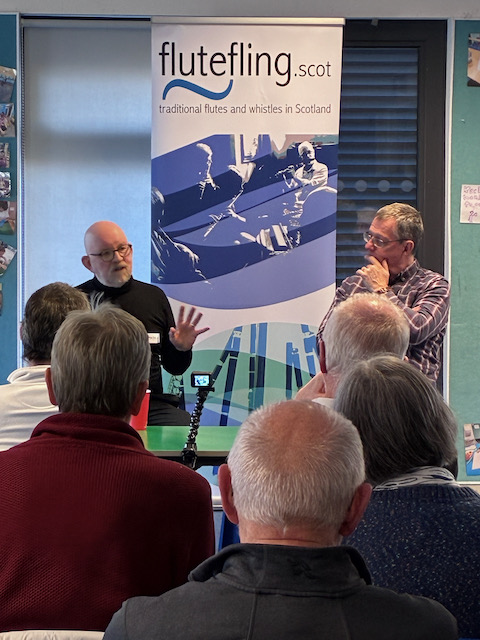
FluteFling Chair Dougie Pincock listens to Hammy Hamilton share details on his experiences and research on the flute in Irish music. (c) Gordon Turnbull

The teaching day ended with FluteFling Chair Dougie Pincock interviewing Hammy Hamilton about his life and experiences as a musician, flute maker, researcher and academic. It was fitting to finish up by deepening the understanding of the music, in particular the development of the flute since the 1970s and 80s.

After the workshops, the now-traditional curry at Rishi’s followed and once more we were looked after very well. We have long-time FluteFling supporter and previous tutor Niall Kenny to thank alongside the welcoming Lost in Leith, for arranging a space for the evening session. This was quickly arranged following the previously organised venue letting us down at the very last minute. But all was well as music and goodwill flowed.
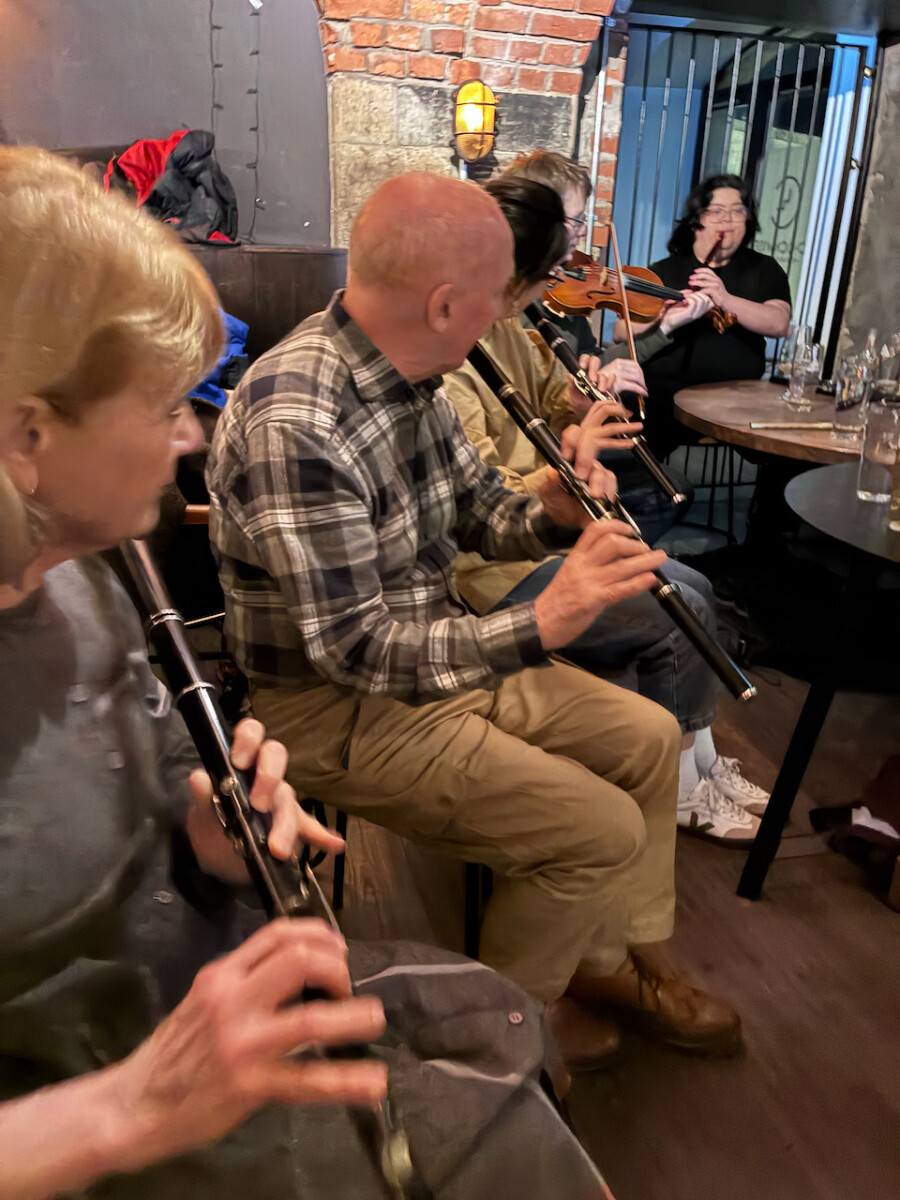
Flutes, fiddle and low whistle at the Saturday session in Lost in Leith (c) Gordon Turnbull


Sunday
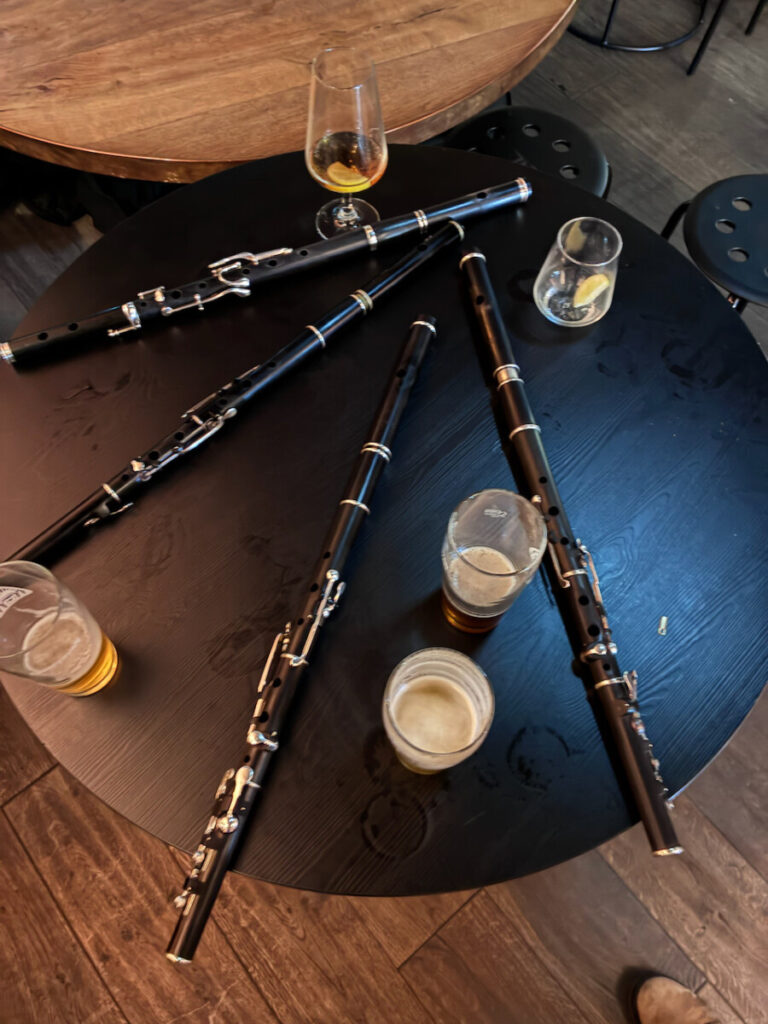
Flutes on the table at the end of the Saturday session at Lost in Leith (c) Gordon Turnbull

Despite the challenge presented by the clocks going forward over the weekend, a large group managed to gather for the Sunday workshop with Claire. This mixed ability workshop is relatively new to FluteFling, but it is proving to be a popular one. On the whistle, Claire led us all through a slow reel that was perfect for Sunday morning vibes. Inside was coffee, tea and mellow music, while outside another shower lashed and blew by. The groups explored phrasing, discussed the merits of learning by ear and whistles in different pitches.

There was still time for a well-attended session in the afternoon at Lost in Leith, but many had journeys to make — to home in County Durham, Aberdeen, Galloway and Somerset. Others had travelled from the USA or the Netherlands to be part of a very successful weekend.


A view from the inside
Brigid Daniel (right) playing the whistle in Claire Mann’s workshop (c) Gordon Turnbull

Brigid Daniel is a whistle player from Edinburgh who attended the weekend. She kindly added her thoughts on the her experiences from the perspective of someone attending.

What was it like to attend? The venues, setting, location? 
The venue works well for such an event with separate rooms to accommodate smaller groups, but also enough space for all to gather. Parking is easy close by and is near shops to buy lunch.


What’s it like to be in a workshop?
I attended the workshops on both days and enjoyed the different styles of the different leaders. It was good to stay part of one group and get to know the other group members. I felt completely safe to have a go at trying all the tunes – it was a supportive, friendly and non-threatening environment in which to learn. The option to record the tunes was helpful. It was also helpful to have some of the sheet music in advance.

What did you enjoy about it?
I enjoyed the chance to learn from expert players. The most useful aspect for me was learning more about ornamentation, in particular, breaking down a tune in detail and patiently trying to infuse ornaments rather than rushing through and moving on. I particularly welcomed the last workshop that focused on the whistle.

Any highlights you would like to share?
Apart from learning from the leaders, I enjoyed the opportunity to compare notes with others. There was ample time to chat informally and to pick up tips and ideas about instruments, music, sessions and events from other attendees. Everyone was very friendly and it was nice to be amongst a group of people who shared a passion for flutes and whistles.

Any tips for surviving the weekend?
I recall from when I was very new to learning by ear how intimidating it can feel. Now, with much more experience of that kind of learning I feel more confident that I will learn a tune in that way. For those who were new to learning by ear there were times when I think the teaching pace might have been a little too fast, but then of course there has to be a balance for those who pick up tunes quickly. I think the only way to address this is to ensure that there is a lot of reassurance to those who are very new to learning by ear that it doesn’t matter if they don’t get it all perfectly immediately. Even picking up some of the phrases is a good start.

What does FluteFling mean to you?
In the sessions I go to there is a tendency for there to be far more fiddles than flutes and whistles so it is a joy to spend time with a large group of flute and whistle players.

Why would you recommend coming?
I would recommend the weekend to players at any level who want to share their love of flutes and whistles in a friendly environment where there is lots to learn in a relaxed and safe space.

Have you ever been to the Aberdeen weekend or plan to?
I haven’t yet, may well one day.


Finally

FluteFling would like to thank Hammy Hamilton, Tina Jordan Rees, Claire Mann, Tom Oakes and George Ormiston for their involvement and support, Alasdair Kampff for delivering the sound impeccably at the concert, the Heart of Newhaven Community, Lost in Leith, Rishi’s Restaurant, to Callum MacLellan for photography, and the many volunteers who stepped in to help at various times. Finally, to all those who were able to come and to those who would have liked to but were unable to.

Once the dust has settled, we will fix a date to return to Edinburgh next Spring. Conversations have already started.

The next FluteFling will take place in Aberdeen 6-8 November 2026. The details will be announced over the next couple of months and Mailing List subscribers will be the first to gain access to tickets towards the end of the summer. If you would like to subscribe it is free to do so on the here on the website.
The North East Scotland Session Tunes Project 8: Fyvie to Aberdeen

FluteFling NE Tunebook Project: 08 The Bonnie Lass o’ Fyvie/ The 72nd Highlanders’ Farewell to Aberdeen (The Little Boy’s Lament for his Dragon) (4/4 March Set)

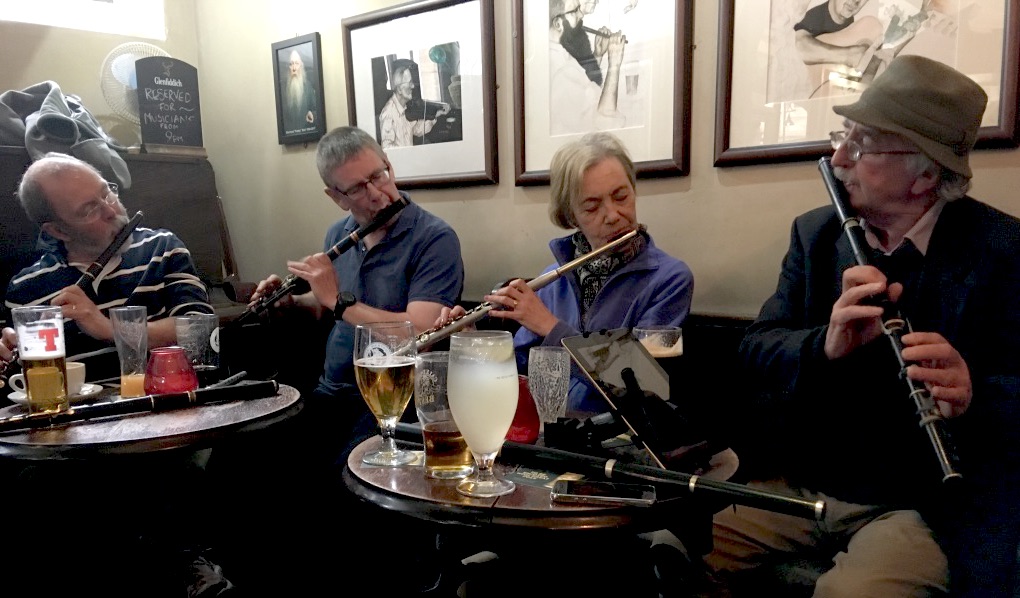
The Sunday lunchtime session at Sandy Bell’s, Edinburgh FluteFling 2018. (c) Gordon Turnbull

This eighth video in the series features two popular marches with Aberdeenshire titles.

For background to the project of 10 sets of tunes being recorded over 10 weeks, and to see the first video, start here. Alternatively, go straight to the videos on my Youtube channel.

You can download the free PDF of the sheet music here:
FluteFling Aberdeen 2019 NE Scotland Tunes


The Bonnie Lass o’ Fyvie/ The 72nd Highlanders’ Farewell to Aberdeen

FluteFling NE Tunebook Project: The Bonnie Lass o’ Fyvie/ The 72nd Highlanders’ Farewell to Aberdeen (The Little Boy’s Lament for his Dragon)

This eighth video in the series features two marches with Aberdeenshire names. These are from the FluteFling NE Tunebook of Scottish session tunes for flute and whistle and I play these on my Rudall and Rose 8-keyed flute and Eamonn Cotter keyless flute, both in D.

The Bonnie Lass o’ Fyvie

The Bonnie Lass o’ Fyvie is the melody to a traditional song that has travelled far and wide, into Scottish, Irish, English and American traditions. It begins:

There once was a troop o’ Irish dragoons
Cam marching doon through Fyvie-o
And the captain’s fa’en in love wi’ a very bonnie lass
And her name it was ca’d pretty Peggy-o

The song may possibly have its origins in the 1600s, according to one theory. With many variations of words, places and names, the versions have been recorded multiple times by a wide range of musicians, singers and artists. For a full breakdown, see this Wikipedia entry.

Many songs have ended up being pipe marches for the simple reason that the soldiers would know the words and could sing them as they marched, boosting morale and helping to keep an even and sustainable marching pace. The words give a sense of the rhythm and pace at which to play the march.

This version of the song by Aberdeenshire’s Old Blind Dogs is one of many fine recordings of the song to be found on YouTube.

The setting in the tune book is in G but drops down to low C natural, so keys will be required. However, it is possible to to play the C natural an octave higher and I demonstrate both of these options. A third option is to play the entire tune an octave higher than is written. I didn’t think of this until after the recording so that option doesn’t appear in the video.

The setting probably suits accordions and fiddles better than flutes and whistles and may be common in NE Scotland sessions. A way around this is to transpose the tune into D. A version in that key can be found on The Session website.

The tune has just one part so might be played many times rather than a number standard to the session you are playing in. In a FluteFling session, playing the tune 4 times would be reasonable, depending on the session dynamics.

The 72nd Highlanders’ Farewell to Aberdeen (The Little Boy’s Lament for his Dragon)

This Highland bagpipe march was probably written by William McKay in 1876, who called it The Little Boy’s Lament for his Dragon, “dragon” meaning “kite”. It acquired its Aberdeen title probably around 1885, and knowledge of the authorship become blurred.

There’s a lengthy discussion on this tune, its authorship, titles, versions and the perils of reading bagpipe music on The Session. With some fine voices such as Kenny Hadden and Nigel Gatherer contributing, it is worth a read.

See The Traditional Tune Archive for a very helpful note on this too.

I originally learned and played a different setting of this tune, one with C naturals and some of the snaps reversed (see that discussion in The Session). Be aware when playing to adapt to the majority of those you are playing with, or, often more importantly, to the person leading that particular set of tunes. Both are good session courtesies.

It’s a reminder that when playing, listening happens on many levels, not just to the performances of the other musicians, but to their versions, their pace and the different demands of their instruments.


Ten weeks of videos

Over a 10 week or so period, I am recording and uploading to YouTube a set of tunes from the PDF roughly once a week. The aim is to introduce the tunes, point out some techniques along the way and then play them as a set as I might play them in a session.

As I go along, I’ll take in suggestions to improve the sound and presentation and get back into the way of teaching again. There is an in-built slow down function in YouTube and the PDF is available to everyone, so why not join me on the journey?

Look out for some more tunes in this project. In the meantime, enjoy learning and playing the tunes!


The North East Scotland Session Tunes Project 5: 3/4 Tune Set

FluteFling NE Tunebook Project: 05 Marnie Swanson of the Grey Coast/ Looking at a Rainbow Through a Dirty Window

This fifth video of the NE Scotland Session Tunes Project features tunes by contemporary composers — Andy Thorburn and Calum Stewart respectively.

For background to the project of 10 sets of tunes being recorded over 10 weeks, and to see the first video, start here. Alternatively, go straight to the videos on my Youtube channel.

You can download the free PDF of the sheet music here:
FluteFling Aberdeen 2019 NE Scotland Tunes


3/4 Set

This fifth video in the project features two tunes from the FluteFling NE Tunebook of Scottish session tunes for flute and whistle. I play these on my Astor flute in D.

This pair of tunes in 3/4 time are both recent compositions by contemporary musicians. Modern compositions are regularly played in sessions and these tunes particularly suit the flute and whistle.

While I have been able to get permission from Calum Stewart to use his tune, I haven’t been able to contact Andy Thorburn to date and have taken the decision to omit playing it in the video.

About the tunes

Marnie Swanson of the Grey Coast by Andy Thorburn

Andy Thorburn is known as a composer and keyboard player in various performing and recording lineups, such as Blazing Fiddles and he often guests on other people’s projects. A resident of Easter Ross in the Highlands, he was inducted to the Tradmusic Hall of Fame in 2014.

In this video, Glasgow-based musician and singer Sarah Markey plays the tune on the flute.

Looking at a Rainbow Through a Dirty Window By Calum Stewart

My thanks to Calum for giving permission to include this tune. He’s one of the top flute players of Scottish repertoire and has written many other fine tunes that have entered Scottish session repertoire. He also plays uilleann pipes and low whistle and his website and recordings are recommended. The tune originally appeared on his debut album and at the time of writing, he plans to re-record this tune for a new album.

You can find out more about Calum from his website.

Here is a video of Calum performing the tune on a low whistle:

  • The tune was originally written in A, but is commonly played in G, which is how I play it and how Calum plans to play it in his new recording.
  • Calum’s original music for it can be found here (PDF):
  • A version of the music can be found on The Session.org

Points to be aware of when learning these tunes:

  • Take your time. In a session or performance environment, slow it down because you are probably playing faster than you think you are.
  • Marnie Swanson is not a conventional waltz in my experience — it ebbs and flows, pauses and continues. In sessions I have heard people play it like a straight waltz and I think it loses some of its grace, strength and wistfulness in the process.
  • Looking at a Rainbow has a stronger rhythm and makes a good contrast as a second tune. It is still a slow tune though, so don’t be tempted to run away with it. Look out for the linking phrases between the parts, which are important in keeping it flowing.
  • Both tunes have opportunities to use flattement – a kind of ghost trill – to decorate certain notes. It’s used by pipers and Baroque flute players alike and often varies from instrument to instrument. Both Sarah Markey and Calum Stewart use it in their videos.

Ten weeks of videos

Over a 10 week or so period, I am recording and uploading to YouTube a set of tunes from the PDF roughly once a week. The aim is to introduce the tunes, point out some techniques along the way and then play them as a set as I might play them in a session.

As I go along, I’ll take in suggestions to improve the sound and presentation and get back into the way of teaching again. There is an in-built slow down function in YouTube and the PDF is available to everyone, so why not join me on the journey?

Look out for some more tunes in this project. In the meantime, enjoy the music!

The North East Scotland Session Tunes Project 4: Marshall Reel Set

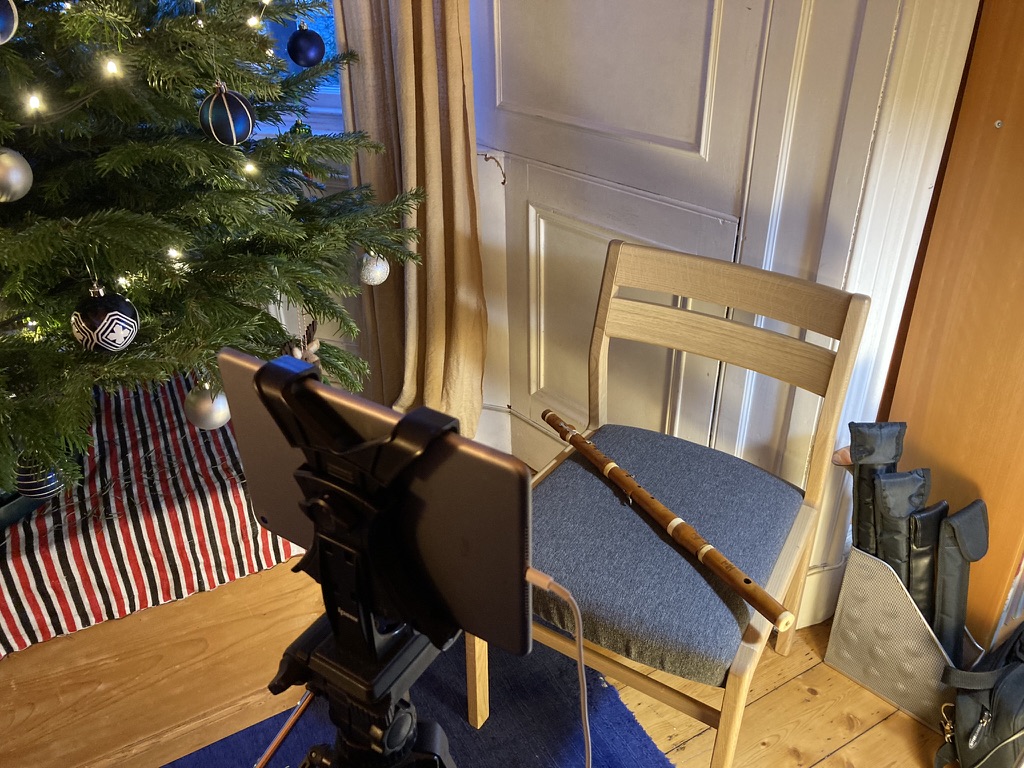
The recording of the videos was squeezed into a corner over the Christmas period. (c) Gordon Turnbull

FluteFling NE Tunebook Project: 04 The Road to Berwick / There’s Nae Harm Done Guidewife/ Mrs Brown of Linkwood

This fourth video of the NE Scotland Session Tunes Project features reels composed by 18th Century fiddle composer William Marshall.

For background to the project of 10 sets of tunes being recorded over 10 weeks, and to see the first video, start here. Alternatively, go straight to the videos on my Youtube channel.

You can download the free PDF of the sheet music here:
FluteFling Aberdeen 2019 NE Scotland Tunes


Marshall Reel Set

This fourth video in the project features three reels from the FluteFling NE Tunebook of Scottish session tunes for flute and whistle. I play these on my Astor flute in D.

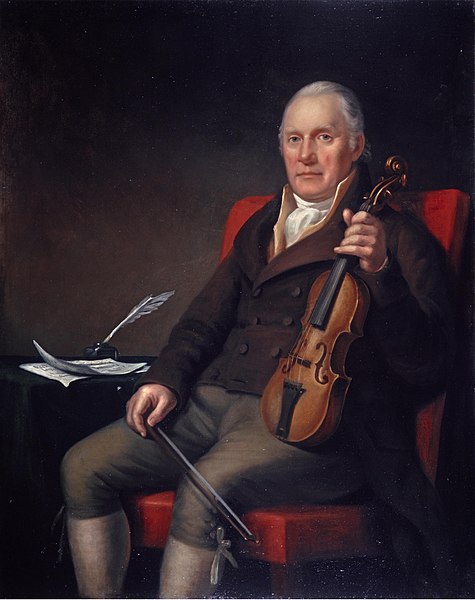
William Marshall

William Marshall (1748-1833), Violinist and composer

William Marshall (1817) by John Moir (1775–1857), from the Scottish National Portrait Gallery

William Marshall (1748 – 1833) hailed from Fochabers in Aberdeenshire and is regarded as one of the most important fiddle composers in Scotland, alongside the Gow family, James Scott Skinner and others. Praised by Robert Burns, he worked for the Duke of Gordon and one of his roles was to compose music for the Duke during a golden age of Scottish music.

Aberdeenshire fiddler Paul Anderson has a YouTube project where he goes through every single William Marshall composition once so you can hear how they should sound. His channel is worth exploring, and is recommended for anyone curious about the strong NE Scotland fiddle style.

About the tunes

This set of reels presents some tricky problems for flute and whistle players. I didn’t know any of these tunes prior to this project, and it will take a while longer before they are completely fluent under my fingers.

This is true of course for any newly learned tune and the process for me is also slower when I learn from printed music than if I learn by ear. The next stage is to try playing the tune away from the music. There are a few ways to do this. I tend to keep the sheet music nearby for reference and go over the tune, pausing at any sticky transitions between the phrases, repeating them and slowing down to encourage the fingers to move correctly.

If you are particularly reliant upon the sheet music, try placing the music stand progressively further away from you as you go over the tune. The individual notes become harder to make out, but you will still see the general rise and fall of the melody. Surprisingly, your brain already knows what to do and at one point you will reach the sweet spot where it becomes harder to read the music than it is to remember it. It’s a process of trusting yourself and developing confidence, but definitely worth persevering with as you develop your skill in this area.

The next key stage for me is to move away from visualising the printed music and instead to understand the feel of the tune. This may take a while and the incipits in the PDF can prompt the recall of the opening bars to help trigger the phrases that come next.

Reels are played with a bit of pace, but don’t be tempted to race away with them. All three of these tunes have dotted phrases and keeping them slower allows you to better integrate them into the music. When played faster, there is less time for each note, dotted or otherwise, and the rhythm tends to become ironed out. And of course, speeding up is a common feature of sessions, so practising and learning slower is the opportunity to keep your technique secure

The Road to Berwick is in D and was first published in 1781. It was renamed The Buck of the Cabrach in an 1822 collection. Cabrach is an area near Fochabers in Aberdeenshire, whereas Berwick probably refers to Berwick upon Tweed in Northumberland, right on the Border with Scotland.

Points to be aware of when learning this tune:

  • Octave drops: e-E and d-D
  • The ascending phrase in the penultimate bar of the B part could become confused with the corresponding bar in There’s Nae Harm Done Goodwife (the second tune). Consider taking time to work on both of these and how they connect to the preceding phrases of their respective tunes.

Also published in 1781, There’s Nae Harm Done Guidewife is also in D and was possibly dedicated to his wife. See The Fiddler’s Companion (a precursor to the Traditional Tune Archive) for some more information. Note that there are a few different spellings of the title — Guidewife/ Guidwife/ Goodwife — the PDF for this project uses two different spellings, for example.

Points to be aware of with this tune:

  • The opening bars of a tune in a set are important in communicating a change to other musicians and to dancers and should be strong. In the A part this combines octave jumps and snaps with use of the G# key that gives the rising phrase an extra lift. It can be tricky but is effective.
  • Where a passage presents problems, work on it in isolation. Take each bar on its own and then combine them with others to get them to work together. In this instance, understanding where the tune goes from there will help make this a secure opening.
  • The B part is relatively straightforward, although again, be aware of the penultimate bar and its similarity to The Road to Berwick. Once more, consider taking time to work on both of these and how they connect to the preceding phrases of their respective tunes.

Mrs Brown of Linkwood is in E minor and was possibly first published in 1822. The title honours a woman associated with the founding of the Linkwood Distillery in Elgin, which still still produces whisky to this day.

The reel runs easily, almost like some Irish polkas, and has a snapped phrase and a phrase that uses D#, both of which recur within the melody.

The use of D# ties the tune in with musical tastes and sensibilities of the 18th Century. It appears in several tunes of that period and also in the classical music of the time. I have come across some tunes where this has been dropped in more recent times, resulting in more than one version of a tune.

If you don’t have a D#/ Eb key, the tune still makes musical sense and it would be possible to play it with others if they had also understood that the D# is not to be played. However, it would not only lack the lift that the D# phrase introduces but also clash if others were playing the D#.

Similarly, this version in the National Library of Scotland has more dotted phrases that are not in the version we are learning and to my mind give it a stronger feel of modern Irish polkas.

I mention the Irish connection not because I think that the tune is somehow directly related to Irish music, but because the large numbers of flute players in Ireland makes it easier to find examples of how such phrases might be played. As flute players we can then use our judgement to bring that into Scottish playing where we think it can be effective. If you’re looking for an introduction to Irish flute playing, there are many guides online, but begin with Brad Hurley’s site.

Be sure to check out John McKenna, who was very influential in the early 20th Century. Some of his playing of Irish polkas includes tunes that Scottish musicians would recognise and his breathing and rhythm are of particular interest to flute players in Scotland. Here’s something I wrote about him a few years ago.

More than one version of a tune?

The other lesson here is that there tends to be more than one version of any tune played in traditional music. This could be due to different instruments, regional and individual styles or the folk process shaping it across the years and centuries. As so much of Scottish music has been in print for a long period, different editorial hands have also been involved, sometimes changing a title or making adjustments to suit personal or audience taste and not always in a way that appeals to our times. Sometimes too, there are just plain mistakes and errors that are then copied and repeated.

So, be aware when playing with others, that they may play the tune differently to you. This may be that they have a different version, their instrument is different or their individual style is (e.g. they have been influenced by different musicians).

In sessions, deference is given to the musician that starts the tune and the trick then is to get in step with them by adapting your playing. If they aren’t a confident player, then doing so supports them and avoids dominating their music. Entrainment is how musical communities and styles evolve and develop. There’s there’s quite a science behind it as this study from the University of Durham shows.

There’s also plenty of discussion about session etiquette to be found online, much of it heated.

Ten weeks of videos

Over a 10 week or so period, I am recording and uploading to YouTube a set of tunes from the PDF roughly once a week. The aim is to introduce the tunes, point out some techniques along the way and then play them as a set as I might play them in a session.

As I go along, I’ll take in suggestions to improve the sound and presentation and get back into the way of teaching again. There is an in-built slow down function in YouTube and the PDF is available to everyone, so why not join me on the journey?

Look out for some more tunes next week. In the meantime, enjoy the music!

The North East Scotland Session Tunes Project

The Sunday session at Ma Cameron’s, Aberdeen FluteFling 2019 (c) Gordon Turnbull

A music project for the Winter

Everyone needs a project for the winter and an idea I had over lockdown has finally clicked for me. Inspired by elements of the Dig Where You Stand movement, I looked at an underused resource that already existed within the FluteFling archives.

John Crawford put together a couple of PDFs of session tunes ahead of the 2019 Aberdeen weekend with the idea that people would learn the tunes and have a few core common tunes for the music sessions. This made sense because people attending come from different areas and have different repertoires.

The result was a useful document containing 10 sets of session tunes that might be expected to be found in NE Scotland sessions. The resources were drawn freely from those already available online and might even be regarded as standards, from Shetland reels to pipe jigs, strathspeys and more. Despite it being a good idea, we failed to promote the idea enough and then the pandemic came along and swept things away.

During lockdown I looked at John’s PDF again and realised that it would be useful to learn  those tunes that I didn’t play properly. Recently I also felt I needed a focus for my playing as I haven’t been in sessions for a long time and nor have I been teaching. So my FluteFling NE Session Tunebook Project was born.

Ten weeks of videos

Over the next 10 weeks or so, I will be recording and uploading to YouTube a set of tunes from the PDF roughly once a week. The aim is to introduce the tunes, point out some techniques along the way and then play them as a set as I might play them in a session.

As I go along, I’ll take in suggestions to improve the sound and presentation and get back into the way of teaching again. There is an in-built slow down function in YouTube and the PDF is available to everyone, so why not join me on the journey?

You can download the PDF here: FluteFling Aberdeen 2019 NE Scotland Tunes

FluteFling NE Tunebook Project: 01 Hurlock’s Reel / Da Rodd to Houl

Two Shetland reels by fiddler Tom Anderson, the first of these I associate with Cathal McConnell’s flute playing with The Boys of the Lough, with Shetlander Aly Bain on fiddle. Composed in 1938, Hurlock was apparently the drummer in the ceilidh band Tom Anderson played with. There is discussion and other settings on The Session website.

Hurlock’s Reel is in A and I use the G# key on my flute. See the video and video notes for some more discussion on the keys I use.

Da Rodd to Houl is in D (not G as suggested in the video). Houl  (sometimes spelled Houll) is on the Isle of Whalsay in the Shetland Islands. Shetland has its own language (Norn) and dialect; “da rodd” means ” the road”. This comment on The Session website gives more information:

In “Haand Me Doon Da Fiddle” Tom Anderson says “Dis tun was written in 1936 whin I came up to Unst to visit a schoolmaister friend o’ mine. It happened it dat moarnin wis da prizegiving an I was axed to play at it. I guid fir a walk an da tun cam in me head. Da place I wis walkin ower wis caaed da Houll Road bit I tocht da Road ta Houll soonded better”

I’ll try to record and upload the tunes in the order that they appear in the PDF. Look out for some Shetland jigs in the next week or so. In the meantime, enjoy the music!