FluteFling NE Tunebook Project: 05 Marnie Swanson of the Grey Coast/ Looking at a Rainbow Through a Dirty Window
This fifth video of the NE Scotland Session Tunes Project features tunes by contemporary composers — Andy Thorburn and Calum Stewart respectively.
For background to the project of 10 sets of tunes being recorded over 10 weeks, and to see the first video, start here. Alternatively, go straight to the videos on my Youtube channel.
This fifth video in the project features two tunes from the FluteFling NE Tunebook of Scottish session tunes for flute and whistle. I play these on my Astor flute in D.
This pair of tunes in 3/4 time are both recent compositions by contemporary musicians. Modern compositions are regularly played in sessions and these tunes particularly suit the flute and whistle.
While I have been able to get permission from Calum Stewart to use his tune, I haven’t been able to contact Andy Thorburn to date and have taken the decision to omit playing it in the video.
About the tunes
Marnie Swanson of the Grey Coast by Andy Thorburn
Andy Thorburn is known as a composer and keyboard player in various performing and recording lineups, such as Blazing Fiddles and he often guests on other people’s projects. A resident of Easter Ross in the Highlands, he was inducted to the Tradmusic Hall of Fame in 2014.
Looking at a Rainbow Through a Dirty Window By Calum Stewart
My thanks to Calum for giving permission to include this tune. He’s one of the top flute players of Scottish repertoire and has written many other fine tunes that have entered Scottish session repertoire. He also plays uilleann pipes and low whistle and his website and recordings are recommended. The tune originally appeared on his debut album and at the time of writing, he plans to re-record this tune for a new album.
Take your time. In a session or performance environment, slow it down because you are probably playing faster than you think you are.
Marnie Swanson is not a conventional waltz in my experience — it ebbs and flows, pauses and continues. In sessions I have heard people play it like a straight waltz and I think it loses some of its grace, strength and wistfulness in the process.
Looking at a Rainbow has a stronger rhythm and makes a good contrast as a second tune. It is still a slow tune though, so don’t be tempted to run away with it. Look out for the linking phrases between the parts, which are important in keeping it flowing.
Both tunes have opportunities to use flattement – a kind of ghost trill – to decorate certain notes. It’s used by pipers and Baroque flute players alike and often varies from instrument to instrument. Both Sarah Markey and Calum Stewart use it in their videos.
Ten weeks of videos
Over a 10 week or so period, I am recording and uploading to YouTube a set of tunes from the PDF roughly once a week. The aim is to introduce the tunes, point out some techniques along the way and then play them as a set as I might play them in a session.
As I go along, I’ll take in suggestions to improve the sound and presentation and get back into the way of teaching again. There is an in-built slow down function in YouTube and the PDF is available to everyone, so why not join me on the journey?
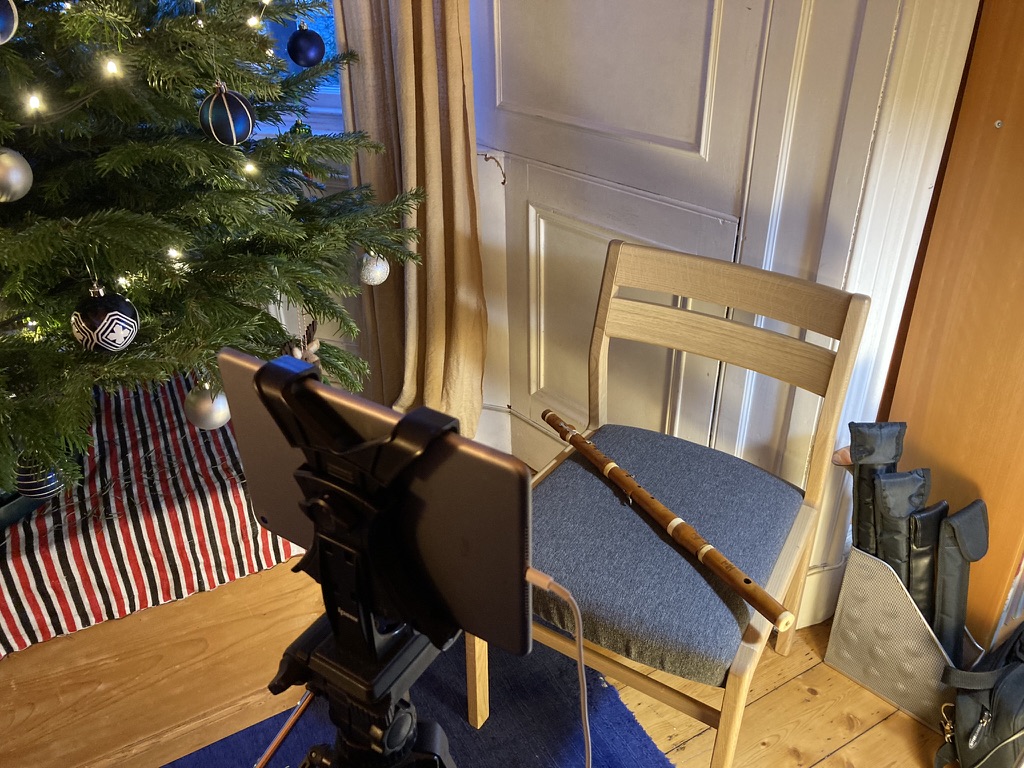
The recording of the videos was squeezed into a corner over the Christmas period. (c) Gordon Turnbull
FluteFling NE Tunebook Project: 04 The Road to Berwick / There’s Nae Harm Done Guidewife/ Mrs Brown of Linkwood
This fourth video of the NE Scotland Session Tunes Project features reels composed by 18th Century fiddle composer William Marshall.
For background to the project of 10 sets of tunes being recorded over 10 weeks, and to see the first video, start here. Alternatively, go straight to the videos on my Youtube channel.
This fourth video in the project features three reels from the FluteFling NE Tunebook of Scottish session tunes for flute and whistle. I play these on my Astor flute in D.
William Marshall
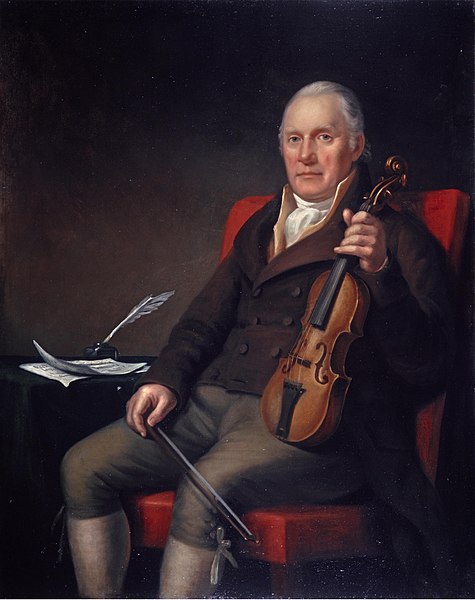
William Marshall (1817) by John Moir (1775–1857), from the Scottish National Portrait Gallery
William Marshall (1748 – 1833) hailed from Fochabers in Aberdeenshire and is regarded as one of the most important fiddle composers in Scotland, alongside the Gow family, James Scott Skinner and others. Praised by Robert Burns, he worked for the Duke of Gordon and one of his roles was to compose music for the Duke during a golden age of Scottish music.
Aberdeenshire fiddler Paul Anderson has a YouTube project where he goes through every single William Marshall composition once so you can hear how they should sound. His channel is worth exploring, and is recommended for anyone curious about the strong NE Scotland fiddle style.
About the tunes
This set of reels presents some tricky problems for flute and whistle players. I didn’t know any of these tunes prior to this project, and it will take a while longer before they are completely fluent under my fingers.
This is true of course for any newly learned tune and the process for me is also slower when I learn from printed music than if I learn by ear. The next stage is to try playing the tune away from the music. There are a few ways to do this. I tend to keep the sheet music nearby for reference and go over the tune, pausing at any sticky transitions between the phrases, repeating them and slowing down to encourage the fingers to move correctly.
If you are particularly reliant upon the sheet music, try placing the music stand progressively further away from you as you go over the tune. The individual notes become harder to make out, but you will still see the general rise and fall of the melody. Surprisingly, your brain already knows what to do and at one point you will reach the sweet spot where it becomes harder to read the music than it is to remember it. It’s a process of trusting yourself and developing confidence, but definitely worth persevering with as you develop your skill in this area.
The next key stage for me is to move away from visualising the printed music and instead to understand the feel of the tune. This may take a while and the incipits in the PDF can prompt the recall of the opening bars to help trigger the phrases that come next.
Reels are played with a bit of pace, but don’t be tempted to race away with them. All three of these tunes have dotted phrases and keeping them slower allows you to better integrate them into the music. When played faster, there is less time for each note, dotted or otherwise, and the rhythm tends to become ironed out. And of course, speeding up is a common feature of sessions, so practising and learning slower is the opportunity to keep your technique secure
The ascending phrase in the penultimate bar of the B part could become confused with the corresponding bar in There’s Nae Harm Done Goodwife (the second tune). Consider taking time to work on both of these and how they connect to the preceding phrases of their respective tunes.
Also published in 1781, There’s Nae Harm Done Guidewife is also in D and was possibly dedicated to his wife. See The Fiddler’s Companion (a precursor to the Traditional Tune Archive) for some more information. Note that there are a few different spellings of the title — Guidewife/ Guidwife/ Goodwife — the PDF for this project uses two different spellings, for example.
Points to be aware of with this tune:
The opening bars of a tune in a set are important in communicating a change to other musicians and to dancers and should be strong. In the A part this combines octave jumps and snaps with use of the G# key that gives the rising phrase an extra lift. It can be tricky but is effective.
Where a passage presents problems, work on it in isolation. Take each bar on its own and then combine them with others to get them to work together. In this instance, understanding where the tune goes from there will help make this a secure opening.
The B part is relatively straightforward, although again, be aware of the penultimate bar and its similarity to The Road to Berwick. Once more, consider taking time to work on both of these and how they connect to the preceding phrases of their respective tunes.
The reel runs easily, almost like some Irish polkas, and has a snapped phrase and a phrase that uses D#, both of which recur within the melody.
The use of D# ties the tune in with musical tastes and sensibilities of the 18th Century. It appears in several tunes of that period and also in the classical music of the time. I have come across some tunes where this has been dropped in more recent times, resulting in more than one version of a tune.
If you don’t have a D#/ Eb key, the tune still makes musical sense and it would be possible to play it with others if they had also understood that the D# is not to be played. However, it would not only lack the lift that the D# phrase introduces but also clash if others were playing the D#.
I mention the Irish connection not because I think that the tune is somehow directly related to Irish music, but because the large numbers of flute players in Ireland makes it easier to find examples of how such phrases might be played. As flute players we can then use our judgement to bring that into Scottish playing where we think it can be effective. If you’re looking for an introduction to Irish flute playing, there are many guides online, but begin with Brad Hurley’s site.
Be sure to check out John McKenna, who was very influential in the early 20th Century. Some of his playing of Irish polkas includes tunes that Scottish musicians would recognise and his breathing and rhythm are of particular interest to flute players in Scotland. Here’s something I wrote about him a few years ago.
More than one version of a tune?
The other lesson here is that there tends to be more than one version of any tune played in traditional music. This could be due to different instruments, regional and individual styles or the folk process shaping it across the years and centuries. As so much of Scottish music has been in print for a long period, different editorial hands have also been involved, sometimes changing a title or making adjustments to suit personal or audience taste and not always in a way that appeals to our times. Sometimes too, there are just plain mistakes and errors that are then copied and repeated.
So, be aware when playing with others, that they may play the tune differently to you. This may be that they have a different version, their instrument is different or their individual style is (e.g. they have been influenced by different musicians).
In sessions, deference is given to the musician that starts the tune and the trick then is to get in step with them by adapting your playing. If they aren’t a confident player, then doing so supports them and avoids dominating their music. Entrainment is how musical communities and styles evolve and develop. There’s there’s quite a science behind it as this study from the University of Durham shows.
There’s also plenty of discussion about session etiquette to be found online, much of it heated.
Ten weeks of videos
Over a 10 week or so period, I am recording and uploading to YouTube a set of tunes from the PDF roughly once a week. The aim is to introduce the tunes, point out some techniques along the way and then play them as a set as I might play them in a session.
As I go along, I’ll take in suggestions to improve the sound and presentation and get back into the way of teaching again. There is an in-built slow down function in YouTube and the PDF is available to everyone, so why not join me on the journey?
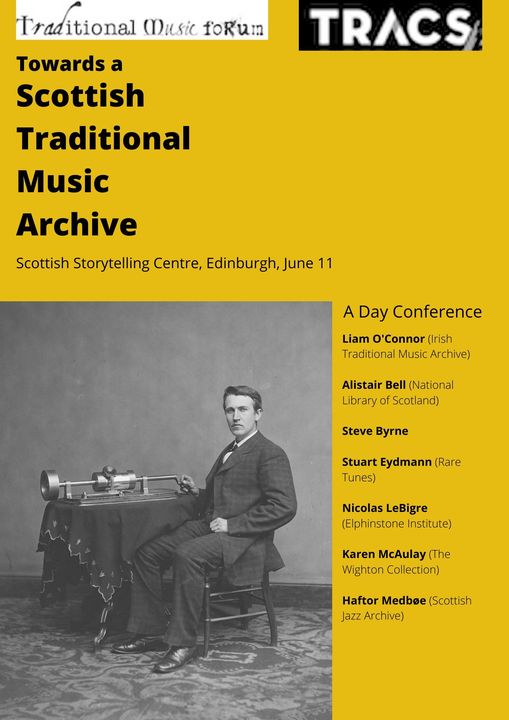
Edinburgh conference hears ideas for a Scottish trad music online portal
There is a move to create a Scottish Traditional Music Archive, much like ITMA in Dublin – a one-stop shop for accessing and curating traditional music. There was a conference on this topic in June in Edinburgh organised by the Traditional Music Forum, of which FluteFling is a member. I attended online and the report from TMF head Dave Francis on the day’s proceedings is now available online for everyone to access.
There were many good speakers and for me the important realisation that the archive in Scotland is very different from Ireland, where numerous resources are housed near each other in neighbouring institutes in Dublin.
In Scotland, there are important archives dispersed across different locations, for example Edinburgh, Glasgow, Aberdeen, Perth, Dundee, The Isle of Canna and many more, plus some exclusively online, such as Tobar an Dualchais/Kist o Riches and rareTunes.
So much of Scotland is already focused on the central belt as we know and the practicalities and costs of establishing a new centre would be prohibitive. It’s arguably a good thing for the archive to be dispersed and have collections remain where they originate.
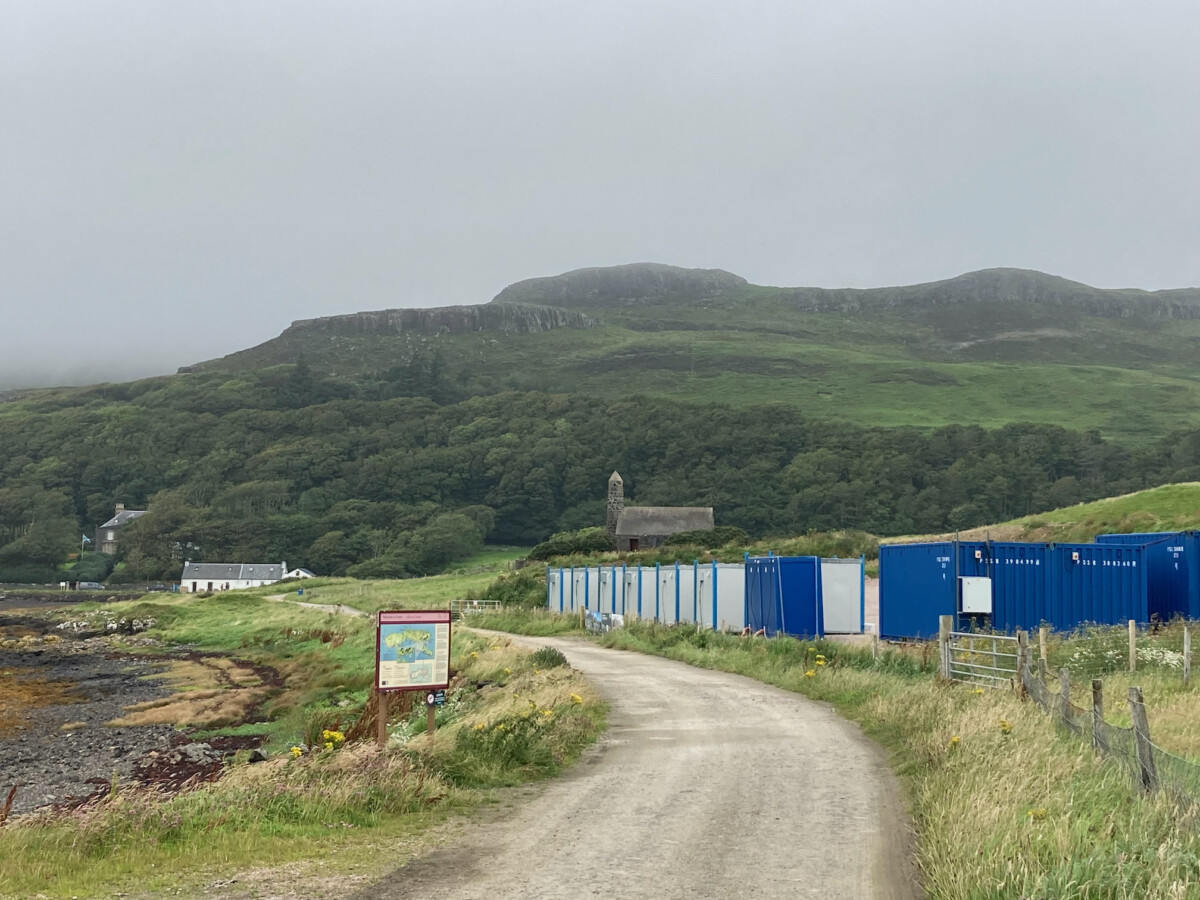
Canna House (left) Isle of Canna, run by the National Trust for Scotland. The Canna House Archive is not permitted to leave the island and is housed in temporary containers (centre and right) near the quay while building refurbishment takes place. Photo: (c) Gordon Turnbull
It was actually a stipulation of the Canna House Collection made by Margaret Fay Shaw and John Lorne Campbell (himself a flute player), that it remains on the island. The owners, the National Trust for Scotland, have taken this seriously and when I visited the Isle of Canna briefly earlier in August, refurbishment of the House meant that the archive was stored near the quay in special containers.
So the challenge will be to create an online portal that allows people to be signposted to the relevant resources as well as visiting the physical archives in person.
John Crawford continues his exploration of the John Miller Fife Manuscript
About the author: John Crawford is a long-standing supporter and co-organiser with FluteFling. John enjoys exploring the forgotten pre-revival Scottish flute manuscripts that reside in online libraries and collections, such as this Scottish fife player’s manuscript from 1799 held in the A K Bell Library in Perth. The manuscript is part of the Atholl Collection, a key archive source for the Scottish flute world.
Part 1 of this article dealt with my early lockdown experience, pursuing the John Miller Fife MS (manuscript) I found in the Village Music Project (VMP) website. This revealed a lot about the music John Miller must have played on his fife and provided a partial understanding of the context of the manuscript, but largely left Miller and his life shrouded in mystery.
The trail to the original document pointed to the Atholl Collection and the AK Bell Library in Perth. The collection was compiled by Lady Dorothea Murray, later Ruggles-Brice, and a daughter of the 7th duke of Atholl. When she died she left instructions for it to be bequeathed to the Sandeman Library in Perth. When this closed the Collection moved to the AK Bell Library.
The general significance of the Collection has been outlined in part 1 of this Blog. The catalogue, compiled by Dr Sheila Douglas, confirms the Atholl Collection has been recognised for many years by the world’s academics, with enquiries from institutions as diverse as Harvard, the Joseph Hayden Institute in Cologne and the University of Sydney. It remains an open question whether Scottish traditional musicians have invested an appropriate level of interest in understanding the value of the collection and what it can offer them.
From a flute perspective it’s worth re-emphasising its significance in the Collection. The Miller MS is one of 60 items where the catalogue description specifically mentions flutes or fifes. This is a powerful demonstration of the popularity of fifes and flutes in the 18th and early 19th century and makes a strong case for further study of the collection. Items of note and interest include:
Fifty Favourite Scotch Airs; for a violin, German flute and violoncello, with a thorough bass for the harpsichord – PEACOCK, Francis, Aberdeen s.n. 1782 [Ref No Bf55 26796]
Complete Repository of Old and New Scotch Strathspey Reels and Jigs adapted for the German flute – HAMILTON John, Edinburgh s.n. 1802 [Ref No Bd49 26661]
At the time of writing the Miller MS, along with the rest of the collection, has not been digitised, making a visit to Perth essential. When Part 1 of this blog was written COVID restrictions made it impossible to see the MS at first hand and examine it in more detail.
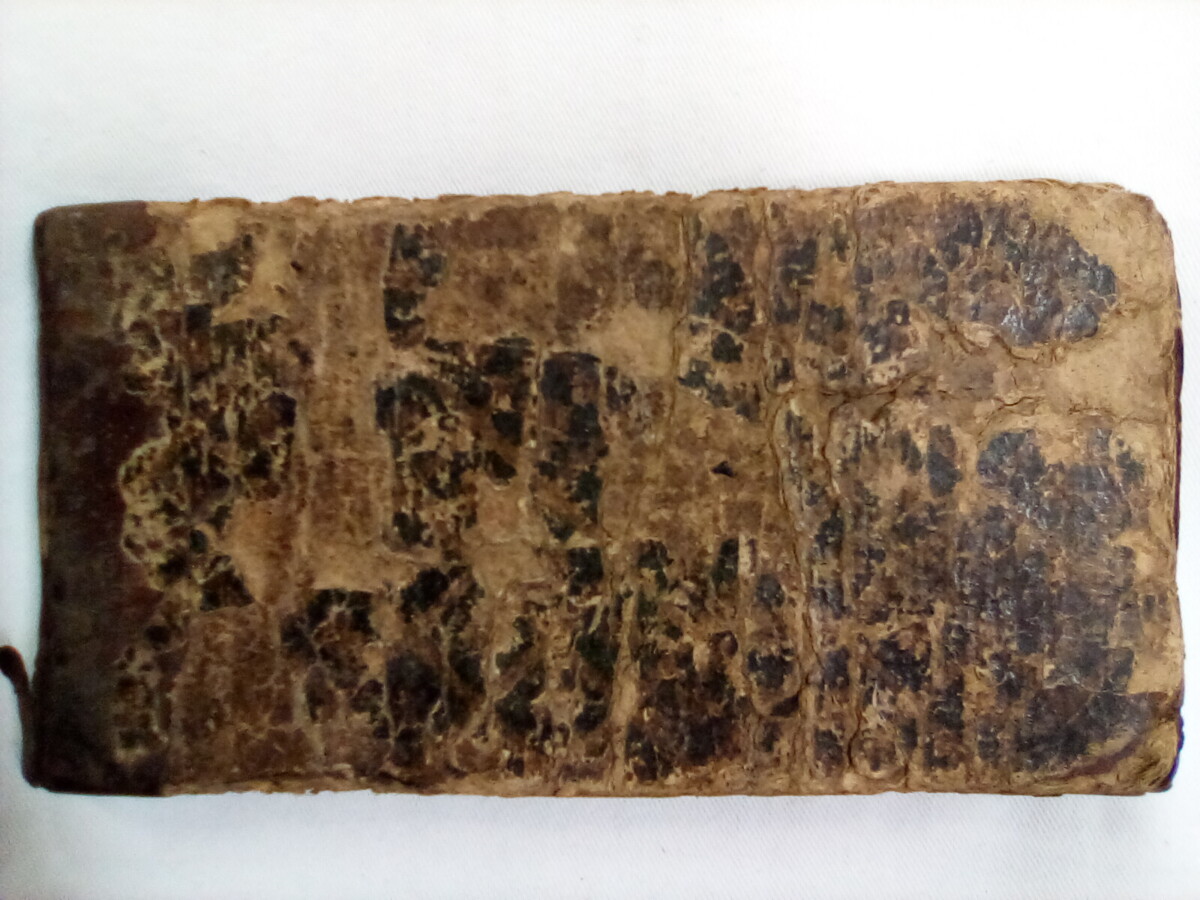
JMS Front cover (c) John Crawford
Waiting another six months to see the MS was a challenge and a time to remember one of my mother’s favourite Gaelic proverbs about patience:
“Am fear a bhios fad aig an aiseag gheabh e thairis uair-eigin.”
[He that waits long at the ferry will get over some time.]
On Friday 10 September 2021 I finally made it to A K Bell Library to see the MS. Was it worth the wait? The answer is an unambiguous and absolute yes. I enjoyed my day immensely. Being able to see, and touch, the MS was a very powerful experience. I felt very privileged and had a very strong sense of being in direct touch with history. Probably the nearest parallels are:
discovering an important artefact during an archaeological dig and
that sense of connectedness you get from playing a vintage flute.
The experience was amplified by:
the fact that what I had in my hands was a MS rather than a printed document;
the obvious age and fragility of the document (particularly the cover boards);
evident fingerprints, particularly on the fore edge of each leaf and
the additional notes on some of the pages in a hand other than that of the person who wrote the tune titles.
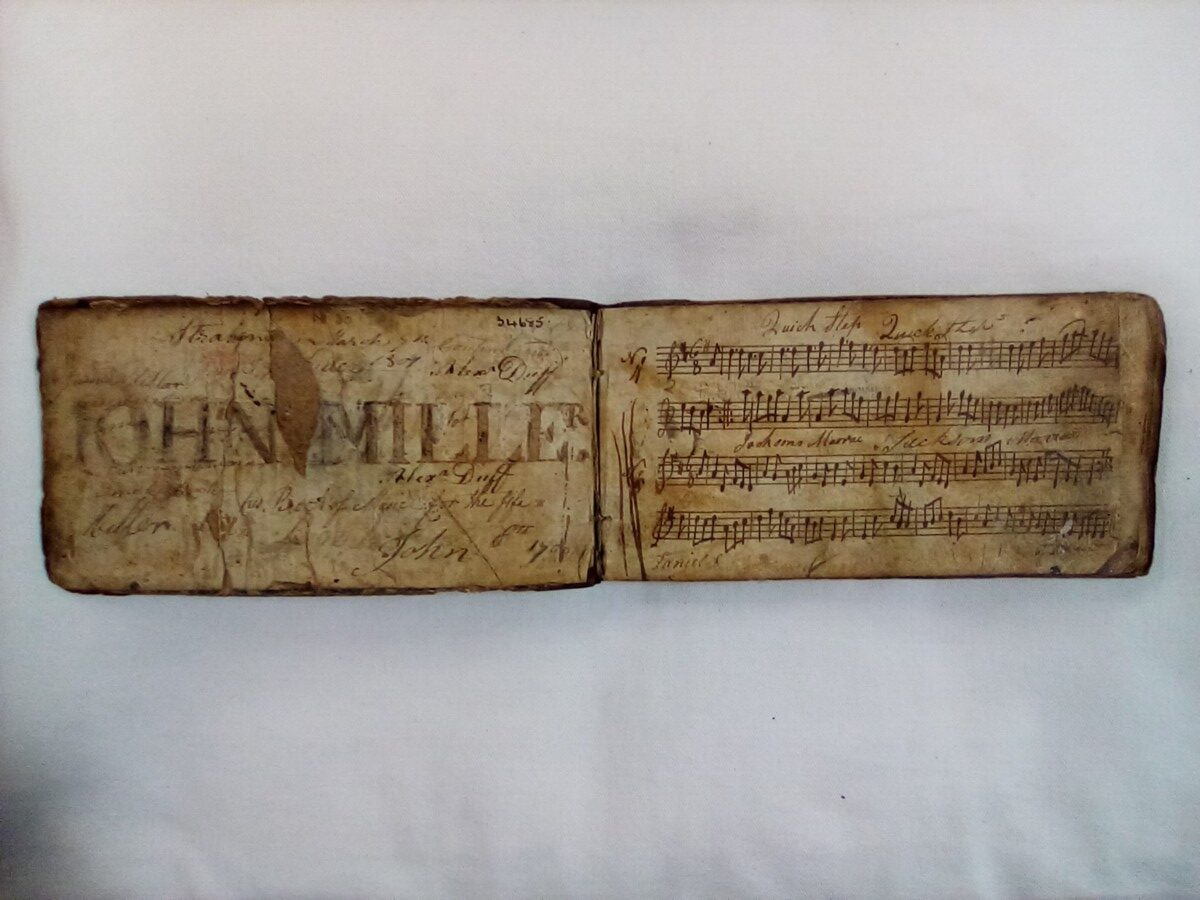
The John Miller Manuscript front cover and first page. (c) John Crawford
Seeing the MS sparked some additional ideas about how the MS originally came into being and what might have happened to it, between John Miller’s time, and it becoming part of the Atholl collection. The handwriting of the tune titles is very precise and stylised; certainly the hand of a highly literate well educated individual. There’s evidence of a second less literate, less well developed hand, in pencil, in additional notation in the book.
I’m now wondering if it’s possible Miller got the book from his Bandmaster and that the second, less literate hand writing is his. Given the lack of history of the MS and how it came into Lady Dorothea’s hands it is, of course, equally possible the other handwriting is that of an interim owner.
My conversation with the library staff during the visit flagged up the material on the adjacent shelves relating to the Black Watch. The Village Music Project narrative relating to the MS, speculates that Miller might have been associated with the Black Watch or its antecedents (the 73rd (Perthshire) Regiment of Foot, or the 42nd Regiment of Foot).
My initial online research had failed to find any indication that the Black Watch, or its antecedents, was in Ireland, at any of the locations mentioned in the Miller MS (Strabane, Stranorlar and Londonderry) between 1798 and 1801. This finding appears to be supported by the additional material I found in the Library.
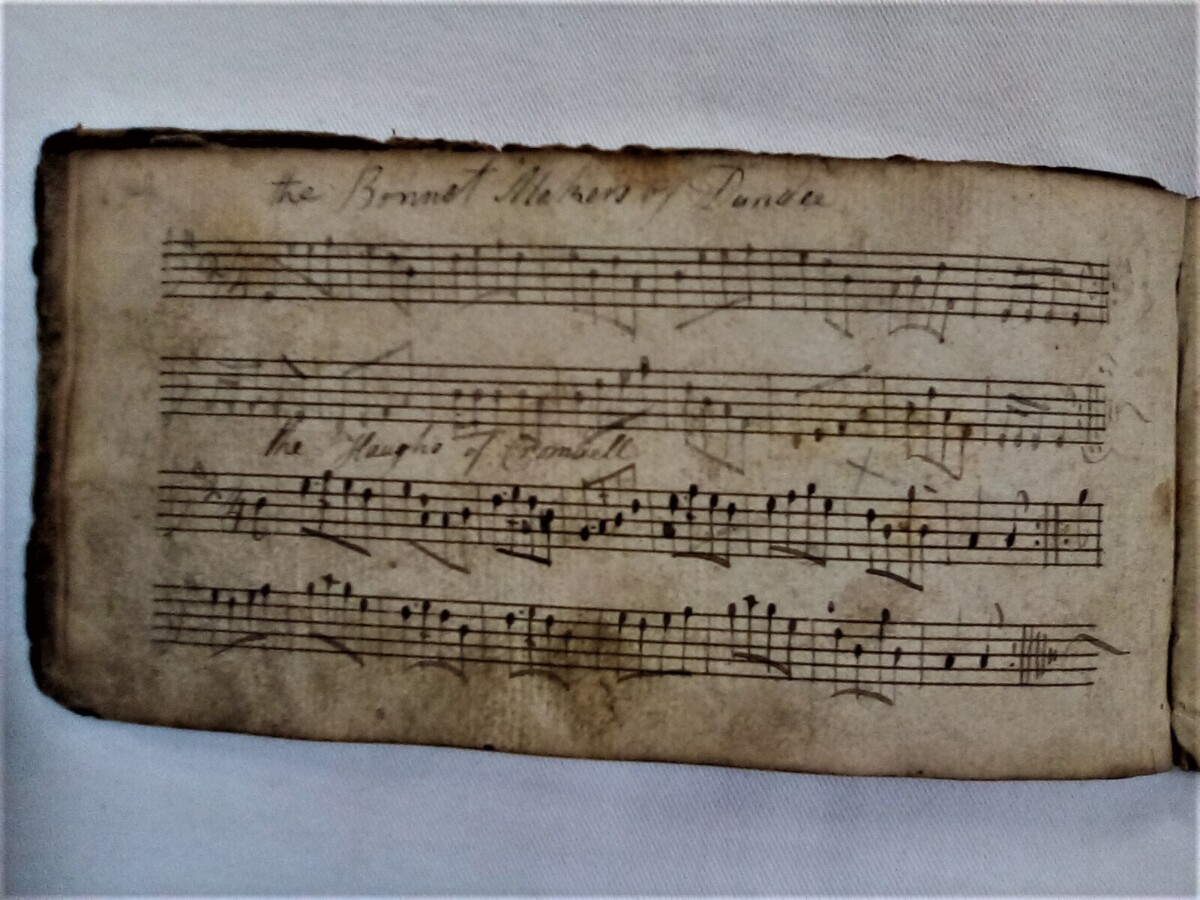
The John Miller manuscript with the tunes Bonnet Makers of Dundee and the Haughs of Cromdale (c) John Crawford.
My view, based on the information currently available, is that it’s much more likely Miller was part of the many Fencible regiments formed and posted to Ireland in the wake of the 1798 uprising and the French invasion. Unfortunately attempts so far to uncover historical sources providing detailed information on recruitment by these Fencible regiments, their bands and musicians appears to be very limited.
Perhaps this is unsurprising given the limited time these regiments existed for. The earliest regiments were raised in 1759. When it became clear that the rebellion in Ireland had been defeated and that there would be peace between France and Britain in 1802 (The preliminaries of peace were signed in London on the 1st of October 1801) the Fencible regiments were disbanded.
We may have to accept that John Miller’s history is lost to us and that we can only speculate about his age and circumstances; how he came to be recruited; what regiment he was part of and how his MS came to be part of Lady Dorothea’s collection. The repertoire in the MS suggests a Scottish connection but this is not 100% conclusive. The Buttrey Manuscript mentioned in my previous post includes a wealth of Scottish tunes. John Buttrey joined the 34th Regiment in Lincolnshire, England in 1797 as a drummer at the age of 13. He served in Africa and India and was discharged when he returned to England in 1814.
John Miller’s MS is, nevertheless, an invaluable and rather unique window offering a more human perspective on the importance of the fife in the life and music of Scottish Regiments in the 18th & 19th century than formal sources like Thompson’s 1765 Compleat Tutor for the Fife with all its duty calls. These are tunes that deserve to be played; when you do, tip your hat and say thanks to John Miller.
Elizabeth Ford describes how she came to study the Scottish baroque flute
Elizabeth Ford performing at Edinburgh FluteFling 2017 (c) Gordon Turnbull
Elizabeth Ford is a flute player, academic and publisher who has been involved with FluteFling for a number of years, performing and speaking at some of our events. Her PhD on the early history of the flute in Scotland was published in book format in 2020 and you can read a review of it in this blog.
Here, Elizabeth describes how she became drawn to early Scottish flute repertoire and to study the history of the flute in Scotland.
My research into the history of the flute in Scotland started informally in 2003, as a Master’s student at the Peabody Conservatory. I was just then learning to play baroque flute and was surprised and somewhat demoralized by how challenging it was. My teacher had assigned a suite by Hotteterre, in a facsimile edition, in the original French violin clef.
I was writing my thesis on Hotteterre’s improvisation manual, L’Art de preluder, so this was good for me. But now and then, I needed something to remind me that I had actually been a pretty good flute player before I took up baroque flute, so I was combing the shelves of the library looking for 18th-century flute music that wasn’t depressingly challenging and that I wasn’t already familiar with. I happened upon Jeremy Barlow’s edition of James Oswald’s Airs for the Seasons. I knew my teacher wouldn’t approve because it was a modern edition, and Scottish; this music was outside the canon and we were not there to challenge the canon. Personally, I think the Peabody Conservatory is exactly the place to do so, but that’s a different topic.
I had always been interested in Scotland, but I didn’t know very much about it as a country or culture. The only recordings of Scottish music I could find at this time were by the Baltimore Consort, which happened to be my favorite band.
I kept my Scottish music tendencies to myself, yet after graduation I started to explore music from Scotland, especially for flute, in greater detail. I kept coming back to Oswald, and how delightful and satisfying his music was to play and to hear. I amassed a large collection of photocopies of music and performed this repertoire any chance I got. I didn’t get into the traditional/art music debate because having been trained in French 18th-century performance practice, I didn’t know what to do with the questions of national identity and ‘traditional’ as it related to music. I had been taught to think that playing by ear was somehow inferior to reading music…even though baroque music is and was largely improvised.
While a law student a few years later, I acquired Concerto Caledonia’s recording Colin’s Kisses: The Music of James Oswald. It was the most exciting, fun recording I’d ever heard. I had a new favorite band and was completely down the rabbit hole. I started reading as much as I could find in the West Virginia University library about Scottish music, and it wasn’t much. David Johnson, Henry Farmer, and that was it. What I kept coming back to was their assertion that the flute was unknown in Scotland prior to 1725. That really bothered me. One thing led to another, and I contacted John Butt and David McGuinness at the University of Glasgow, who said that this would be an excellent PhD topic.
This is the question from which all my research on the flute in Scotland sprang: how, if there was no flute in the country prior to 1725, was there so much flute music published so early in the century? If an instrument wasn’t known or wasn’t popular, it would presumably take a while before composers or music publishers started marketing for it. But, as I made my way through the secondary literature, I realized that this date of 1725 had never before been challenged.
To me, this was ludicrous. The one-keyed flute was developed in France sometime before 1692 (the first image is on the title page of Marin Marais’s Pieces en trio) by a member of the Hotteterre family. The addition of the key revolutionized music: a formerly one-piece non-chromatic instrument with a limited range became fully chromatic, in three pieces, and with wide range. The flute was very popular in France, and considering the long and well-established relationship between Scotland and France, it didn’t make sense to me that no flutes travelled back home with a visiting Scot. I wondered if music scholarship had become victim to that unfortunate ailment, the Scottish Cringe.
These questions guided me I as began my archival research. I quickly found evidence for the flute in Scotland prior to 1725 in the National Record Office. I know that this can sound like I’m saying previous scholars didn’t do their work properly, but that’s not my intention. My predecessors were not focused on the flute, lacked my background in flute history, and didn’t have any reason to question the date. I then began to challenge the historiography of Scottish music scholarship, and its reliance on antiquarian sources.
So, this is the long story of how and why I study the history of the flute in Scotland. My next task is to determine when it disappeared from Scottish music, as until recently most contemporary Scottish traditional flute players would assert that there is no historic evidence for the flute in Scotland and they must look to Ireland for culture, tradition, and repertoire. This is obviously incorrect, but it has been the prevailing assumption, and I want to know why that’s the case.
Here are some factoids on the flute in 18th-century Scotland:
The earliest iconographical evidence for the flute dates to the 16th century
The earliest mention of the German flute, or transverse flute, is 1702
It was primarily played by gentlemen amateur musicians, although ladies and lower class men also played it
Musical tastes were similar to those in the rest of Europe: there was a taste for Handel and Quantz
The first music for flute published in Scotland by a Scottish composer was William McGibbon’s 1727 Sonatas for Two German flutes, or two violins, and a bass
Many compositions were based on traditional tunes, but this is not unusual for the time
Much so-called traditional music was newly composed and collected in the 18th century
Flutes were made in Scotland in the first half of the century
The idea of traditional music and art music isn’t relevant to music of the 18th century
There is evidence of shared repertoire between flute players and pipers
Some of the major composers for flute are William McGibbon, Mr. Munro, James Oswald, John Reid, Daniel Dow, and Francesco Barsanti. Some known flute players include Susanna, Countess of Eglinton, John Reid, Alexander Bruce, the 3rd Duke of Gordon, and Robert Tannahill. Flutes were played in homes, concert halls, and taverns.
Here are some excellent recordings of this repertoire:
Captain Tobias Hume: A Scottish soldier, Concerto Caledonia
On the Banks of Helicon, The Baltimore Consort
Adew Dundee, The Baltimore Consort
Wind and Wire, Chris Norman and Byron Schenkman
She’s Sweetest When She’s Naked, Alison Melville
Colin’s Kisses: The music of James Oswald, Concerto Caledonia
Fiddler Tam: The music of Thomas Erskine, the 6th Earl of Kellie, Concerto Caledonia
Mungrel Stuff: Francesco Barsanti and others, Concerto Caledonia
The High Road to Kilkenny, Les Musiciens de Saint-Julien
[Ex]tradition, The Curious Bards
The Reel of Tulloch, Chatham Baroque
The Caledonian Flute, The Chris Norman Ensemble
Sometime in the 19th century, the flute seems to have disappeared from Scottish music: it stops being mentioned, it stops appearing on title pages, and there are notably fewer flute manuscripts. I’m interested in knowing why and how this happened, and this exploration of historiography and cultural history will (hopefully) be a future project.
More about the author:
Elizabeth Ford won the 2017 National Flute Association Graduate Research Award for her doctoral research on the flute in eighteenth-century Scotland. She was the 2018-2019 Daiches-Manning Memorial Fellow in 18th-century Scottish Studies, IASH, University of Edinburgh. Her complete edition of William McGibbon’s sonatas is published by A-R Editions, and her monograph, The Flute in Scotland from the Sixteenth to the Eighteenth Century, is part of the Studies in the History and Culture of Scotland Series from Peter Lang Press.
In 2021 (hopefully!), Elizabeth will hold the Martha Goldsworthy Arnold Fellowship at the Riemenschneider Bach Institute, the Abi Rosenthal Visiting Fellowship in Music at the Bodleian Libraries, and the American Society for Eighteenth Century Studies-Burney Centre Fellowship at McGill University for research related to James Oswald, Charles Burney, and John Reid. She is co-founder of Blackwater Press.