Remembering Boxwood Aberdeen

Scottish Flute Weekend 16-18 Nov 2001: Twenty Years of Scottish Traditional Flute

Malcolm Reavell in Ma Cameron’s snug, Aberdeen. (c) Gordon Turnbull

November 2021 marked twenty years since Boxwood Aberdeen took place, a weekend that sowed the seeds for FluteFling and inspired many others to further explore the flute in Scottish traditional music contexts.

Organised by Malcolm Reavell for Scottish Culture and Traditions, here he describes the background to the event, which was possibly the largest such gathering in Scotland.
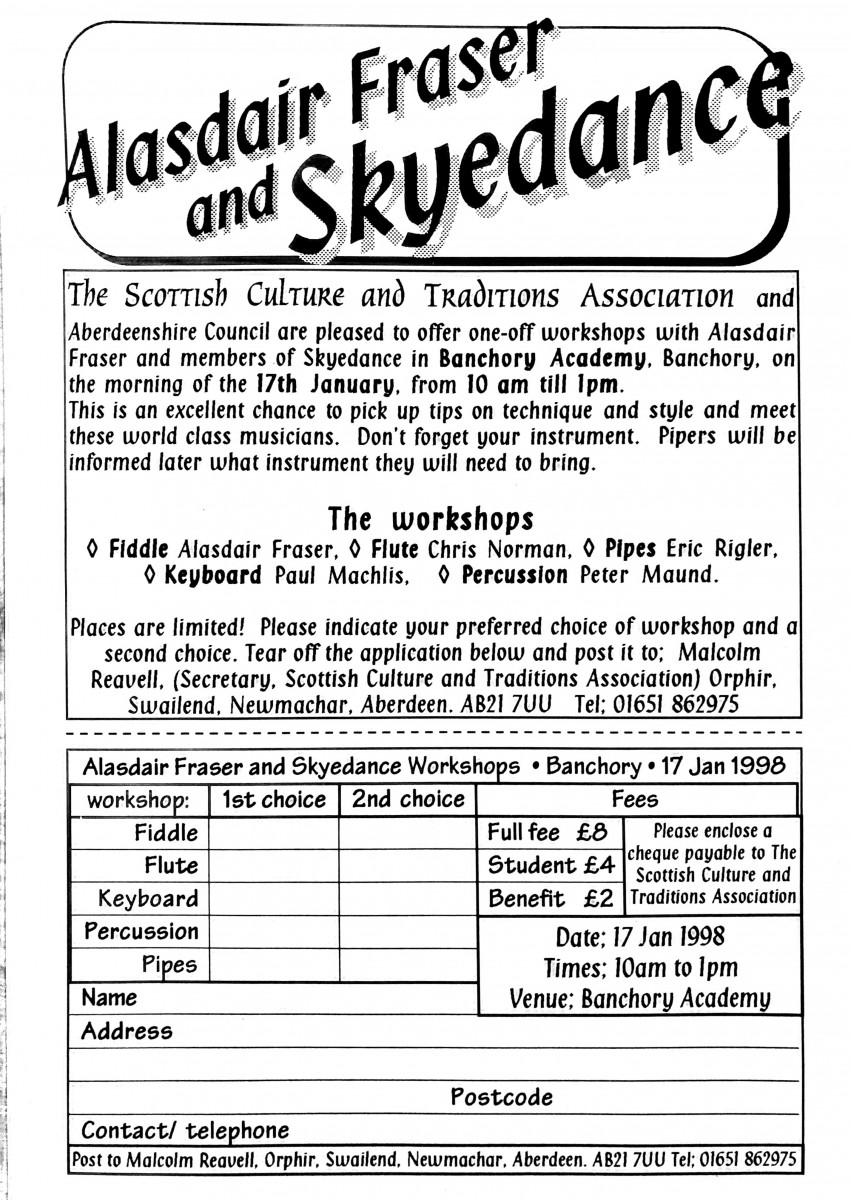

Publicity for Skyedance performing and teaching in Banchory

Publicity for Skyedance performing and teaching in Banchory

In 1997, representing Scottish Culture & Traditions organisation (SC&T) I contacted Duncan Hendry who was at the time managing the Aberdeen Alternative Festival (now at the Edinburgh Festival Theatre) to see if he would help us arrange to get Alasdair Fraser’s band Skyedance to run a day of workshops for traditional musicians. The lineup at that time was Alasdair on fiddle, Eric Rigler on pipes, Peter Maund on percussion, Paul Machlis on piano, and as American/ Canadian flute player Chris Norman had joined the band, we could have flute a workshop as well.

The workshop was held on a snowy January day in Banchory Academy. Chris Norman had previously held workshops at Celtic Connections in Glasgow, attended by just a couple of people, so when he walked into the room, he was pleasantly surprised to be confronted by about a dozen flute players.
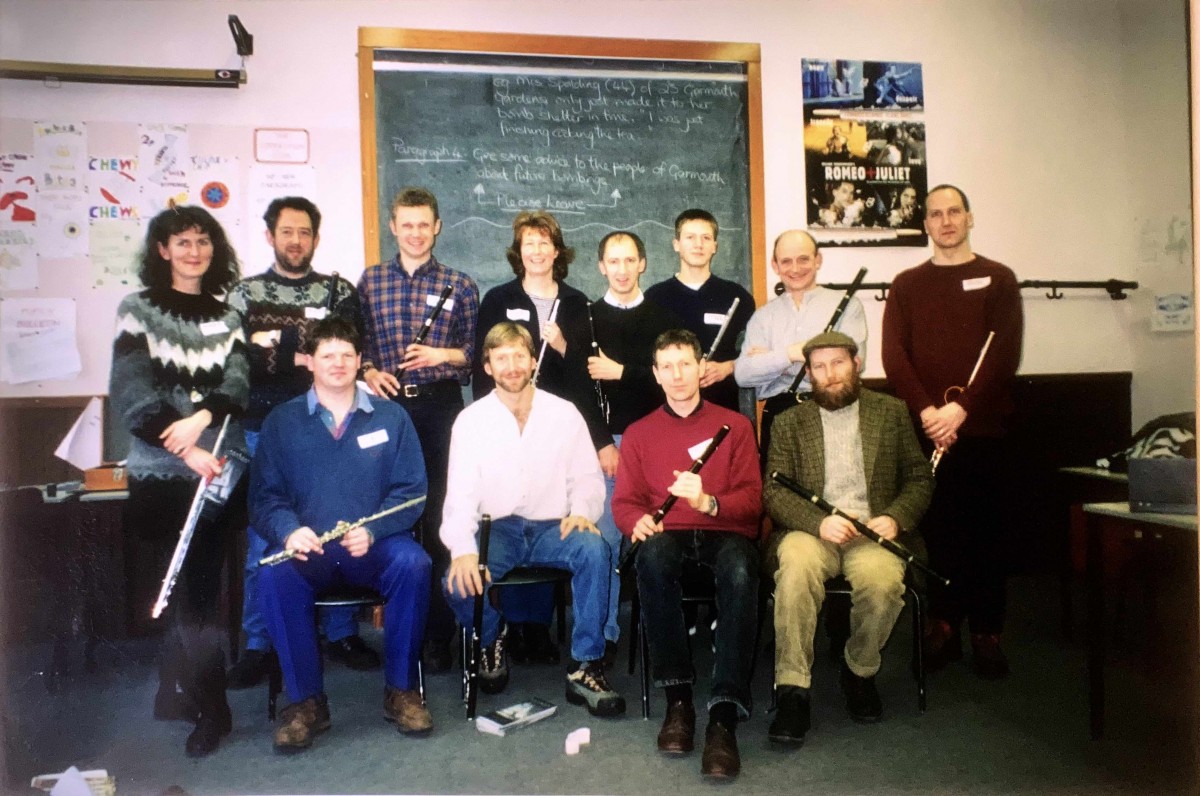
Flute players in Banchory

Flute players in Banchory. Chris Norman is front row, in white. Malcolm Reavell to the right of him.

Chris advertised the Boxwood week he ran, and so that was where I went for my holidays the next two years – Lunenburg, Nova Scotia. It was an inspiring event, and I really wanted to do something like this in Scotland, and I got the chance in 2001. Chris got in touch about coming over to Scotland, I jumped at the chance to try and organise something.

I thought it would be good to try out the format Chris used for Boxwood with three tutors covering different styles and traditions. As well as Chris I invited Eddie McGuire whose reputation as composer as well as flute player appealed to classical flute players, and from Limerick, Niall Keegan, who was pushing the boundaries of traditional Irish flute playing.
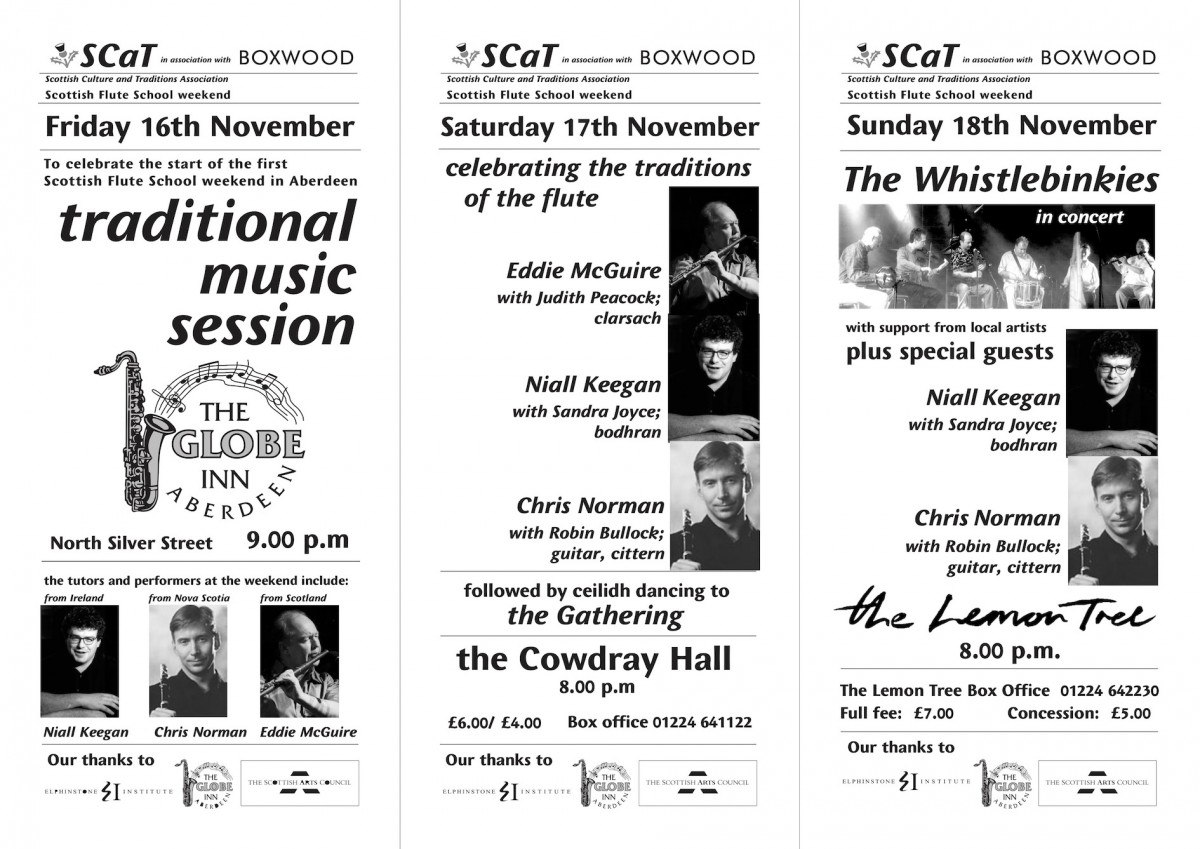
Flyer for the Boxwood Aberdeen Weekend

Flyer for the Boxwood Aberdeen Weekend

It was going to cost a bit of money to put on the event. We could not run it for a whole week as Chris did in Lunenburg, but a weekend seemed achievable.

At this time I was still working shifts as an aircraft engineer, so I had days off during the week which I could devote to SC&T (in fact SC&T took up most of my spare time anyway).

I investigated Scottish Arts Council funding and luckily Dave Francis pointed me in the direction of a new funding stream for which few people had applied.

I submitted the grant application and budgeted for about half of the amount I put in the application (that’s kind of normal for such applications). The Scottish Arts Council approved the whole amount. This was not supposed to happen! I had to then revise the programme and remove all the cost saving I had incorporated to use up all the money we were getting (you can’t give it back – you must spend it!).

So… venues for workshops, evening concerts, sessions, accommodation for artists, publicity, leaflets, press releases, flyers, catering,… the machine was set in motion. It wasn’t all plain sailing, I had several weeks, and a few frantic days, sorting out last minute international work permits with the UK Home Office.

Organising it under the SC&T banner gave us access to volunteer resources of the SC&T committee and helpers. The Elphinstone Institute under the auspices of Dr Ian Russell became involved, and Ian gave a talk on the flute bands of NE Scotland. (a photograph of one of the flute bands was used by Chris on his album cover for The Caledonian Flute).

Kenny Hadden helped put out the word to all the flute players we could find in Scotland, and by some magic, we managed to attract participants from the south of England, and one lady (who I had met at Chris’s Boxwood event in Lunenburg) that decided to come all the way from Wisconsin in the US.

The workshops took place in the Aberdeen Foyer. We had an evening concert in Cowdray Hall, and one in the Lemon Tree, and Friday night session in The Globe.
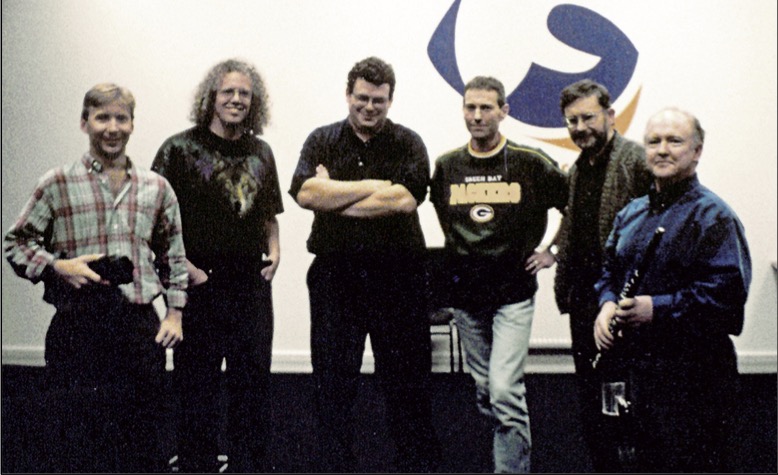
(Left to Right) Chris Norman, Robin Bullock, Niall Keegan, Malcolm Reavell, Dr Ian Russell, Eddie Maguire

The weekend was the first time this number of traditional flute players had gathered in Scotland and acted as inspiration to continue from there. A young Calum Stewart was even in the audience, (although he told me recently, at the time, he didn’t play much flute).
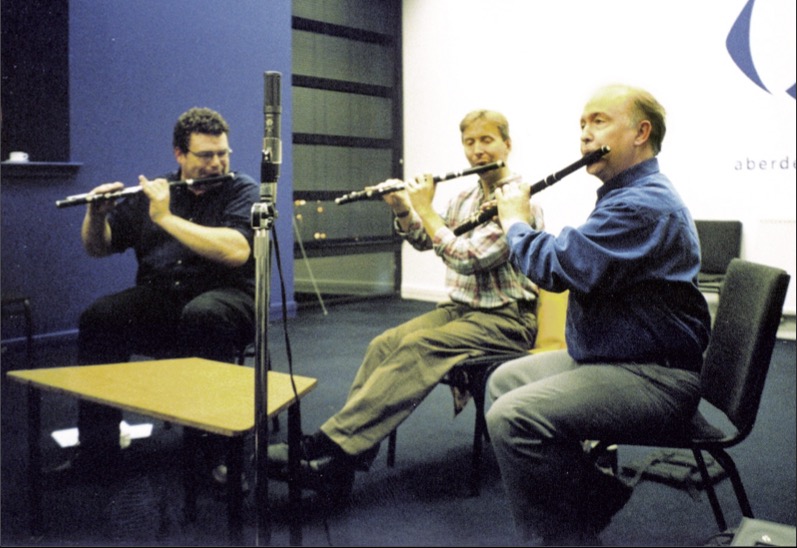
Niall Keegan, Chris Norman and Eddie Maguire performing

I can’t remember how many participants we had at the weekend, (data protection means I no longer have access to enrolment details), but I seem to have the number 45 in my head.

As for names… well, have fun looking through some of these pictures and try putting names to faces, and a video of the weekend was made by Dr Ian Russell and we hope to make some of it available in the future.

Eddie Maguire and the Whistlebinkies with the participants. Notice the animated music stand. (c) Malcolm Reavell
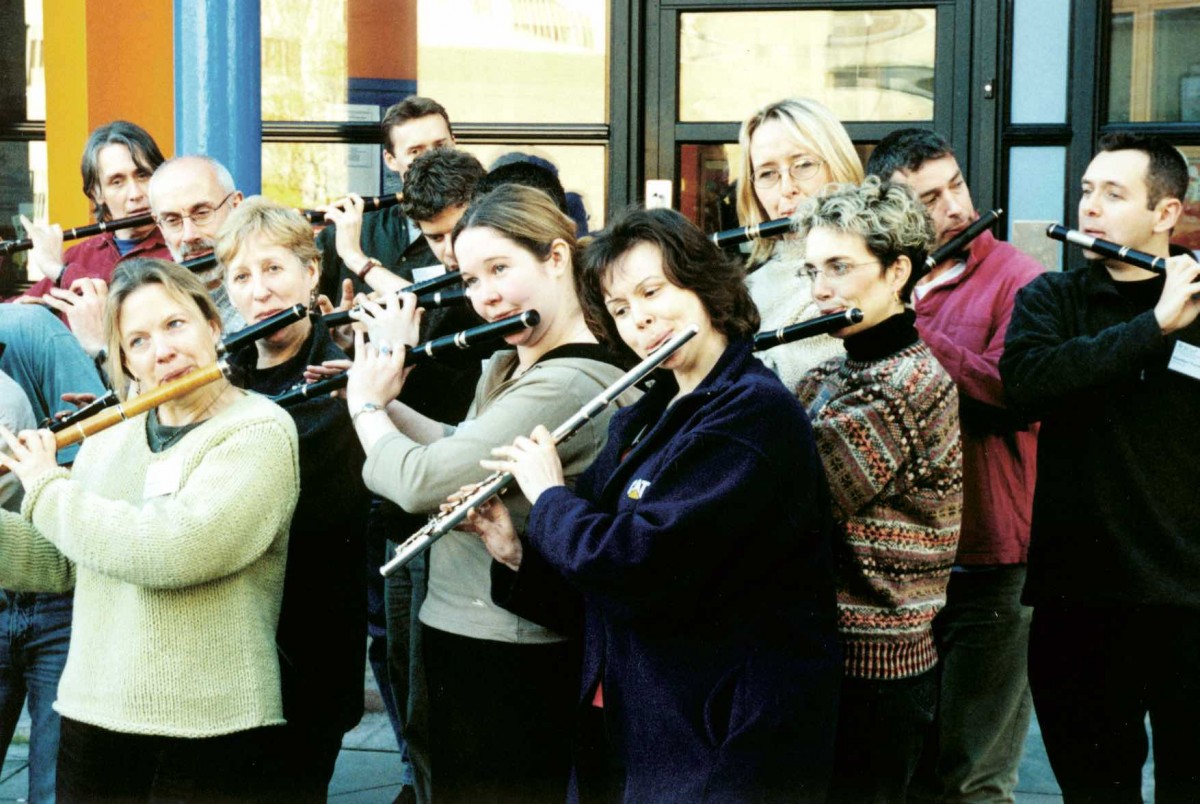
Aberdeen Press and Journal. Some weel kent faces here: Rebecca Knorr (left) and a young Mhairi Hall centre left, Ann Ward just behind them, a young Calum Stewart (partly hidden behind Mhairi), Munro Gauld and Gordon Turnbull (back right). The lady in the Fairisle pattern sweater is Ann Huntoon from Wisconsin. Apologies for not being able to recall other names at present.
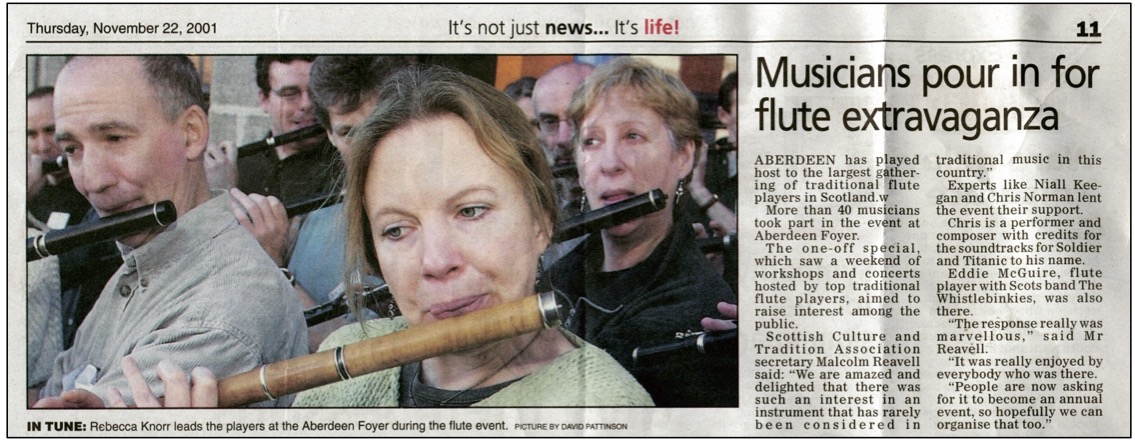
Aberdeen City Evening Express a few days later: Kenny Hadden, Rebecca Knorr and Ann Ward front and centre.
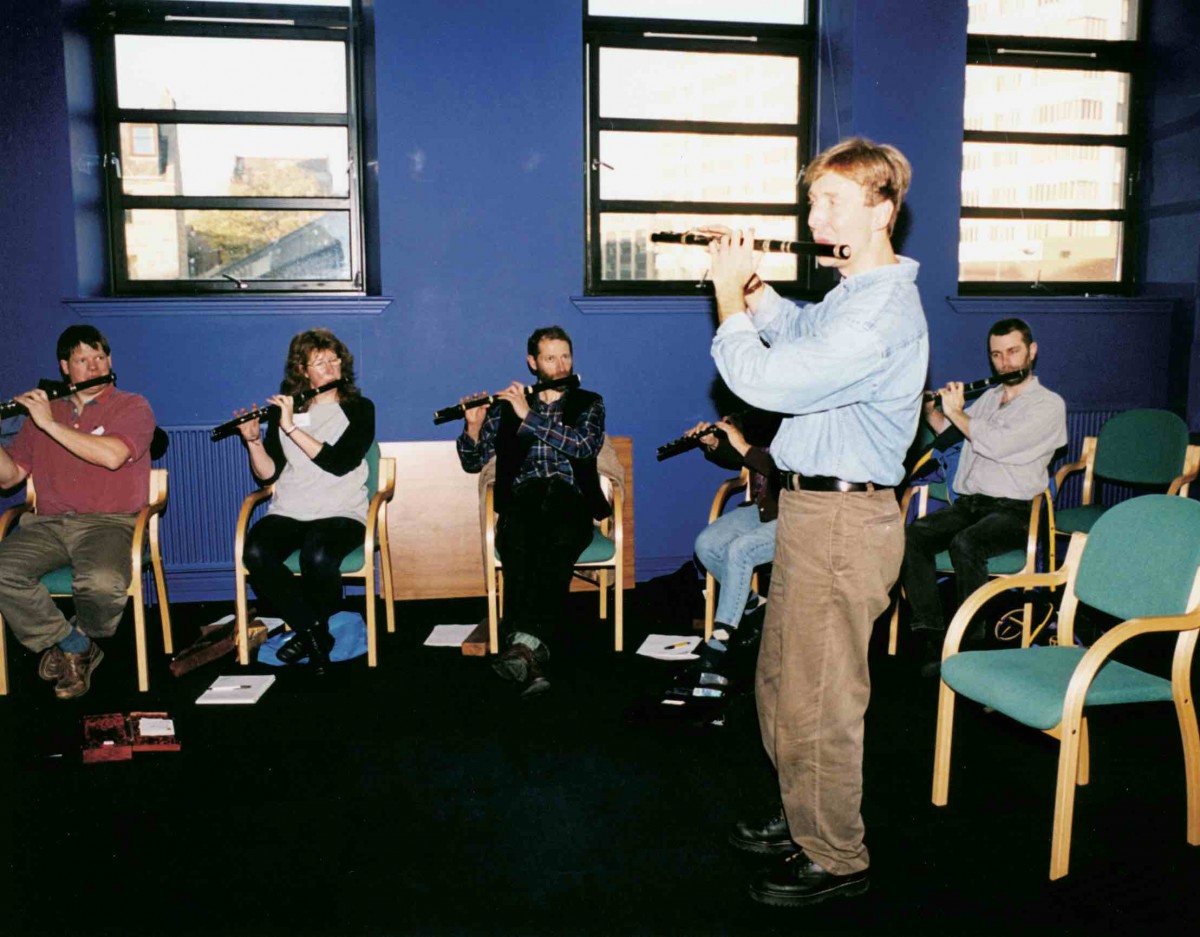
A workshop with Chris Norman. Pete Saunders back, right.
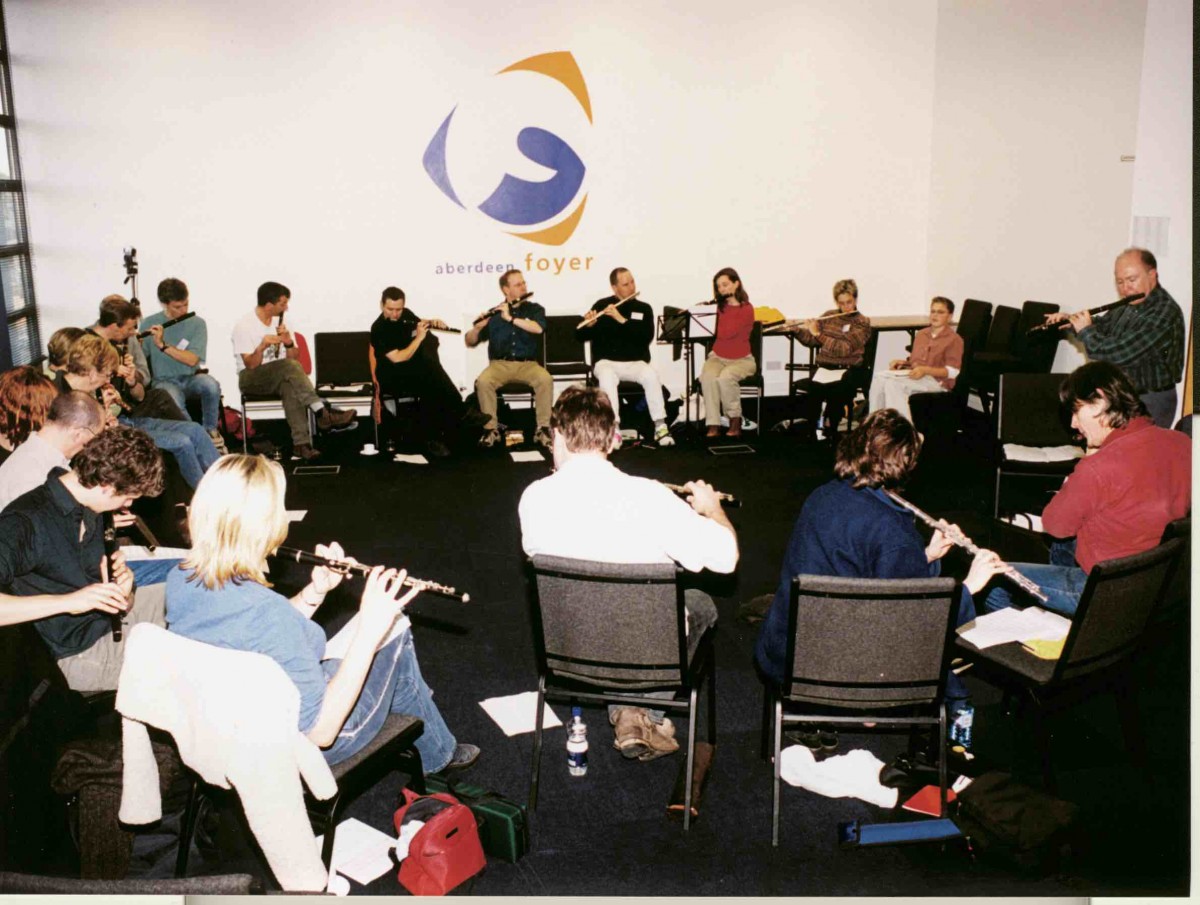
Some more faces to spot, this time with Eddie Maguire.
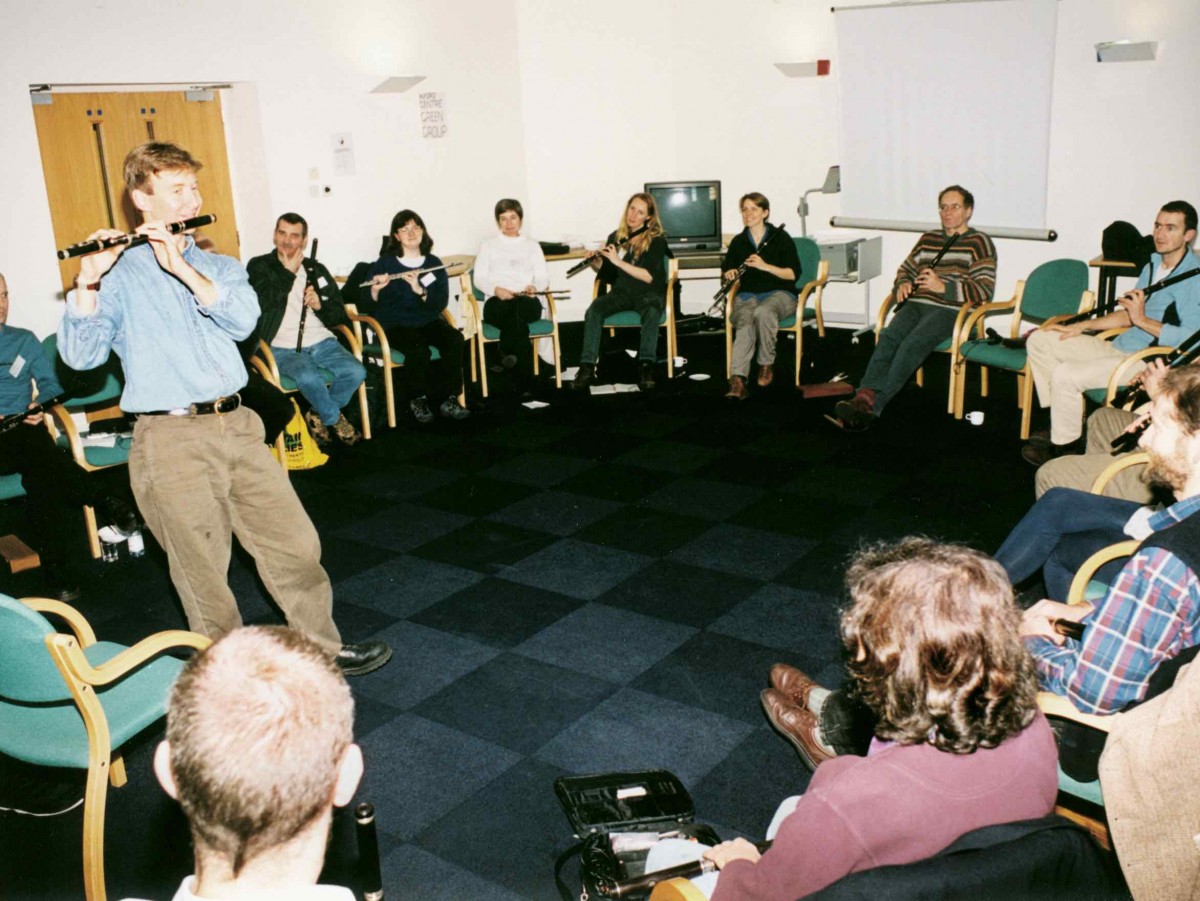
Chris Norman in a workshop
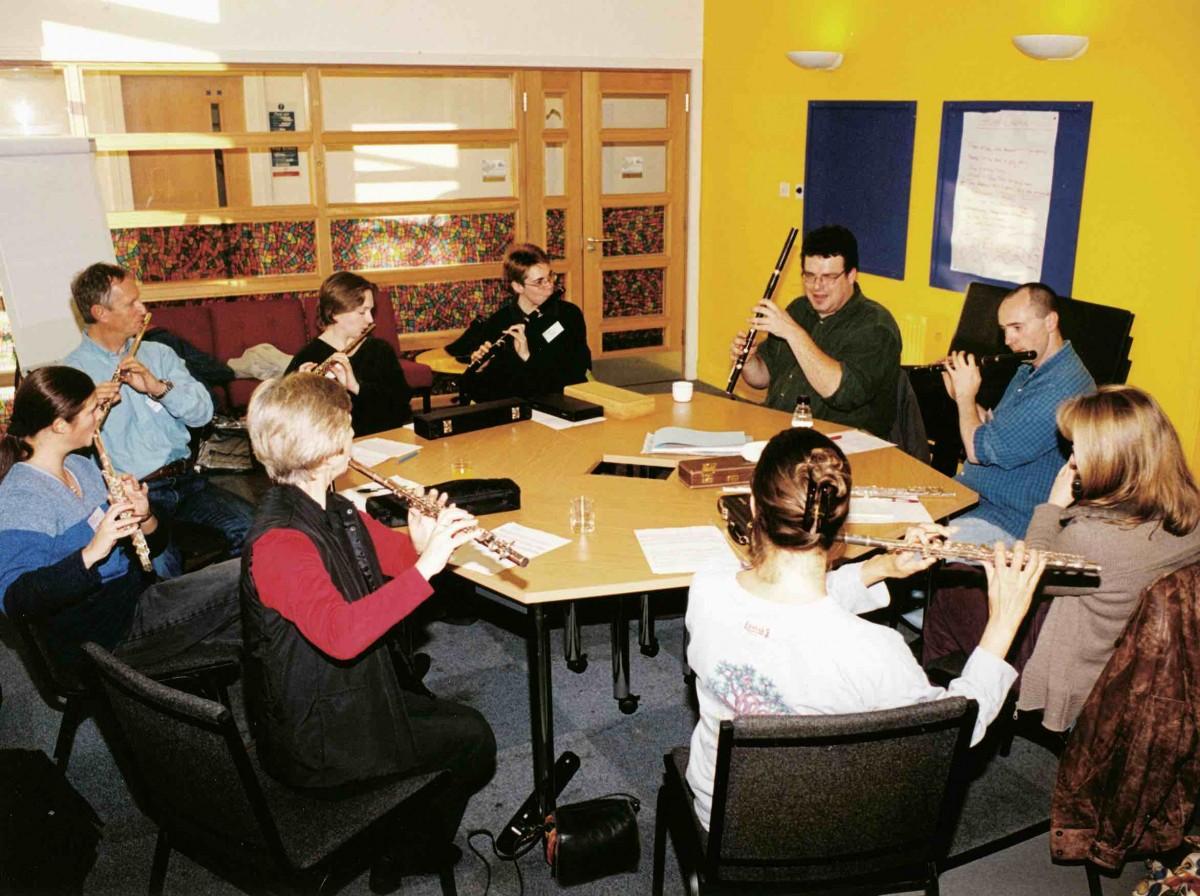
Niall Keegan with a group

The participants at the end of a full day animated and ready to listen to the three tutors.

(c) Malcolm Reavell 2021

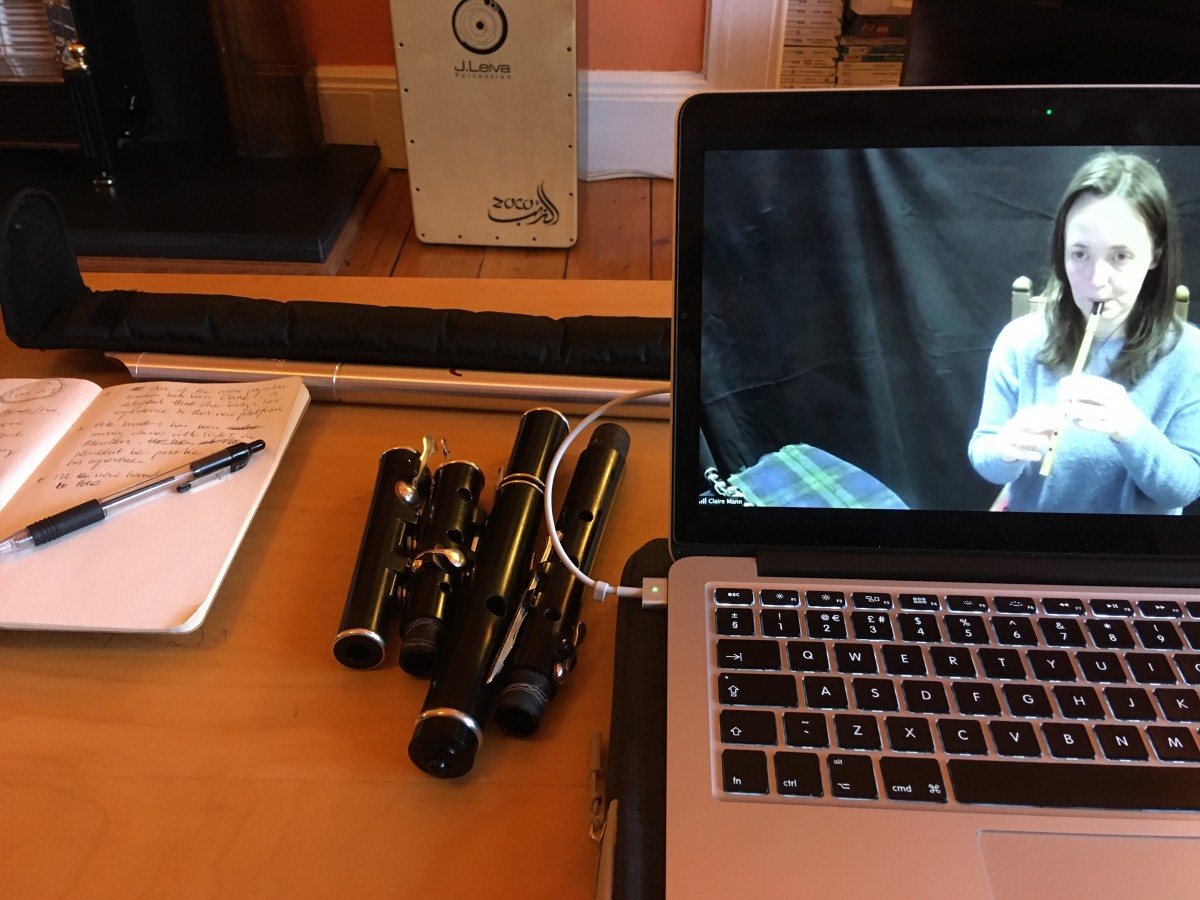
FluteFling online with Claire Mann

The first FluteFling Online event took place in December with a mini-series of workshops led by Claire Mann. The event marked what would have been a weekend event in Aberdeen and attracted a great turn-out, with participants from across the world.

When John Crawford approached me in September and asked what the plans were for the FluteFling Aberdeen Weekend, which usually takes place every November, I confess that my heart sank a little. It was a good question and needed addressing in some way, but it meant that we had to bite the bullet as so many have done and dive into the Online experience.

What did we know about putting on such things? Had we attended any? I personally had shied away from teaching online so didn’t really know what was involved. In addition, so much our working and personal lives are lived online during the pandemic, did we want to spend our spare time wrangling with setups, links and connections? And each of these questions seemed to have others lining up behind them. Wasn’t there online fatigue? Or was that just me?

John has been involved in the FluteFling weekends for many years and has been active in the Aberdeen event too and links up the Aberdeen flute community. He brought in fellow FluteFling supporter Pete Saunders, who has been running the SCaT flute and whistle classes in Aberdeen online this autumn and the technical experience and confidence that was needed. John had also attended a number of online workshops over the summer and had been taking plenty of notes of what worked well.

Over Zoom calls and emails with Sharon Creasey and Kenny Hadden, we realised that it was doable with manageable risks. We quickly identified Claire Mann as a tutor we wanted to involve and with her we were able to shape an event. We all wanted it to be a little different and supportive of those facing the common experience of not being able to meet and play music with others, having to dig deep for inspiration and motivation.

The result was a two-weekend event just towards Christmas. People were unlikely to be going anywhere during the pandemic and we felt that a week between the two workshop days gave people time to work on the material and learning, whatever their commitments. Providing the music and recordings from Claire a week in advance extended the learning focus and we extended it further by including a joint recording project for a video that will be completed soon.

The workshops were timed to be short and focused to avoid fatigue, which meant that they flew by an a lot was packed in as Claire took us through some choices from the online archive of the William Gunn Collection and Shetland reels. The Q&A session became highly technical as Claire responded to questions about rolls, cuts, strikes and alternatives with ease and clarity.

An unexpected development came from those looking to attend from USA and Canada. We had timed the workshops to be either side of lunchtime here in Scotland, but this was still 4 in the morning for some people, or even earlier. To attend at that time was a level of commitment that we hadn’t expected and we responded by recording the workshops and making them available to attendees for several weeks afterwards.

The implication for data protection was a concern and we had to seek consent. However, the way we ran the workshops helped enormously. Pete was a co-host and managed all of the running technical concerns — anchoring the workshops, muting participants and fielding questions through the chat facility. It meant that Claire could focus on the teaching, which was new to her in this setting too. The format was a success and was raised by a few as such in the feedback.

Claire Mann teaching online. Photo: (c) Gordon Turnbull

We were quite unprepared for the response, which was overwhelming. With over 70 participants, this was by far and away our biggest event and has caused us all to positively review future plans, including when we all get back together in person.

As participants began joining in the online session, people recognised each other and began chatting and creating a buzz. We have all seen each other on social media, but here we were again, with new faces coming in, some familiar names that are on our mailing lists but are never able attend. People spoke about the friendliness, as visitors from around the world logged in — from a chilly Niagara Falls to Spain, France and Germany. Meanwhile, Claire was in Newton Stewart, Pete was in Aberdeenshire and I was in Edinburgh. There was a definite community feel that spanned the globe.

The recordings enabled people to revisit the workshops and review the learning but also enabled those in California and Japan to be part of the event. Additionally, some people couldn’t attend all of the workshops or had to change plans at short notice, but didn’t miss out. In a non-online situation (IRL – in real life), these people couldn’t have attended or would have lost money or needed a refund.

Our eyes have been opened and while there is no substitute for an IRL experience, this has proved to be a decent substitute with a lot of potential. We are already in the process of organising our next event and what we continue to learn we will be taking into the regular workshops when they are able to resume. Can they be live-streamed or recorded? Or can they be sit alongside our regular events diary? Maybe, maybe.

In the meantime, look out for the video and also for news of our next event.


FluteFling Online December 2020 Roundup

FluteFling Online December 2020 Roundup

It was wonderful to see such a great turn-out for our first ever FluteFling Online event.

Claire Mann took us through some fine tunes over four workshops on two consecutive Saturdays and there is a group recording of everyone playing together to look forward to as well.

Claire herself was in Newton Stewart in Dumfries and Galloway, Pete Saunders did a great job controlling the technology from Aberdeenshire, while Sharon Creasey in Dumbarton, John Crawford in Aberdeen and myself in Edinburgh were also on hand to support. We had much of the country covered and then people attended live from Canada (a 5.30 am start!), USA, Germany, Sweden, France, Ireland, England, the Netherlands, Spain — apologies if I have missed anywhere — and more people accessing it through recordings afterwards, including one person from Japan.

We are already thinking of when we will do our next one, so make sure you are signed up to the newsletter to hear about it first.

Event Resources

The Event Resources archive, including recordings of the workshops themselves, will remain accessible to all ticket holders until 9 January, which is also the date for submitting videos for the group video. Once this is edited it will become available in January.

Most questions were answered either in the workshop or by chat in the messages, which have also been archived in the Event Resources.

Someone new to Scottish traditional music asked for some useful tune collections. It’s something we should maybe address more fully, but here are a few, plus some others:


FluteFling Online December 2020

Claire Mann to deliver FluteFling Online 12 & 19 December

FluteFling’s first venture into online events takes place in just a week’s time when Claire Mann will deliver four 45 minute workshops on Zoom over two consecutive Saturdays. The response has been terrific but luckily we are not limited by space and places are still available.

Tailored to flute, whistle and low whistle, Claire has helped to shape the workshop mini series to provide a way for people to focus on their music and instrument over three weekends and more. Uploads of Claire’s teaching material — both PDF sheet music and recording — go up this weekend, followed by the workshops themselves, which will be recorded. With time to go over the tunes, work on the ideas and techniques AND revisit the workshops, this is a close but realistic alternative to an immersive weekend away.

Although there won’t be any sessions, there is the additional option of recording some of the material covered by Claire for a group video, to be submitted for compilation by the end of December. That’s almost a month of digging deep into the music after the extended fallow period we all currently have had to endure. The video will be completed and made available later in January, giving us all something to look forward to in 2021.

It promises to be a memorable experience and much needed by many of us traditional musicians. How can you be sure? Well, all of the organisers have all bought tickets — Sharon Creasey, John Crawford, Pete Saunders and Gordon Turnbull.

You can get your ticket on the event page too. We look forward to seeing you there.


Flutes face potential problems post Covid-19

One of the questions that has cropped up in Covid-19 conversations amongst flute players and their friends is — how safe are we? As we begin to learn more about this aerosol-borne virus, singers and wind instrument players — flutes, whistles and bagpipes included — are being seen in a new light. Could a wind musician potentially spread the virus more widely than other musicians?

We don’t yet know the answer, but for flutes and whistles, splitting the airway through the far edge of the embouchure or the fipple is how the sound is generated. Air also escapes at the tone holes and at the end of the instrument. How fast is the air and how far is the air projected? Studies are ongoing but this is what is understood at present.

There is still much to be understood and my gut feeling is that the majority of the concerns at the moment relate to the flute and not necessarily the whistle. One speculated thought on the Facebook group is that blowing across the embouchure with force and direction may be an issue. If so, there may be a solution that has the added benefit of being a wind shield AND tone reflector. It’s the Win-D-Fender developed in the USA and carried in a few places in Europe and across the world.

Personally, I hope some additional thought goes into the name and the colour options as it seems functional and clinical (although in a world of PPE and face masks, maybe that is less of an issue). So here are a couple of videos endorsing the product (caveat: I’ve no idea if this works on wooden flutes).

Relating this to sessions, if this is helpful, then the airflow coming from out of the flute may then be the big issue. Sessions are often sight spaces and flutes tend to need more room than others. In a session with increased distancing, that may be a bigger issue. On the other hand, whistles are more self-contained and that may be an advantage.

Finally, on a more upbeat note, my own Lockdown tunes project on YouTube continues. Mostly Scottish repertoire, but not entirely. I hope you enjoy them.