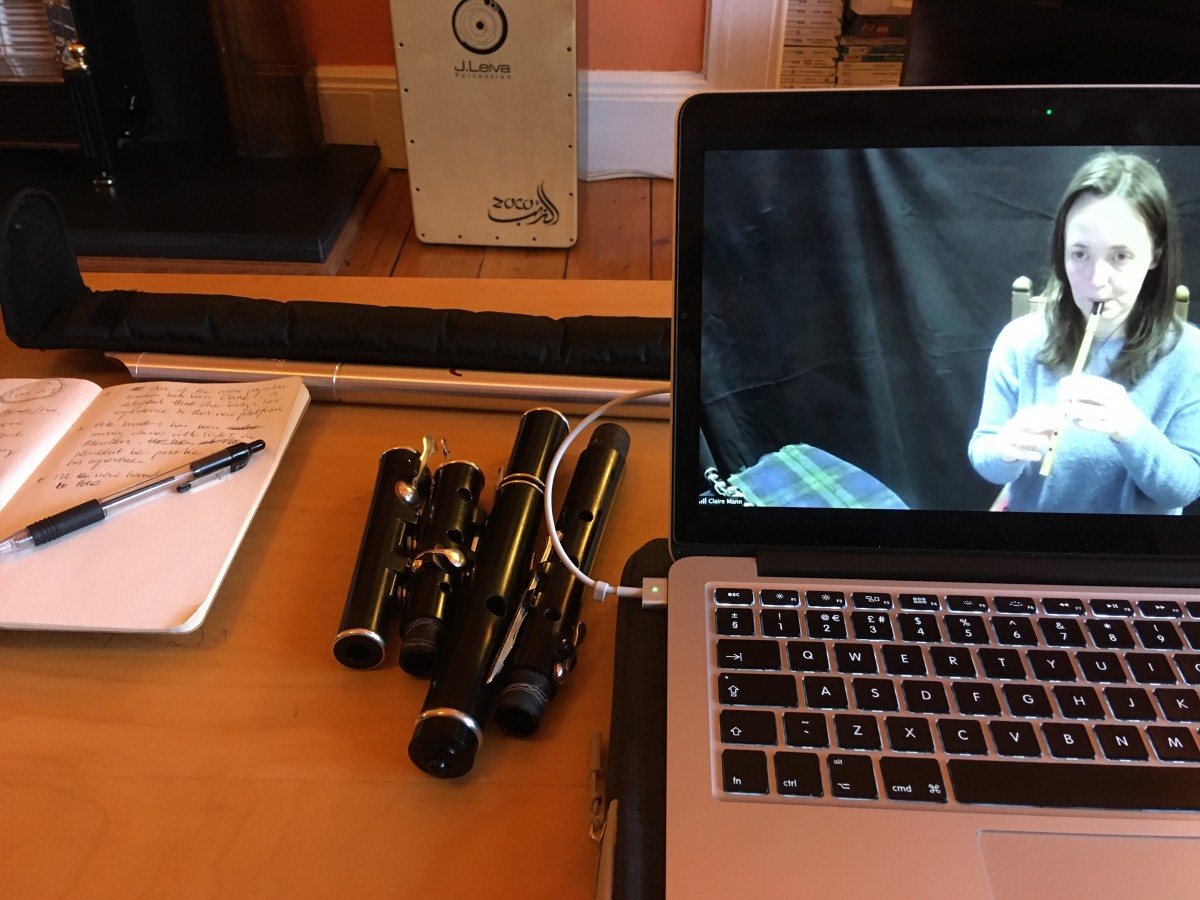
Exploring the John Miller fife manuscript

John Crawford digs into the digital archives of the Scottish flute world
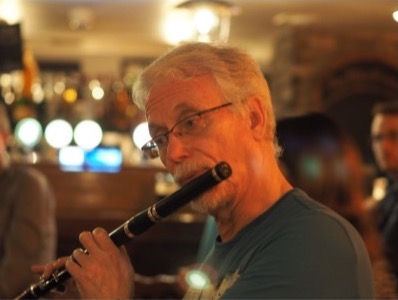
About the author: John Crawford is a long-standing supporter and co-organiser with FluteFling. John enjoys exploring the forgotten pre-revival Scottish flute manuscripts that reside in online libraries and collections, such as this Scottish fife player’s manuscript from 1799.


Update: John Crawford has written a follow-up to this post.

Early in lockdown, I found myself in the Village Music Project (VMP) website. Their primary interest is the traditional social dance music of England and I was intrigued by their Manuscript collection. They’ve transcribed some 45 manuscripts into ABC format with most also rendered as printable PDF documents.
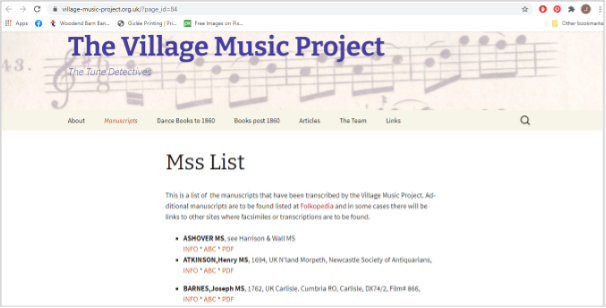
The Village Music Project Manuscript List © Village Music Project

The people who wrote these manuscripts were generally educated and literate people with some available leisure time and a strong interest in music.

The VMP collection includes a manuscript book belonging to Grace Darling’s father and another by poet, John Clare. It’s said that John Clare used to stand in the bookshop, in Stamford, copying the latest tunes from published books into his manuscript book. No doubt, some musicians copied from books owned by better off friends and acquaintances.

The Scottish location of the John Miller MS, held in the AK Bell Library in Perth, as part of the Atholl Collection, made it the obvious first choice to explore in more depth. I was surprised and delighted when I opened the file and discovered the content was fife music. My first ever flute, nearly fifty three years ago, was a five key, rosewood Bb fife which my friends christened “Roxanne”.
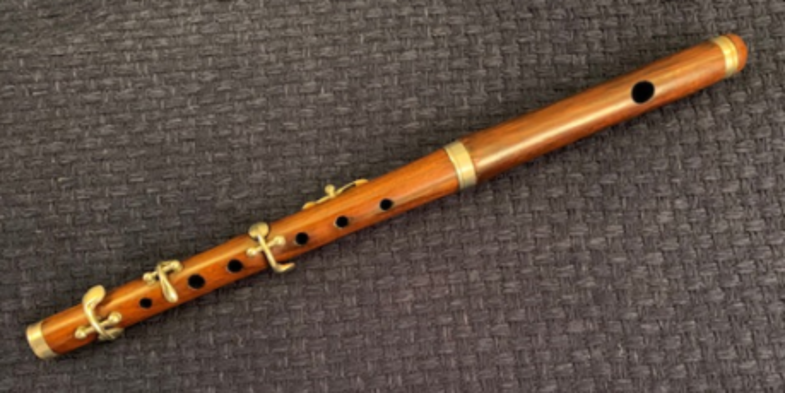
John Crawford’s Bb, 4 key rosewood fife, “Roxanne” (c) John Crawford

The Village Music Project transcriptions and the related notes have provided the opportunity to take a trip back to 1799 into the world of a military fife player.

St Cecilia’s Boxwood C Fife, 1800 © 2021 University of Edinburgh.

John Miller’s fife would have been far simpler than “Roxanne”. It would have been made from a single piece of wood with six finger holes, an embouchure hole, brass ferrules at the ends and no keys.

St Cecilia’s Hall Concert Room and Music Museum, in Edinburgh, have a boxwood C fife, made around 1800, that is almost certainly similar to the instrument John Miller played. Their website provides more details of the instrument and a sound sample.
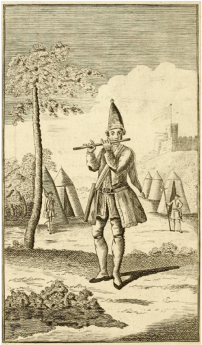
Flyleaf illustration from Thompson’s Compleat Tutor for the Fife – published in 1765 © NLS Inglis Collection.

Chris Partington’s introduction to the VMP material on the MS (see the extract below) provides a summary of the MS contents, some speculation about the man behind it and the context of his fife playing.

The insight we get into the world of a fife player 220 years ago tells us quite a lot about the music John Miller played but relatively little about the context of his playing or indeed the man himself.


The Manuscript

The John Miller MS is in the A.K.Bell Library, Perth, Scotland
This introduction by Chris Partington, village music project, 2002

DESCRIPTION

The John Miller MS is in the A.K.Bell Library, Perth, Scotland, accession number possibly 34685, which is inscribed on the fly-leaf. We have worked from a good photocopy. We do not at present have a context for how the MS comes to be in Perth, other than the obvious martial nature of it and the fact that Perth is I believe the home of the Black Watch.

Music manuscript book, 7.5″ wide, 3.75″ tall, apparently hard – bound. 4 pre-ruled staves per page.

Inscribed (repeatedly) prominently on the flyleaf and elsewhere “John Miller his book of tunes for the Fyfe” often along with dates from August 1799(most often) to 1801. Also postings in Ireland, “Strabane May 12th 1800”, “Stranorlar”, “Londonderry”. Ireland had been and still was in some considerable turmoil at this period……1798 rising, etc. Some of the tunes herein may still have some resonance today, particularly played by a fife & drum band, as it was intended by Mr. Miller.

There are 117 Musical items surviving, at least two pages are missing, the book is otherwise in good condition.

The handwriting is consistent through the book.

It would seem then that John Miller wrote the book, that he was a Fife player, rank unknown, probably in the Regimental Band, but I would not at this stage like to form an opinion as to which Regiment, even if Perth was the home of the Black Watch. Somebody with knowledge of Military History may be able to throw some light on this if they were so inclined.

THE MUSIC

    • 117 surviving musical items, some barely legible.
    • 26 common time marches (or serving as)
    • 11 6/8 marches (or serving as)
    • 8 jigs
    • 4 strathspeys
    • 12 reels
    • 14 English hornpipes, all well known
    • 16 airs
    • 1 slip jig
    • 25 sacred items, psalms

I would suspect that most of the non-martial and non-sacred tunes would be Lowland rather than Highland in nature. The most remarkable feature to us is the number of tunes marked as being for marches, but this would not be remarkable I suppose for a member of a Regimental fife band.


The Context

Understanding the context of the John Miller manuscript has required exploration of:

  • Other music collections including the Buttrey Manuscript and the Black Watch Fife Manuscripts in the NLS;
  • Sources on the history of the fife and its place in the music of Scottish regiments (including – Highland Soldier: A Social Study of the Highland Regiments, 1820-1920 by Diana M Henderson; Drum & Flute Duty 1887; Scots Duty – The Old Drum and Fife Calls of Scottish Regiments – Journal of the Society for Army Historical Research Vol. 24, No. 98 ) and
  • Sources on the Irish rebellion in 1798 (REBELLION, INVASION AND OCCUPATION: A MILITARY HISTORY OF IRELAND, 1793-1815 – Thesis by Wayne Stack, University of Canterbury 2008)

Each of these topics deserves to be the subject an article on its own right.
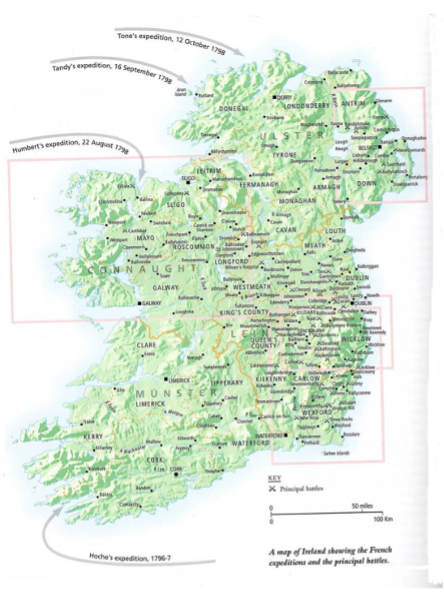
Military activities in Ireland 1798 (c) Wayne Stack, University of Canterbury 2008

Dates and locations given in the MS strongly indicate that Miller was in counties of Tyrone, Londonderry and Donegal during a tumultuous time in Irish history as part of some sort of military unit. The 1798 uprising had just happened. Massacre and atrocities were perpetrated by both government and rebel forces, each feeding on religious bigotry.

The French invasion in August the same year came too late to aid the rebel cause. Dublin Castle accepted the offer of English militia regiments to serve in Ireland, alongside the numerous English and Scottish fencibles units that remained in the country until their disbandment in 1802. In 1801 Britain reclaimed political control of Ireland through the Act of Union.
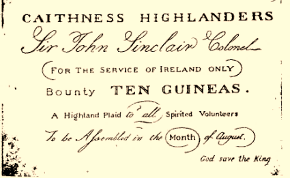
Recruiting card for the Caithness Highlanders 1799 (c) Journal of the Society for Army Historical Research

None of the locations cited in Miller’s MS, other than Londonderry, appears to have been the location of permanent barracks, associated with a specific regiment. Londonderry seems to have been the location of a Militia barracks. Evidence supporting the VMP suggestion that Miller might have been part of what was to become the Black Watch is very limited. There is no clear evidence that the 73rd (Perthshire) Regiment of Foot, or the 42nd Regiment of Foot, were in any of the locations mentioned by Miller on the dates indicated in his MS.

An alternative possibility is that Miller belonged to one of the Scottish fencibles regiments. These were raised as a defence force during 1793/ 94 due to the fear that the French would either invade Great Britain or Ireland, or, that radicals within Britain and Ireland would rebel against the established order.

A significant number of the Scottish fencibles served in Ireland including the Breadalbane Regiment (Embodied in Perth in 1793 – 3rdBn disbanded in Ayr in 1802) and the Angus –shire Regiment (disbanded in Perth in 1802). It’s interesting, and perhaps not entirely coincidental, that Miller’s MS has no postings or dates after 1801.

The possibility that Miller was part of an Ulster militia regiment seems to me less credible.

The Content
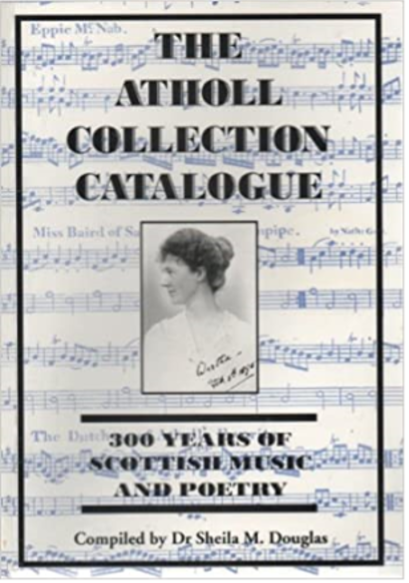
The Atholl Collection Catalogue (c) 1999 Perth and Kinross Libraries

The original copy of the MS, in the Atholl Collection, has not been digitised. It is of course, possible to visit the Bell Library in Perth to view the manuscript. Naively, I thought when the pandemic is over it’ll be relatively easy to go to Perth and see this at first hand. Here we are a year later still waiting.

The Collection, consisting of around 600 books and manuscripts of Scottish music, some from the seventeenth century, has been described as one of the most important collections of its kind in existence. In addition to the Miller manuscript the collection includes 50 other flute specific items making a visit to the Bell Library well worthwhile.

A catalogue was published in 1999 and is available from the library service at a cost of £4.95 plus postage. A card index to the tunes has been compiled by a volunteer and this is currently being transferred to an Access database. Contact the library if you are looking for a particular tune. info@culturepk.org.uk

There are two main options for accessing the manuscript online.  The first is via the Village Music Project website: The VMP manuscript list is at this link. The MILLER,John MS, 1799, is item 32 in the list. The following links will take you directly to an introduction to the manuscript and the tunes in ABC and standard music notation respectively.
INFO * ABC *  PDF

The second online access option is to use  Richard Robinson’s Tunebook . The following link will allow you to see the entire Miller MS in standard notation:
http://richardrobinson.tunebook.org.uk/documents/0/11/112.html

The links associated with each tune provide download options including ABC files, a printable PDF of the tune in standard notation and a MIDI file.

My own favourite tunes from the manuscript include:

  • JMP.019 – The Bonnet Makers of Dundee (Bremner’s  1757 collection)
  • JMP.026 – The Sussex Polka  (untitled polka from the 1796-1818 MS collection of William Aylmore)
  • JMP.015 – Quick March [aka  “Auld Reckie”, or “Hoble about”] (Aird – Selection of Scotch, English, Irish and Foreign Airs, vol. 3  1788) Note the dedication on the cover! “Humbly Dedicated to the Volunteer and Defensive Bands of Great Britain and Ireland
  • JMP.062 – West’s Hornpipe (Appears in Preston’s Twenty-Four Country Dances for the Year 1798. The tune also appears in the Buttrey fife manuscript. This tune is now a regular fife and Lambeg drum repertoire)
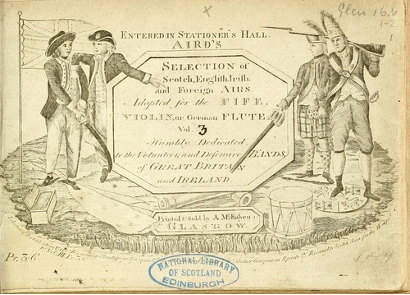
Cover of Volume 3 of Aird’s Collection published in 1878 (c) National Library of Scotland

Although this is only a small sample from the manuscript, it does support a view that Miller’s had a source that had access to contemporary music collections, like Aird’s, Bremner’s and  Preston’s  published in the late 1700s.

Another feature of the manuscript is the number of tunes (like West’s Hornpipe) that are now part of the Orange Order fife and drum tradition.
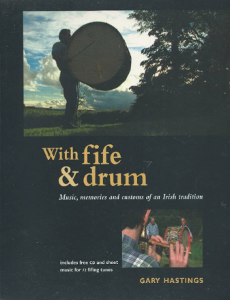
Cover of With Fife and Drum by Gary Hastings (c) Gary Hastings

Perhaps this isn’t surprising; in the late 1790s Orangeism quickly spread in the North of Ireland; by early 1797 as many as 30,000 Orangemen had enlisted in Ulster yeomanry corps. Miller, and his regiment, must have found himself in the middle of a society where Protestant/ Orange Order values were very influential.

Other tunes in the MS that currently feature in the music of Orange Flute bands include:

  • Boyne Water
  • Croppies Lie Down
  • Morning Stare (Star)

See Gary Hasting’s excellent book With Fife and Drum for more details.

In common with the contemporary Black Watch & Buttrey fife manuscripts, the Miller MS omits the duty tunes that would have regulated the soldier’s day (The Reveille, The General, to Arms, the Gathering, the March, the Retreat and the Tattoo). Presumably, as part of the fabric of regimental life, no written reference to these was required.
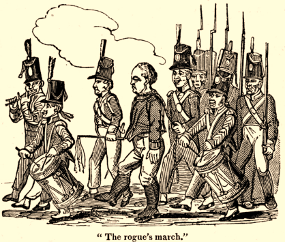
An 1819 political cartoon (c) Wikipedia.org

Only the Buttrey MS includes “The Rogue’s March”; arguably the most recognised melody in martial repertory of the era. Being “drummed out of the regiment” consisted of as many drummers and fifers as possible, playing the tune, parading the prisoner in front of the regiment. The offender’s coat would be turned inside out as a sign of disgrace. The final ignominy was a kick from the youngest drummer followed by ejection through the barrack’s gate with an order never to return.

Some of the available manuscript resources suggest that the musicians who played for marches and parades would be the same ones playing for social events and dances in the officer’s mess and the Sunday morning church parade and service. Other sources dispute this; making the point that the drums and fifes were part of the regiment. The fifers were generally boys. Some were the sons of soldiers who were brought up in the regiment, regarding it as their home. This is unlikely to apply to Miller if he was part of a short term fencibles regiment.

As the Buttrey MS confirms another recruitment path, for fifers, was via the poor house or, other comparable institutions. In contrast, the regimental bands were civilian professional musicians, in uniform, sponsored by the officers of the regiment. Ironically the band uniforms were often more exotic and elaborate than those of the drums and fifes.

Who was John Miller, what regiment was he part of, where, when and how was he recruited, where did he obtain the tunes in his MS book, why did the book have a four line stave, how did he obtain his skills in playing the fife and writing  music notation, who did he play music with and in what circumstances? The answer to these and a host of other questions may lie in a closer examination of the Atholl Collection or, may be lost to us forever. His music though is still with us thanks to his manuscript and deserves to be remembered and played providing an insight into our musical history.

Update: John Crawford has written a follow-up to this post.
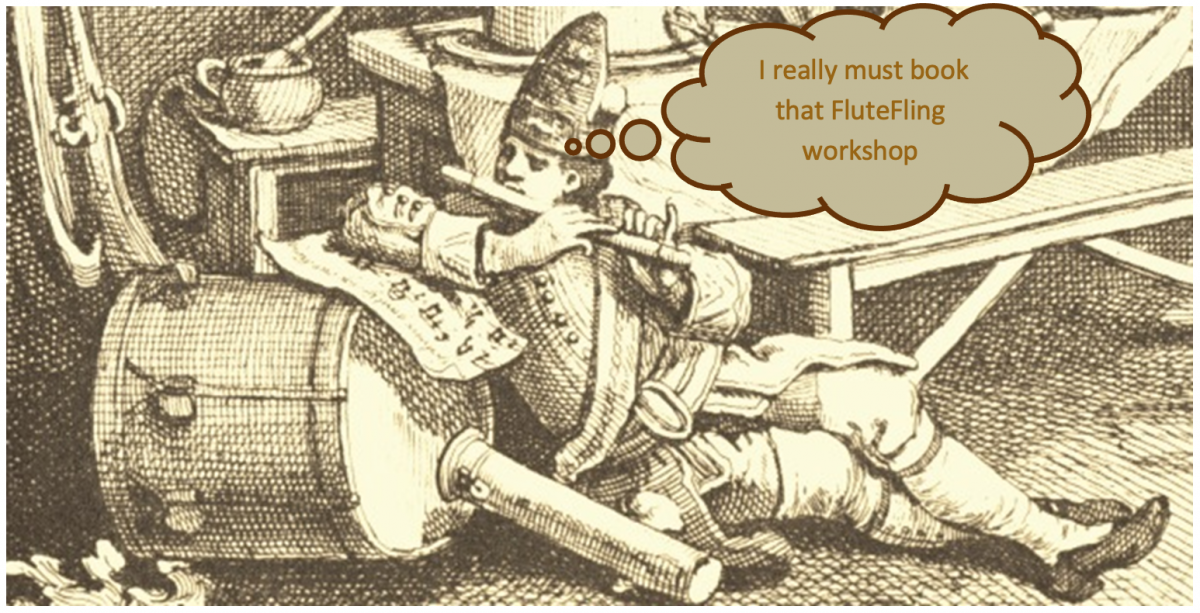
An 18th Century British Army fife player practicing (c) militaryheritage.com (additional text by John Crawford)

Article (c) John Crawford 2021

Scotching a musical myth

The Flute in Scotland from the Sixteenth to the Eighteenth Century,
Elizabeth C Ford; published by Peter Lang (2020)

Review by Gordon Turnbull


Until very recently in Scotland, when we thought of the flute in traditional music, we tended to immediately think of Irish musicians. This is beginning to change, but the truth is that the flute has been undergoing a revival in Scotland for less than 50 years, with most of the activity being since 2000.

Many of us, myself included, were drawn to the instrument largely through exposure to the flute in Irish traditional music, where it is long established. By studying these examples and applying what we have learned to Scottish traditional music through trial and error, it has been possible to begin to piece together something that might be understood as a Scottish flute. This was the origin of the FluteFling weekends — an attempt to understand and share as part of an ongoing process of revival.

But an ongoing mystery for many traditional flute players in Scotland who are part of the current revival is: to what extent was the instrument previously played? There have been hints in publications of repertoire found in many public archives, but they have been buried away. As Kenny Hadden noted, there must have been a market for flute arrangements of Scottish music in the past.


Discovering the origins

Just before the second FluteFling Scottish Flute Day in Edinburgh in 2015, Elizabeth Ford approached the organisers. A PhD student at the time, she was studying the early history of the flute in Scotland and gave a talk and performance for attendees, opening up a new world for many of us. Elizabeth returned the following year to participate in a notable concert and has remained in touch.

Following the completion of her landmark PhD, it has been published by Peter Lang as The Flute in Scotland from the Sixteenth to the Eighteenth Century.

Dr. Elizabeth Ford giving a talk on flutes

Dr. Elizabeth Ford giving a talk on flutes

It has to be said that Elizabeth Ford’s book is a welcome publication in the history of Scottish music and is a must-have for any serious student of the flute in Scotland. This is a well-researched fascinating read, full of engaging detail, fascinating diversions and leavened with disarming wit; dry it is not.

Importantly, Dr. Ford firmly dispels the long held myth that the flute was introduced to Scotland in 1725 and reveals instead that it was present in the 16th century and was part of a rich musical flourishing in Scotland throughout the 18th century and into the 1800s. Through detailed research, she examines and scotches many established assertions to piece together a rich and colourful picture of the Scottish flute world. What emerges is that the flute was confidently part of the contemporary musical landscape. A quote from Tobias Smollett of 1771 sets the scene: “The Scots are all musicians — Every man you meet plays on the flute, the violin, or the violoncello…”

Covering amateur and professional musicians of the period, evidence for women playing, composers and repertoire, traditional musicians, teachers and instrument makers, Elizabeth Ford delves deep into the archives to demonstrate that the flute was prevalent in the Lowlands, from Aberdeen to Glasgow, Edinburgh, the Lothians and Galloway. As yet, no direct evidence for the flute in the Gaelic archives has been uncovered, but it is to be hoped that the tantalising hints may be pursued in the future.

Gordon Turnbull holding an ivory flute.

Gordon holds an ivory and silver flute claimed to have been once owned by Bonnie Prince Charlie. At an Edinburgh auction room 2015 (c) Gordon Turnbull

Much like elsewhere in Europe, the flute was largely a symbol of gentrification and grew in popularity alongside that of other instruments in tandem with the increasing wealth of the landed classes. Scotland underwent a period of rapid urbanisation, from 1750-1850 in particular, as Lowland farming was “Improved”, resulting in the displacement of many who had formerly worked the land.

Some of these displaced people went to work in towns and cities, while the wealth of landowners increased and merchants prospered with transatlantic trade such as sugar, tobacco and slaves. The Scottish Enlightenment, the Jacobite uprisings of 1715 and 1745 and the start of the notorious Highland Clearances also occurred during this turbulent period of rapid change in Scotland.

For more on this, the early chapters of Tom Devine’s The Scottish Nation: A Modern History perfectly complement Elizabeth Ford’s book.

Against these many changing strands of Scottish society, we learn from Dr. Ford’s book that the establishment of Musical Societies took place in Aberdeen and Edinburgh. Associated professionals were engaged to teach various instruments, including flute, and organise performances. The flute was also featured in Glasgow where the music teachers organised performances in the absence of a local society.

The Flute in Scotland from the Sixteenth to the Eighteenth Century digs deeply into the archives and shines the light on many personalities and characters, from letters requesting new flutes to be purchased from London to a love message secreted into an instrument gifted to a female flute player. (And yes, women most certainly played the flute).


Flute players, composers, arrangers, teachers and makers

Dr. Ford offers us portraits of different amateur and professional musicians of the period, looks at the flute elements of the work of composers and arrangers, not just bigger names such as William McGibbon and James Oswald, but also Daniel Dow and the Italian influence of Barsanti and Urbani, who worked and resided in Edinburgh. Combined with private manuscript collections of flute players, a broad sweep of Scottish flute playing society is captured. The repertoire ranges from traditional music to newly composed sonatas in an Italian style, suggesting a healthy amateur scene and a wide range of ability.

William Nicholson’s flute (c) The Future Museum, Southwest Scotland.

Flutes have always been expensive instruments and require some care, but it wasn’t just those with money and aspirations who played the flute. Information is scant, but much can be inferred. Lower class examples such as weaver poet Robert Tannahill (Paisley) and pedlar poet William Nicholson (Kirkudbright) suggest that there may have been another traditional and undocumented scene. I think that many of us can recognise this musical scene painted by Tannahill:

There is Rab, frae the south, with his fiddle and his flute;
I could sit list tae his strains still the starns fa out.
An we’re noddin, nid nid noddin,
We’re a noddin fu at e’en
— Robert Tannahill, The Five Frien’s

It is in this context that the music of Scotland began to be collected, organised and published, with the patronage of the landed classes, professionals, middle and merchant classes. The Flute in Scotland from the Sixteenth to the Eighteenth Century describes the music societies of Edinburgh and Aberdeen, and the teachers of Glasgow who organised concerts, where flutes featured naturally alongside violin and harpsichord.

Dr Ford also provides us with a tantalising glimpse of flute makers active in Scotland: James Lily (no surviving flutes but active 1708), Urquhart (his one surviving example is the earliest Scottish flute and can be seen here, probably first name Alexander and active as a maker and writer 1726; he was the first translator of Hotteterre into English), John Mitchell Rose (of Rudall and Rose fame), Thomas McBean Glen (no examples, but listed as a maker of bagpipes and flutes 1833).

John Gunn was one of many new names to me and to my mind should be more widely celebrated as an influential teacher and author of flute theory books. The first to attempt a scientific description of tone production and method while discussing style and expression, he bridges the worlds between single keyed and 8-keyed instruments and surely stands alongside Hotteterre and Quantz in his contribution to the instrument. From a traditional musician’s point of view the discussion of the changes in ornament styles is of particular interest.

Once exposed, all of this activity reveals a compelling argument for the flute being rightfully part of Scottish musical heritage. The reason it has been long forgotten while other instruments and repertoires have been celebrated in Scotland remains an unanswered question. A crux seems to be the formulation of cultural symbols for Scotland in the 19th Century. Dr. Ford ponders on the associations of “German” flute (as the transverse flute was known) with the Hanovarians at a time when Jacobitism was being safely romanticised. That is an area for further study, but The Flute in Scotland from the Sixteenth to the Eighteenth Century lays a welcome firm foundation for future investigations.

The Flute in Scotland from the Sixteenth to the Eighteenth Century by Elizabeth Ford, published by Peter Lang (2020) https://www.peterlang.com/view/title/69223

FluteFling online with Claire Mann

The first FluteFling Online event took place in December with a mini-series of workshops led by Claire Mann. The event marked what would have been a weekend event in Aberdeen and attracted a great turn-out, with participants from across the world.

When John Crawford approached me in September and asked what the plans were for the FluteFling Aberdeen Weekend, which usually takes place every November, I confess that my heart sank a little. It was a good question and needed addressing in some way, but it meant that we had to bite the bullet as so many have done and dive into the Online experience.

What did we know about putting on such things? Had we attended any? I personally had shied away from teaching online so didn’t really know what was involved. In addition, so much our working and personal lives are lived online during the pandemic, did we want to spend our spare time wrangling with setups, links and connections? And each of these questions seemed to have others lining up behind them. Wasn’t there online fatigue? Or was that just me?

John has been involved in the FluteFling weekends for many years and has been active in the Aberdeen event too and links up the Aberdeen flute community. He brought in fellow FluteFling supporter Pete Saunders, who has been running the SCaT flute and whistle classes in Aberdeen online this autumn and the technical experience and confidence that was needed. John had also attended a number of online workshops over the summer and had been taking plenty of notes of what worked well.

Over Zoom calls and emails with Sharon Creasey and Kenny Hadden, we realised that it was doable with manageable risks. We quickly identified Claire Mann as a tutor we wanted to involve and with her we were able to shape an event. We all wanted it to be a little different and supportive of those facing the common experience of not being able to meet and play music with others, having to dig deep for inspiration and motivation.

The result was a two-weekend event just towards Christmas. People were unlikely to be going anywhere during the pandemic and we felt that a week between the two workshop days gave people time to work on the material and learning, whatever their commitments. Providing the music and recordings from Claire a week in advance extended the learning focus and we extended it further by including a joint recording project for a video that will be completed soon.

The workshops were timed to be short and focused to avoid fatigue, which meant that they flew by an a lot was packed in as Claire took us through some choices from the online archive of the William Gunn Collection and Shetland reels. The Q&A session became highly technical as Claire responded to questions about rolls, cuts, strikes and alternatives with ease and clarity.

An unexpected development came from those looking to attend from USA and Canada. We had timed the workshops to be either side of lunchtime here in Scotland, but this was still 4 in the morning for some people, or even earlier. To attend at that time was a level of commitment that we hadn’t expected and we responded by recording the workshops and making them available to attendees for several weeks afterwards.

The implication for data protection was a concern and we had to seek consent. However, the way we ran the workshops helped enormously. Pete was a co-host and managed all of the running technical concerns — anchoring the workshops, muting participants and fielding questions through the chat facility. It meant that Claire could focus on the teaching, which was new to her in this setting too. The format was a success and was raised by a few as such in the feedback.

Claire Mann teaching online. Photo: (c) Gordon Turnbull

We were quite unprepared for the response, which was overwhelming. With over 70 participants, this was by far and away our biggest event and has caused us all to positively review future plans, including when we all get back together in person.

As participants began joining in the online session, people recognised each other and began chatting and creating a buzz. We have all seen each other on social media, but here we were again, with new faces coming in, some familiar names that are on our mailing lists but are never able attend. People spoke about the friendliness, as visitors from around the world logged in — from a chilly Niagara Falls to Spain, France and Germany. Meanwhile, Claire was in Newton Stewart, Pete was in Aberdeenshire and I was in Edinburgh. There was a definite community feel that spanned the globe.

The recordings enabled people to revisit the workshops and review the learning but also enabled those in California and Japan to be part of the event. Additionally, some people couldn’t attend all of the workshops or had to change plans at short notice, but didn’t miss out. In a non-online situation (IRL – in real life), these people couldn’t have attended or would have lost money or needed a refund.

Our eyes have been opened and while there is no substitute for an IRL experience, this has proved to be a decent substitute with a lot of potential. We are already in the process of organising our next event and what we continue to learn we will be taking into the regular workshops when they are able to resume. Can they be live-streamed or recorded? Or can they be sit alongside our regular events diary? Maybe, maybe.

In the meantime, look out for the video and also for news of our next event.


FluteFling Online December 2020 Roundup

FluteFling Online December 2020 Roundup

It was wonderful to see such a great turn-out for our first ever FluteFling Online event.

Claire Mann took us through some fine tunes over four workshops on two consecutive Saturdays and there is a group recording of everyone playing together to look forward to as well.

Claire herself was in Newton Stewart in Dumfries and Galloway, Pete Saunders did a great job controlling the technology from Aberdeenshire, while Sharon Creasey in Dumbarton, John Crawford in Aberdeen and myself in Edinburgh were also on hand to support. We had much of the country covered and then people attended live from Canada (a 5.30 am start!), USA, Germany, Sweden, France, Ireland, England, the Netherlands, Spain — apologies if I have missed anywhere — and more people accessing it through recordings afterwards, including one person from Japan.

We are already thinking of when we will do our next one, so make sure you are signed up to the newsletter to hear about it first.

Event Resources

The Event Resources archive, including recordings of the workshops themselves, will remain accessible to all ticket holders until 9 January, which is also the date for submitting videos for the group video. Once this is edited it will become available in January.

Most questions were answered either in the workshop or by chat in the messages, which have also been archived in the Event Resources.

Someone new to Scottish traditional music asked for some useful tune collections. It’s something we should maybe address more fully, but here are a few, plus some others:


FluteFling Online December 2020

Claire Mann to deliver FluteFling Online 12 & 19 December

FluteFling’s first venture into online events takes place in just a week’s time when Claire Mann will deliver four 45 minute workshops on Zoom over two consecutive Saturdays. The response has been terrific but luckily we are not limited by space and places are still available.

Tailored to flute, whistle and low whistle, Claire has helped to shape the workshop mini series to provide a way for people to focus on their music and instrument over three weekends and more. Uploads of Claire’s teaching material — both PDF sheet music and recording — go up this weekend, followed by the workshops themselves, which will be recorded. With time to go over the tunes, work on the ideas and techniques AND revisit the workshops, this is a close but realistic alternative to an immersive weekend away.

Although there won’t be any sessions, there is the additional option of recording some of the material covered by Claire for a group video, to be submitted for compilation by the end of December. That’s almost a month of digging deep into the music after the extended fallow period we all currently have had to endure. The video will be completed and made available later in January, giving us all something to look forward to in 2021.

It promises to be a memorable experience and much needed by many of us traditional musicians. How can you be sure? Well, all of the organisers have all bought tickets — Sharon Creasey, John Crawford, Pete Saunders and Gordon Turnbull.

You can get your ticket on the event page too. We look forward to seeing you there.