December workshop: of Squirrels and Tatties

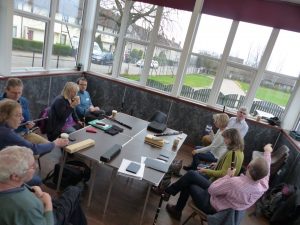
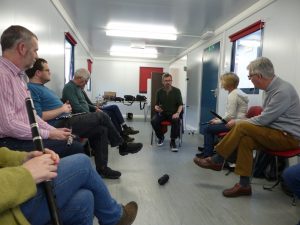
A few of us braved the icy conditions last Saturday to continue the journey of learning tunes aided by a process of internalisation. The Tribe Porty White Hall is far warmer than a couple of years ago, with new heating and insulation in place. And Malcolm brought some mince pies along, which were equally welcome!

A few blind tunes were prepared and all of them had noteworthy names: Hunt the Squirrel and The Droketty March were from the playing of Cran, an Irish band with an active interest in Scottish repertoire that also have flutes, whistles and pipes at their instrumental heart.

These proved to be popular, but everyone was also taken by the performance of Mike Vass and Mairearad Green of Tha ‘m Buntata Mor. So instead of working on a new tune and then repertoire, we learned Hunt the Squirrel and Tha ‘m Buntata Mor. Sheet music and recordings of all three tunes are in the Resources section.
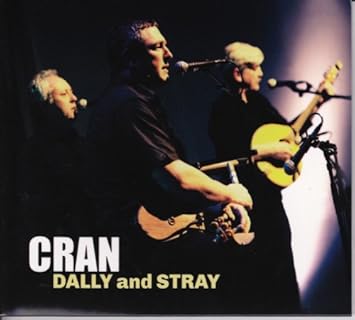
Hunt the Squirrel has a rich history. The Sleeve notes for Cran’s Dally and Stray CD seem to be no longer available online, but a search around sees it associated with Dumfriesshire and Ayrshire.

Tune Archive suggests it is played in England, Scotland, Ireland and USA and first published in Playford’s English Dancing Master, 1689. There it is listed as A New Scotch Jigg, as Scottish music was fashionable in London at that time. It appears in Oswald’s Caledonian Companion in 1760.

Another, possibly later, name for it is The Geud Man of Ballangigh, which seems to be the name of the dance that accompanies it. This fascinating account reveals that The Geud Man was none other than James V in disguise going about his people in Stirling. Although whether that tale was collected by Scott or invented by him is open to question. The dance that accompanies Hunt the Squirrel can be found on YouTube.

Other references associate it with Ayrshire, Dumfriesshire and Kelso, which gives it a good Lowland spread.

Cran play Hunt the Squirrel in quite a stately and unhurried way, which leads nicely into the busier 3-part Drocketty March. The D and G notes sit strongly on flutes and whistles and are helpful for getting the ear into focus.

Tha ‘m Buntata Mor translates as The Potato is Large and appears to be a 9/8 port a beul, as sung by Julie Fowlis here:

Aside: Note that the port Julie Fowlis sings is more like what the Irish call a hop jig, characterised by an underlying long-short note pattern throughout. By comparison, Muireann Nic Amhlaoibh‘s following song An Bairille has a more standard slip jig sound featuring quavers grouped in three. Incidentally, if that second sounds familiar, it’s a version of The Rocky Road to Dublin. This set is one they recorded on dual, available as a download here. With fine singing, flutes and whistles and Éamon Doorley and Ross Martin accompanying, it’s one to look out for.

However the arrangement by Mike Vass and Mairearad Green, simply entitled Buntàta, is in the old 3/2 hornpipe time, illustrating the connection between 3/2 and 9/8 tunes. Indeed, their arrangement, as recorded on A Day a Month may have been influenced by that relationship.

In G and Em, the tune sticks closely to an arpeggiated melodic structure, so the rhythm becomes even more important. The close repetition of phrases and unusual time signature lends it a hypnotic and beguiling air that draws the listener in. As in some other 3/2 tunes such as Pawky Adam Glen, the underlying rhythm is a constant:

1-and-2-and-3-and | 1-and-2-and-3-and |

1-and-2-and-3-and | 1-and-2-and-3-and ||

The beat tends to fall most heavily on the 1 and 3, so requires a pulsing breath. 3/2 tunes tend to be punchy but this one can also take a moderate pace, so feel free to take it easy while learning it as you won’t lose its inherent identity.

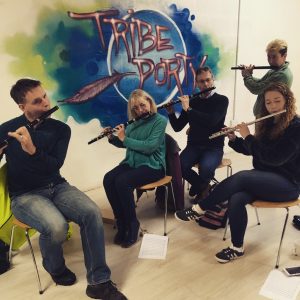
At the workshop we had the three low whistles and two flutes getting into quite a groove with countless repeats and nuances merging that was pleasing to be part of. I wish I had recorded it at the time, but it inspired me to play for a bit longer than usual in my own reference recording of it.

This tune would go well in a set ahead of Pawky Adam Glen. Both are in 3/2 and the shift from G/Em to Bm/D is a striking one. Alternatively, going into a tune in 9/8 would also be effective.

The Droketty March is from Drogheda in County Louth. While we didn’t manage to cover this tune, I have also included it in the Resources.

Upcoming worshops

Edinburgh FluteFling workshops resume 26 January 2019. The FluteFling Scottish Flute Weekend for flutes and whistles will take place in Edinburgh 26-28 April. Sign up to the FluteFling Newsletter to hear news about events and tickets directly.
Aberdeen weekend report

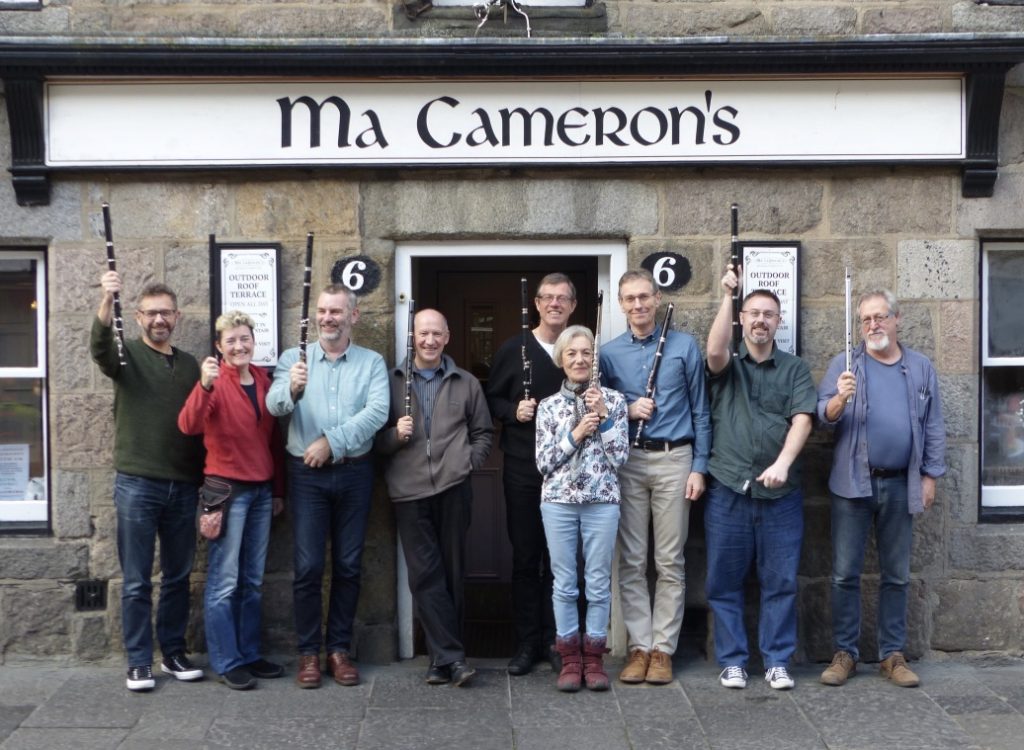
The farewell session at Ma Cameron’s. (c) John Crawford

Well, what a weekend we had in Aberdeen in November! This was the second annual event in the Granite City and was again based upon a day of flute and whistle workshops. This year we had three tutors — Dougie Pincock, Sharon Creasey and Gordon Turnbull — with a very strong turn-out to the classes and sessions and lots of positive feedback.

Sharon Creasey and Kenny Hadden on whistles. (c) John Crawford

Thanks to everyone who attended and to Kenny Hadden and the supporters for helping it run so well on the ground. A big thank you too to Inchgarth Community Centre for looking after us and to the Blue Lamp and Ma Cameron’s for their hospitality with the sessions.

Dougie’s workshop (c) John Crawford

One pleasing comment that stood out referred to the unified thread of musicality running through the workshops, of going beyond the notes and into phrasing and rhythm. While this wasn’t consciously planned, all of the tutors and those involved in organising FluteFling events do have a clear idea of what good traditional flute and whistle playing sounds like and there are many ways to achieve this.

Gordon’s workshop (c) John Crawford

By having different tutors with different approaches and experiences, we do hope that this opens up possibilities for others. And let’s face it, we are all learning and continue to learn from each other — tutors included — which is why these events are always a joy and an inspiration to everyone involved.

Tunes taught on the day included repertoire from Aberdeen, highland pipe tunes and others with technical challenges, and port-a-beul.

Sharon Creasey and Kenny Hadden listen to Dougie Pincock talk about his experiences and thoughts on playing the flute and whistle. (c) John Crawford

The Saturday afternoon ended with Dougie Pincock in conversation with Kenny Hadden. Dougie is full of entertaining anecdotes about his early experiences learning the pipes, entering the Glasgow folk and session scene and learning to play the flute. It was an hour but it flew by and we could have all listened to many more.

The weekend sessions featured strathspeys, marches, slow airs, jigs, reels, Border hornpipes and tunes old and new. One particularly memorable moment was Sharon and Dougie duetting on piccolos, which is not something you see every day!

Upcoming in 2019

Participants and tutors continue to have ideas to develop our weekends together and we will try an implement them as and when we can. The Aberdeen weekend will return in November 2019.

The next weekend will be in Edinburgh April 26-28th. Dates and details for other events will appear on the website very shortly, so look out for those.

Edinburgh September workshop: Sir John Fenwick’s

Flutes at the September workshop. (c) Gordon Turnbull

September saw the return of the Edinburgh FluteFling workshops to Tribe Porty, while Glasgow also saw the first of Sharon Creasey’s monthly workshops.

The main focus for Edinburgh’s workshop was on developing our skills in learning by ear, exploring ways to listen and understanding the music.

We looked at a traditional Northumbrian tune in 3/4 time, Sir John Fenwick’s Floo’r Amang Them A’. This delightful, almost stately, tune was new to most of the group and it may be less commonly known than I thought, but it proved to work very well for us.

Sir John Fenwick’s, as it is usually known, has an interesting history (link to history of the tune here and here and also here for background on Sir John Fenwick himself) and may indeed be from 17th Century. It also became known as The Flower of Yarrow and Mary Scott, appearing in early 18thC Scottish collections. Resources (recording, PDF and ABC format) for this can be found in the Resources section.

We began by listening to the tune a few times in order to familiarise ourselves with it. Some time spent singing and moving to the music then helped to deeper internalise the tune before we began to see how this might even fit on the flute.

The process, which was opened up to me by Conal O Gráda when he taught a workshop at Cruinniú na bhFliúit in Ballyvourney earlier this year, follows the natural process of acquiring a tune and it should be straightforward to incorporate into learning from home.

I learned this tune from Newcastle guitarist Sean Paul Newman, basically on stage while performing with Absolutely Legless. His setting is in D and is a little more complex than the older versions in G or D that can be found. However, I have only heard others play this version, so it seems to be popular.

In the workshop we learned the tune from a rehearsal recording from a promising but short lived group in Portobello I was part of. Called Transverse, the trio consisted of Pamela Carr (flute, whistles, concertina), Ann Ward (flute, whistles, concertina) and myself (flutes, whistles) and played just a couple of local performances.

The recording was of a set and the tune that followed was a Breton waltz, which we also had a look at. I learned that waltz from a recording of the band Shegui and Valse de Galorn can be found in previous teaching information herehere and here).

The next Edinburgh workshop will be on Saturday 27 October. You can find out more, book tickets and also learn about the Glasgow workshops on the Workshops page. The 2nd FluteFling Aberdeen weekend will take place 16-18 November. More details and tickets can be found here.

Autumn workshop dates confirmed

FluteFling flutes and whistles in Glasgow, Edinburgh and Aberdeen

Traditional flute workshop with Sharon Creasey at FluteFling Edinburgh Weekend 2018 (c) Gordon Turnbull

If you’ve signed up to the newsletter, you will probably know that the dates and tickets for workshops in Glasgow with Sharon Creasey and in Edinburgh with Gordon Turnbull are up and running.

Be sure to book in advance as spaces are limited and the September events are just a week and two weeks away respectively.

If you’re coming to the Edinburgh events, remember you can get a discount by booking all three in advance.

The 2nd FluteFling Aberdeen Weekend will now take place 16-18 November, with three tutors, including a special guest now confirmed, plus an expanded format that includes whistles. The event last year was very well attended and those on the mailing list will get the details and ticketing opportunity first. There is now a dedicated page for the event, so be sure to check back there for updates.

Whichever events you are interested in, we hope you can make it and look forward to seeing you.

Inside the Fairy Hill: Tomnahurich

Inverness from Charleston North Kessock Black Isle Ross & Cromarty Scotland

This month we looked at ways to learn a tune by ear and focused on Tomnahurich, an evocative slow air by Pipe Major Donald Macleod that was recorded by Calum Stewart and Lauren MacColl on Wooden Flute and Fiddle.

The tune appears in Volume 3 of Pipe Major Donald MacLeod’s Collection and translates as The Hill of the Yew Trees or the Hill of the Fairies. It refers to the distinctive hill by Inverness that was until recently a cemetery, but was traditionally where the Fairy Folk lived. The Fiddlers of Inverness is a tale told about it (see here and here for more).

Update 12 October 2018: flute player Catriona Patience has spotted a resemblance to the song Tha an Crodh-laoigh air Aodann Chorra-bheinn, as archived in this recording at the fabulous  Tobar an Dualchais/ Kist o Riches Scottish oral traditions website.

Learning by ear v sheet music

The tune is deceptively simple, but offers a great way into learning by ear, which is the way most traditional musicians teach and learn. One thing that has become clear to me is that many people find it difficult to play by ear because, while traditional music relies upon this skill, it isn’t emphasised in formal music education. Indeed, many traditional musicians in Scotland rely on sheet music —in ceilidh bands it is not uncommon for example.

Of course, musicians interested in discovering traditional music that have originally learned their instrument in another tradition, for example Classical, have developed skills in sight reading at the expense of trusting and understanding their ears.

This difference struck earlier this year me when I attended the fantastic Cruinniú na bhFliúit (Flutemeet) for the first time. It takes place in County Cork just after Easter and is an inspiration behind the FluteFling Scottish flute and whistle weekends. If you haven’t been, you should go at least once. All the teaching though is by ear and no sheet music is available. You can record the tunes and ABC notation is used, but these are really for use afterwards. It’s the way they do it there and generations of Irish musicians can testify to the way it works.

Flute players in Scotland have different needs as playing by ear is new to many and needs to be supported. So I usually offer sheet music as a back-up option, again for later reference. Recently we had some success in Aberdeen and Edinburgh in sending out some sheet music in advance, but there is a risk that it becomes a distraction and it’s good to get the balance right.

If the aim is to play by ear, at what point do you refer to the sheet music? Sheet music is a representation of music itself. The more information that is represented, the more complex it becomes. However, just as speaking a language comes before reading and writing, so it is with music. Accent, dynamics, emphasis, breathing, articulation/ decoration and expression are immediately accessible through music but a piece of sheet music needs to be interpreted. I’m not against sheet music at all, but for teaching, learning and playing traditional music as well as we can, we need to step away from the paper and develop our ears.

So, to a small class on a sunny May afternoon, I thought I would try an approach used by Conal Ó Gráda at Cruinniú na bhFliúit to teach the Connemara Hornpipe from a recording. As this was intended to build confidence in learning by ear, the recording I chose was Tomnahurich, a much slower tune.

The process is is a simple idea based on very natural processes:

  • Listen to the recording a few times
  • Begin to move, tap feet etc to the tune
  • Lilt the tune, singing along. Before even picking up the flute, this internalises:
    • Rhythm
    • Melody
    • Breathing
    • Phrasing
    • Dynamics
    • “Memory hooks”, for want of a better expression: basically, a social and sensory association of place, time and people that helps anchor the tune when learning it and when recalling it. When I play this tune now, I will have associations not just of the title (and those associations) but also of the original recording, where I heard it, where I learned it and who with, what the day was like, the bright sunlight coming though the white room skylight on a rare warm May afternoon on a long weekend. When thinking of how to play this tune in future, these associations will be there and may help to jog my memory and even inform my performance.

So, preparing ourselves with the tune through familiarisation before even picking up the instrument laid a foundation for our learning. By the time we came to play, we were already inside the tune in a sense. What we were trying to do is match our fingers to our ears and the existing sense of the tune, joining up the processes.

We paused along the way to reflect on how the melody fits into the bagpipe scale and range of A Mixolydian (underlying chord shape here of A-E, no C or C#) and shifts to G shapes (underlying chord shape of G-B-D). Other considerations were, what phrases repeat, where and how do changes occur?

When training the ear in this way, songs are a natural reservoir to turn to – the melody remains mostly constant, but phrasing and dynamics can shift to emphasise meaning. Be aware that many songs can be in other keys, which is where Bb, C and Eb whistles become handy. Learn the fingering on the whistles and then transfer this to the D whistle or flute. This transposes the tune to a friendlier key and you don’t have to think about theory to do so.

Tomnahurich Resources

I have recorded Tomnahurich and the notation is up on the Resources page.

Create time and space for your music

I’m still digesting my time at Cruinniú na bhFliúit with lots of great new tunes and ideas. However at the workshop I also shared some of Paul McGrattan‘s advice on practising an instrument, creating time and space, setting achievable goals, focus, structure, exercises and routines. Lots to think about.

Session etiquette

June will see an end of term session at The Dalriada Bar, basically a slow session for flute and whistle, based upon, but not limited to, the repertoire covered by FluteFling. It will be suitable for beginners and more experienced players alike. Bringing sheet music along is fine, your friends too of course. It’s free, but if you sign up, I can get an idea of numbers.

As it happens, we ended the afternoon with various discussions, including confidence and session etiquette. That’s a whole topic in itself. Nigel Gatherer has some good advice:

In general, the watchwords are courtesy, consideration, sensitivity and patience.

There are other lengthy accounts on the web, but two types of session cropped up. One is organic, much more like a musical conversation and perhaps akin to traditional house ceilidhs or kitchen sessions. This is what I am most used to and understand. Working out what is happening can be tricky to newcomers, but the rules of normal social interaction will stand you in good stead (see those watchwords above). There are quite probably session leaders or a core of regulars and friends, their own core repertoire, stops for conversation and so on.

It isn’t a performance, it’s a social and cultural gathering. Just as in life, some are friendlier and more welcoming than others and you need to be read the situation and signs.

The other type of session is more structured and maybe even quite formal. Here there will a recognised leader and organiser and there will be turn-taking to ensure a sense of fairness when it comes to starting tunes or songs. Beyond this, my experience fails me. I can only add that these seem to lie somewhere between a session as described above and a folk club. In addition, I might add that possibly may tend to be in settings that call on a small pool of musicians and that this structured approach might be seen to be supportive of those musicians.

The Dalriada session in June will definitely be sociable and also supportive!