FluteFling Online with Tom Oakes

FluteFling Online with Tom Oakes 22-24 April 2021

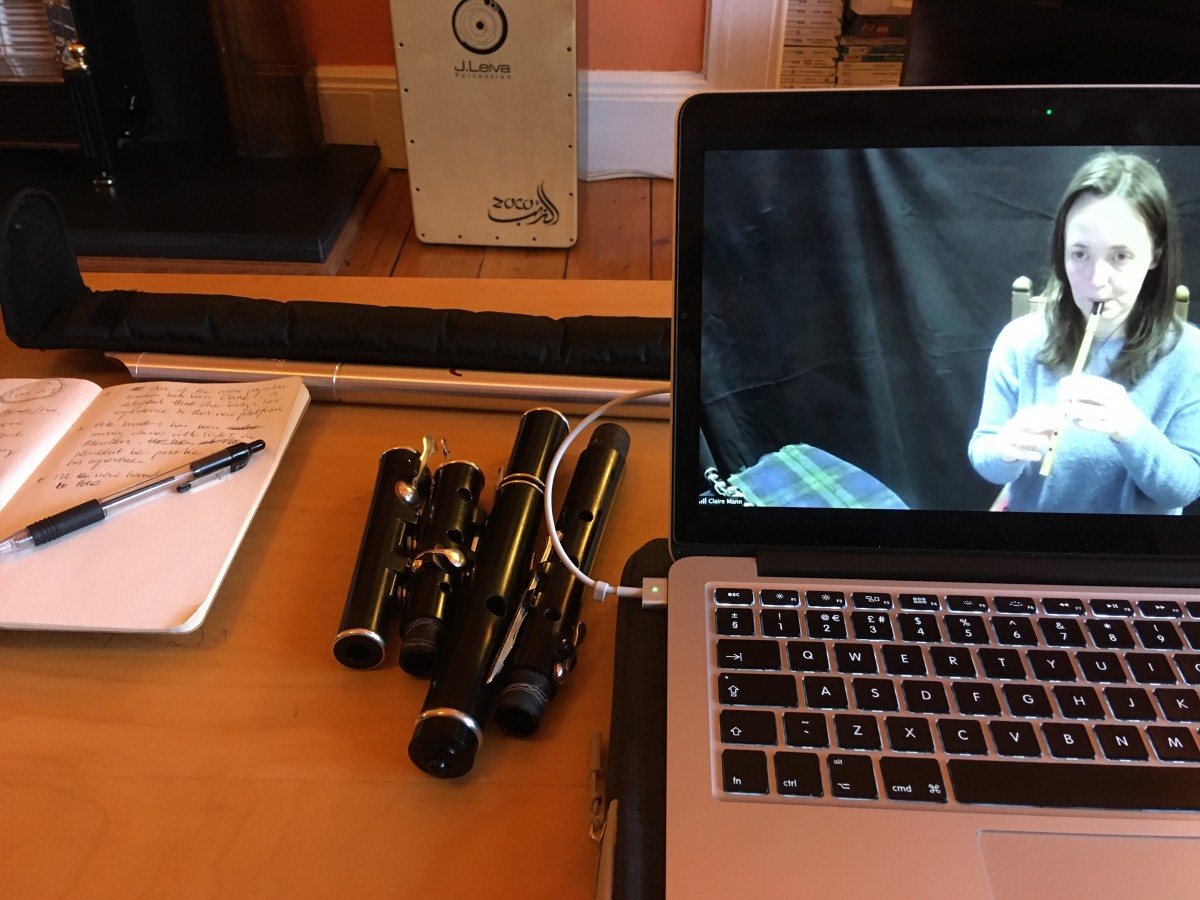
A laptop with the screen showing Tom Oakes playing the flute

In April 2021 the second FluteFling Online event took place, with a weekend curated by Tom Oakes featuring an online concert, workshops and a masterclass. Finally, I have managed to complete writing it up.

Following the success of the first FluteFling online workshops with Clare Mann in December 2020, the team were keen to try to mark the Edinburgh weekend that was cancelled at the beginning of the pandemic in April 2020. Tom Oakes had been due to perform that weekend, so it was natural to approach him. 

After exploring a few options together the outcome was a core series of four workshops over two days, with an additional multi-location concert on the Friday night. The weekend finished with a masterclass from Tom on using the keys on keyed flutes for traditional music, an aspect of the music performance which is often overlooked. Delivered via Zoom, the main workshops were recorded to allow access across different time zones, a popular decision that we carried over from our previous event. 

Despite the beginning of the easing of some lockdown restrictions, cumulative screen fatigue, better weather and improving daylight hours, numbers were very healthy. 35 people attended the evening concert, 38 attended the workshops and 21 attended the masterclass. This still compared favourably with previous in-person events and has encouraged FluteFling organisers to consider including online access in the future, regardless of circumstances.


Friday night concert

The Friday concert was informal and international, featuring Tom Oakes (Edinburgh) who had invited Aoife Granville (County Kerry, Ireland), Philippe Barnes (London) and Kirsi Olja (Finland) on a variety of flutes, whistles and recorders. The musicians played solo from their homes but there was engaging crossover chat and conversation about music, instruments and traditions, ending in questions from the global online audience. 

Technology didn’t let us down and the audience at home enjoyed a journey with flutes across Europe. Aoife Granville’s music from Kerry included punchy and spirited traditional fife tunes that resonated with Scottish traditions. Her performance also referenced her project that celebrates the pioneering contributions of women to Irish traditional flute music. You can watch a video on that topic on YouTube. 

The Boehm system flute is becoming better understood in traditional music and Philippe Barnes showcased a fine range of driving tunes and slower pieces with tone and colour more associated with wooden flutes. He also played a simple system wooden flute and introduced us to a richly sonorous Boehm alto. Philippe is a multi-instrumentalist who also plays the uillean pipes, his fingered articulation carries over from them effortlessly. A personal highlight was a slow air that I failed to make a note of, so I’ll have to try and catch him again.

The music of Finland is not necessarily well-known in Scotland and Kirsi Olja introduced us to traditional airs and dance music on recorders and end-blown flutes that invite us all to learn more. However, her improvisational singing while playing primitive fipple flutes with bark intact was as elemental and arresting as it was unexpected.


Weekend workshops and masterclass

The workshop formats of Saturday and Sunday morning and afternoon sessions worked to allow everyone screen breaks and keep things fresh. From his studio in a 17th Century building in Leith, the old port for Edinburgh, Tom took us through a wide range of tunes for all tastes. These included The Keilder Schottische and Matt Seattle’s The Four Winds — Borders tunes from his time living in Newcastle, while the pipes jig The Snuff Wife and Hamish the Carpenter from Cape Breton reflected more his time in Edinburgh and Glasgow sessions. The vibrant contemporary folk scene in Scotland often features more modern tunes that play on traditional themes and Tom also treated us to one of his own compositions.

As if that wasn’t enough, the weekend finished with a Masterclass from Tom. Initially focusing on the use of keys on keyed flutes in traditional music, he also covered tuning, embouchure and ergonomics, tone, flute design and the differences between historical flutes and contemporary models used in traditional music.

With so much covered, there was something for everyone to take away and explore. Thanks again to Tom for taking it on and keeping the energy levels going. Thanks too to Pete Saunders who manned the decks admirably and kept the technology running smoothly. Not to forget the FluteFling team who worked in the background and were on hand to assist when called upon.

It has taken me a while to get around to writing this up, but Tom has been working hard. He has a new album coming out as I write. By popular demand his solo flute outing, entitled Water Street, is available for pre-order. See his website for more details: https://www.tomoakesmusic.com

Update: Tom’s album has launched and can be ordered or downloaded from Bandcamp.

FluteFling online with Claire Mann

The first FluteFling Online event took place in December with a mini-series of workshops led by Claire Mann. The event marked what would have been a weekend event in Aberdeen and attracted a great turn-out, with participants from across the world.

When John Crawford approached me in September and asked what the plans were for the FluteFling Aberdeen Weekend, which usually takes place every November, I confess that my heart sank a little. It was a good question and needed addressing in some way, but it meant that we had to bite the bullet as so many have done and dive into the Online experience.

What did we know about putting on such things? Had we attended any? I personally had shied away from teaching online so didn’t really know what was involved. In addition, so much our working and personal lives are lived online during the pandemic, did we want to spend our spare time wrangling with setups, links and connections? And each of these questions seemed to have others lining up behind them. Wasn’t there online fatigue? Or was that just me?

John has been involved in the FluteFling weekends for many years and has been active in the Aberdeen event too and links up the Aberdeen flute community. He brought in fellow FluteFling supporter Pete Saunders, who has been running the SCaT flute and whistle classes in Aberdeen online this autumn and the technical experience and confidence that was needed. John had also attended a number of online workshops over the summer and had been taking plenty of notes of what worked well.

Over Zoom calls and emails with Sharon Creasey and Kenny Hadden, we realised that it was doable with manageable risks. We quickly identified Claire Mann as a tutor we wanted to involve and with her we were able to shape an event. We all wanted it to be a little different and supportive of those facing the common experience of not being able to meet and play music with others, having to dig deep for inspiration and motivation.

The result was a two-weekend event just towards Christmas. People were unlikely to be going anywhere during the pandemic and we felt that a week between the two workshop days gave people time to work on the material and learning, whatever their commitments. Providing the music and recordings from Claire a week in advance extended the learning focus and we extended it further by including a joint recording project for a video that will be completed soon.

The workshops were timed to be short and focused to avoid fatigue, which meant that they flew by an a lot was packed in as Claire took us through some choices from the online archive of the William Gunn Collection and Shetland reels. The Q&A session became highly technical as Claire responded to questions about rolls, cuts, strikes and alternatives with ease and clarity.

An unexpected development came from those looking to attend from USA and Canada. We had timed the workshops to be either side of lunchtime here in Scotland, but this was still 4 in the morning for some people, or even earlier. To attend at that time was a level of commitment that we hadn’t expected and we responded by recording the workshops and making them available to attendees for several weeks afterwards.

The implication for data protection was a concern and we had to seek consent. However, the way we ran the workshops helped enormously. Pete was a co-host and managed all of the running technical concerns — anchoring the workshops, muting participants and fielding questions through the chat facility. It meant that Claire could focus on the teaching, which was new to her in this setting too. The format was a success and was raised by a few as such in the feedback.

Claire Mann teaching online. Photo: (c) Gordon Turnbull

We were quite unprepared for the response, which was overwhelming. With over 70 participants, this was by far and away our biggest event and has caused us all to positively review future plans, including when we all get back together in person.

As participants began joining in the online session, people recognised each other and began chatting and creating a buzz. We have all seen each other on social media, but here we were again, with new faces coming in, some familiar names that are on our mailing lists but are never able attend. People spoke about the friendliness, as visitors from around the world logged in — from a chilly Niagara Falls to Spain, France and Germany. Meanwhile, Claire was in Newton Stewart, Pete was in Aberdeenshire and I was in Edinburgh. There was a definite community feel that spanned the globe.

The recordings enabled people to revisit the workshops and review the learning but also enabled those in California and Japan to be part of the event. Additionally, some people couldn’t attend all of the workshops or had to change plans at short notice, but didn’t miss out. In a non-online situation (IRL – in real life), these people couldn’t have attended or would have lost money or needed a refund.

Our eyes have been opened and while there is no substitute for an IRL experience, this has proved to be a decent substitute with a lot of potential. We are already in the process of organising our next event and what we continue to learn we will be taking into the regular workshops when they are able to resume. Can they be live-streamed or recorded? Or can they be sit alongside our regular events diary? Maybe, maybe.

In the meantime, look out for the video and also for news of our next event.


FluteFling Online December 2020 Roundup

FluteFling Online December 2020 Roundup

It was wonderful to see such a great turn-out for our first ever FluteFling Online event.

Claire Mann took us through some fine tunes over four workshops on two consecutive Saturdays and there is a group recording of everyone playing together to look forward to as well.

Claire herself was in Newton Stewart in Dumfries and Galloway, Pete Saunders did a great job controlling the technology from Aberdeenshire, while Sharon Creasey in Dumbarton, John Crawford in Aberdeen and myself in Edinburgh were also on hand to support. We had much of the country covered and then people attended live from Canada (a 5.30 am start!), USA, Germany, Sweden, France, Ireland, England, the Netherlands, Spain — apologies if I have missed anywhere — and more people accessing it through recordings afterwards, including one person from Japan.

We are already thinking of when we will do our next one, so make sure you are signed up to the newsletter to hear about it first.

Event Resources

The Event Resources archive, including recordings of the workshops themselves, will remain accessible to all ticket holders until 9 January, which is also the date for submitting videos for the group video. Once this is edited it will become available in January.

Most questions were answered either in the workshop or by chat in the messages, which have also been archived in the Event Resources.

Someone new to Scottish traditional music asked for some useful tune collections. It’s something we should maybe address more fully, but here are a few, plus some others:


FluteFling Online December 2020

Claire Mann to deliver FluteFling Online 12 & 19 December

FluteFling’s first venture into online events takes place in just a week’s time when Claire Mann will deliver four 45 minute workshops on Zoom over two consecutive Saturdays. The response has been terrific but luckily we are not limited by space and places are still available.

Tailored to flute, whistle and low whistle, Claire has helped to shape the workshop mini series to provide a way for people to focus on their music and instrument over three weekends and more. Uploads of Claire’s teaching material — both PDF sheet music and recording — go up this weekend, followed by the workshops themselves, which will be recorded. With time to go over the tunes, work on the ideas and techniques AND revisit the workshops, this is a close but realistic alternative to an immersive weekend away.

Although there won’t be any sessions, there is the additional option of recording some of the material covered by Claire for a group video, to be submitted for compilation by the end of December. That’s almost a month of digging deep into the music after the extended fallow period we all currently have had to endure. The video will be completed and made available later in January, giving us all something to look forward to in 2021.

It promises to be a memorable experience and much needed by many of us traditional musicians. How can you be sure? Well, all of the organisers have all bought tickets — Sharon Creasey, John Crawford, Pete Saunders and Gordon Turnbull.

You can get your ticket on the event page too. We look forward to seeing you there.


Flutes face potential problems post Covid-19

One of the questions that has cropped up in Covid-19 conversations amongst flute players and their friends is — how safe are we? As we begin to learn more about this aerosol-borne virus, singers and wind instrument players — flutes, whistles and bagpipes included — are being seen in a new light. Could a wind musician potentially spread the virus more widely than other musicians?

We don’t yet know the answer, but for flutes and whistles, splitting the airway through the far edge of the embouchure or the fipple is how the sound is generated. Air also escapes at the tone holes and at the end of the instrument. How fast is the air and how far is the air projected? Studies are ongoing but this is what is understood at present.

There is still much to be understood and my gut feeling is that the majority of the concerns at the moment relate to the flute and not necessarily the whistle. One speculated thought on the Facebook group is that blowing across the embouchure with force and direction may be an issue. If so, there may be a solution that has the added benefit of being a wind shield AND tone reflector. It’s the Win-D-Fender developed in the USA and carried in a few places in Europe and across the world.

Personally, I hope some additional thought goes into the name and the colour options as it seems functional and clinical (although in a world of PPE and face masks, maybe that is less of an issue). So here are a couple of videos endorsing the product (caveat: I’ve no idea if this works on wooden flutes).

Relating this to sessions, if this is helpful, then the airflow coming from out of the flute may then be the big issue. Sessions are often sight spaces and flutes tend to need more room than others. In a session with increased distancing, that may be a bigger issue. On the other hand, whistles are more self-contained and that may be an advantage.

Finally, on a more upbeat note, my own Lockdown tunes project on YouTube continues. Mostly Scottish repertoire, but not entirely. I hope you enjoy them.