The Tarbolton: A Scottish reel in Ireland

Tarbolton in Ayrshire has strong associations with Robert Burns, so it is sometimes a surprise to discover a very popular Irish reel that bears its name. The Tarbolton — sometimes called The Tarbolton Reel — was popularised by County Sligo fiddle master Michael Coleman in a set that is often played today.

The tune is originally Scottish, entitled Tarbolton Lodge in some collections but doesn’t seem to be as well known in Scotland, or not in my experience. It is in the Athole Collection and Skye Collection (both 19th Century), for example. Some background information on publications can be found on the Fiddler’s Companion.

Some information on recordings of this tune can be found on the Folk Music Index and at irishtuneinfo. From a flute player’s perspective it is definitely worth checking out Matt Molloy’s version on his first solo album, although this is on an Eb flute.

I have recorded the version that we learned in the class and the notation that was handed out in the lesson will go online there very soon.

Michael Coleman’s 1934 version is below. We will also be learning the other tunes in this set. Comhaltas have other versions of the set as well.

Photo of The Bachelor’s Club, Tarbolton, by Rosser1954, Wikipedia Commons.


February Break News

Sandy Bell's music session

A couple of quick news points at the end of this February Break.

Firstly, check out the recent  Fragments Project post to learn more about our composition project inspired by a piece of Medieval music from Hawick.

Secondly, top Scottish flute player Calum Stewart is playing at Smailholm Village Hall on Friday 21st March. If you can go, you won’t forget it as his music is extraordinary. A good excuse for a FluteFling trip!

Next, things are in motion for a FluteFling Scottish Flute Day on Saturday 10th May as part of Tradfest Edinburgh. Tutors Kenny Hadden (Aberdeen) and Sharon Creasey (Glasgow) will be teaching, as well as myself. There will be a new page with updates and information on this site very soon.

Finally, be sure to check the Diary page as classes skip a week due to the February break.

Photo: Sandy Bell’s music session (c) Gordon Turnbull. Flute player is David Begg, Pete McClements plays fiddle, Robert Chalmers concertina.

More Mouth Music: S’iomadh Rud A Chunnaic Mi

S’iomadh Rud A Chunnaic Mi (Many’s the Thing I Saw) is the latest Slow and Steady tune and is a piece of port a beul (mouth music) that is also a reel. The largely straightforward construction of this tune makes it suitable for getting to grips with the rhythm of the reel.
I was reminded of this tune through two routes, one through the recent Youtube video of Irish fiddler Kevin Burke and guitarist Mícheál Ó Domhnaill, who sang the port. I believe they recorded this on Portland and the Breton Gavotte that we recently covered also appeared on that album. I also found this tune in Davy Garrett’s gem of a book, An Fhideag Airgid (A Whistle Tutor for Highland Music) as I was looking at a version of A’ Cur nan Gobhar às a’ Chreig, itself a version of the Shetland reel Oot Be Est da Vong, that the Improvers class covered last week.

There’s a discussion of the tune over on The Session, where Nigel Gatherer describes the tune as a version of Cenneag Mhor, which he has music up for on his highly recommended web site. You can also find a translation of the lyrics in that discussion.

The class resources for this tune are in place. The Burke/ Ó Domhnaill version is below. I mistakenly used this to illustrate the Gavotte recently, but I have now corrected that. A version of it can also be found on The Tannahill Weaver’s Cullen Bay recording.

Oot be est da Vong: a Shetland reel

The Improvers and Beyond group are putting together a set of Shetland reels and Oot be Est da Vong is the second, which we decided that this one goes nicely after Sleep Soond I’da Mornin’. Next time we’ll add a third.

I learned this tune many years ago, probably from English and Scottish Tunes by Anthony “Sully” Sullivan, a banjo player from the NW of England I believe, with several publications and compositions to his name. Before the internet, his tune books were essential and even now the versions of traditional tunes are far better than many that pop up on web sites. His own tunes have become popularised by people like Michael McGoldrick in recent years.

However, I imagine that the original source for the tune is probably Ringing Strings by Tom Anderson, the Shetland fiddler who taught, amongst many others, Aly Bain. It reminds me as well of a piece of Gaelic port that I have identified as A’ Cur nan Gobhar às a’ Chreig and there’s a clip of Capercaillie performing a version of it on BBC Alba. It’s also the first tune in this clip of a session from the Summer Isles Festival:

The tune title refers to a the location of a fishing ground, da Vong being a rock I believe and sits quite nicely on flute and whistle. We had a look at some places to play cuts, rolls and casadhs (as defined by Geraline Cotter) within the tune. FluteFling class resources for the tune can be found on the usual page. There’s some discussion on The Session about the tune and this link to Aly Bain playing it:

In the class I mentioned Millie Godger, a Shetland tune with no set time signature that may have been a “mill tune” and imitated the rhythms of the mill. I couldn’t get to grips with it from the written music, but here’s a lovely version by Morag Brown in a set of Shetland tunes:

Photo: More Shetland Magic Light by Pete and Lynne, some rights reserved.

Music from the Western Isles and beyond

At last week’s class we discussed some aspects of Gaelic Mouth Music, psalm singing and Cape Breton fiddling in relation to some of the tunes we have been learning. This quick follow-up post is to share some related links.

Gaelic psalm singing

  • For some background on this unique singing style, there is an introduction at the Education Scotland website:

    Each line of the psalm is ‘put out’ by the precentor or leader. The congregation then joins in gradually and slowly sings those words, but with varying degrees of ornamentation and at varying speeds. Although each singer is singing the same tune, the effect is of a continuous sound with different chordal effects being created. This is known as heterophony.

    Although the music sounds very complicated, the roots of the melodies being sung lie in straightforward Scottish metrical psalm tunes.

  • Gaelic psalms at Back Free Church, Isle Of Lewis- 20/21/oct/2003:
  • The clip is from the church in this recording, Salm vol 2 which the text in the link describes as:

    the congregation singing unrehearsed, unaccompanied Psalms with various precentors.

    This is traditional Gaelic psalm singing in the style of free heterophony – precentor-led singing with the congregation following through. Various precentors lead a large congregation in the most popular psalms.

  • The many field recordings at Tobar an Dualchais/ Kist o Riches website includes this anonymous recording of Salm 133.

Mouth Music

  • We have looked at music associated with Mouth Music a little before. Here’s an example in strathspey time, similar to the Bidh Eoin and the Donegal Highlands we are looking at. Air Do Shlàinte Mhàiri an Dotair is sung by Annie Arnott and was recorded by the great archivist Hamish Henderson.

Cape Breton fiddle

    • We talked about the relationship between the fiddle styles of Cape Breton, the west of Scotland and the type of swing we are trying to put into our playing as flute players. I mentioned Winston “Scotty” Fitzgerald as someone to look out for and there are some related clips on Youtube, but it can also be seen in the opening strathspey by left-handed fiddler  Kimberly Fraser  in this set, accompanied by Mark Simos on guitar.

Highlands

  • Here’s a clip of Duncan Chisolm to compare, playing a strathspey followed by Scottish and Irish reels:

Donegal

  • And here are some links to Donegal. First some fine fiddling from Glencolmcille. The tunes are Casey’s Pig (The Duke of Gordon’s Birthday) and Miss McLeod of Raasay:
  • Here’s a Highland being danced:

Finally

  • Here’s a clip of flute player Calum Stewart astonishing performance of James Scott Skinner’s astonishing variations on Tullochgorum.

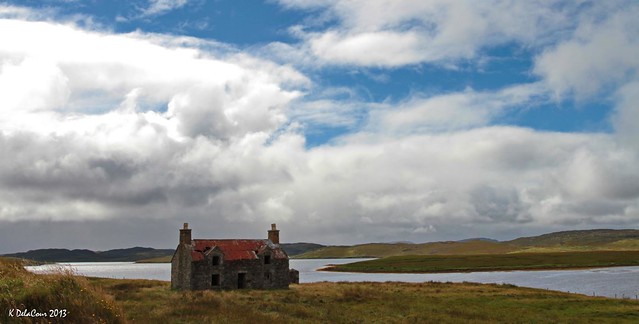
Photo from the Western Isles (CC) Kristian Dela Cour.