The rain may have returned, but it’s still the Summer and the Edinburgh Festival is about to kick off. However, it is a timely nudge for organising Autumn events and I am pleased to say that there will be a few FluteFling things happening. Dates and tickets are still being finalised, but here’s a quick look at what is coming up.
New monthly workshops in Partick
Sharon Creasey begins FluteFling West, a monthly trad flute and whistle workshops in Partick Burgh Hall Lesser Hall on Saturday afternoons 2-4pm. Sharon is still putting together ticketing details but her dates are:
15 September
20 October
10 November
This looks to be is the first workshop of its kind in the Glasgow area and is a great opportunity for anyone in the west looking to work on their music. Sharon’s dates won’t clash with the Edinburgh ones either, so it would be possible to maximise your flute and whistle time and attend both or pick and choose. As soon tickets etc are set up, we will let you know.
Monthly FluteFling workshops in Edinburgh from September
Gordon Turnbull’s monthly Saturday afternoon workshops resume in Portobello, Edinburgh on 22 September, remaining dates tbc at this stage but they will not be the same dates as Sharon’s. These will take place once more on Saturday afternoons 1-4pm at Tribe Porty. Dates so far:
22 September
October date tbc
November date tbc
December date tbc
Tickets to be arranged very soon, once the Aberdeen weekend is finalised. Talking of which…
FluteFling Aberdeen weekend 2018
Aberdeen FluteFling weekend will return for second year, with added whistles. Details to be confirmed at this stage but hopefully early November. Again, an announcement will be made as soon as we have things in place.
Watch out for updates on these events and also more going into 2019. If you haven’t already, sign up for the newsletter to hear the announcements directly. There’s a lot to look forward to. Until then, enjoy your music and the rest of the Summer.
First of all, a Big Thank You to everyone who was involved or attended the Edinburgh Weekend a couple of weeks ago. This was our biggest event yet and we were very close to being sold out.
Regulars Sharon Creasey and Kenny Hadden (basking in his new-found honour) provided our core continuity, with Niall Kenny as guest tutor and Claire Mann as guest speaker bringing in their own takes on the music and instruments. Feedback has been very positive and there was a real buzz about the place all day and into the evening.
A special thanks to the City of Edinburgh Methodist Church for hosting our event again – it really is a lovely venue with great acoustics. A big thumbs up to the Boda Bar on Leith Walk for hosting Friday night with such enthusiasm and to the Mercat Bar on West Maitland Street for sympathetically and efficiently sorting us out for Saturday. Very different venues to each other, but both highly recommended. Anyone looking to put something on should consider them as potential venues.
And of course Sandy Bells looked after us well on the Sunday lunchtime as always. One or two of us also made it to the Waverly Bar afterwards, where a great session was also to be had. A pantomime Booooo! however, to the session venue that let us down badly at very short notice (see the archive). I will try and do a more comprehensive round-up very soon, but I am now in the throes of report writing for school.
Summer workshops
After the April break, May and June workshops return this month. These will be the first since returning from Cruinniú na bhFliúit (Flutemeet) in Ballyvourney, County Cork and also since the FluteFling Edinburgh Weekend, of course, so I hope to share some ideas that I picked up over that period. NB Dates now corrected below – thanks to David Flett for pointing out the error.
Saturday 19 May 1-4 pm | Back at Tribe Porty, this will be suitable for everyone as I intend to focus on slowing things down, getting into the tunes further and helping with playing by ear. Tickets now on sale.
Saturday 16 June 1-4 pm | This will be a more sociable event and include a slow session that will utilise the FluteFling back catalogue. Venue and tickets tbc.
There will be a summer break over July and August, but there will definitely be further events from September, which will be announced just as soon as they become finalised.
More details of the weekend. For the lineup and background, see the event page.
URGENT UPDATE: change of session venues
Unfortunately, for reasons outwith our control we have had to change session venue for Friday and Saturday at very short notice and have had to make alternative arrangements. Other parts of the weekend are unaffected.
Both bars are on main bus routes and the Mercat is within walking distance of Haymarket Station and tram stops
Both web sites have maps and they should be straightforward to find, although they both have small shop fronts. Boda Bar is on a corner and Mercat Bar is near a corner. Parking is easier around Boda Bar, but it is possible to park not too far away from the Mercat.
The January workshop couldn’t have taken place without a nod to Robert Burns and it turned out that much of the music we covered had lyrics or associations with words.
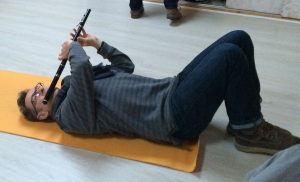
Gordon demonstrates how to engage the diaphragm while playing the flute. Photo (c) Oonagh O’Brien
We also tried out some different flutes and whistles and explored learning to use the diaphragm.
When playing while lying down, the diaphragm has to be engaged. The sensation is then recreated when resuming a vertical position in order to better support the breath.
Other technique covered included rolls, cuts and strikes and longer phrasing.
Leaving Lismore
We began with Leaving Lismore as a slower piece to warm up. A retreat march in D by Mrs. Martin Hardie (of which nothing seems to be known), there is a harmony for fiddle by Christine Martin from Breakish, Isle of Skye that I have adapted for flutes and whistle. There are some good opportunities for simple decoration and space to concentrate on tone and breath support.
Once we had the slow waltz feel down, we tried introducing the harmonies to good effect, with the whistles adding to the range of sound. While I have taught this tune before, it was new to the group and is one of a few pieces that might be suitable for working on as an ensemble.
Kye Comes Hame
A strathspey I have never heard others play but is undoubtedly related to When the Kye Comes Hame, a song written with James Hogg (“The Ettrick Shepherd”) and first published in 1822 in his novel The Three Perils of Man. There’s a good historical overview of the song at the National Library of Scotland web site which suggests that the tune may have already been well known.
I learned my version many years ago via Kerr’s Merrie Melodies and I think it was the lyricism of the tune that appealed to me at the time, although I was unaware of the song at that point. Being aware of the lyrics can often help with phrasing and is often recommended for slow airs that derive from songs. However, without the words, the opportunity opens to emphasise the rhythm and bounce of the tune.
In D, this tune goes well with Leaving Lismore.
Here are the Tannahill Weavers with their version of the song:
Green Grow the Rashes
Green Grow the Rashes O is a poem of 1787 by Robert Burns with a very long and detailed history. Some information here from the Scottish Country Dancing perspective and also some lyrics analysis from this website, which says there were three other pre-existing versions that Burns took as inspiration.
However the Traditional Tune Archive has more on the melody that can be traced back to 17th Century lute collections and became known in a different format as Grant’s Rant. As the Grants were traditionally in the Rothiemurcus area, this might suggest it is from the heart of strathspey country.
I had thought that the version we learned is based on one from Donegal, but listening back to my sources which have some of the Scotch snaps shaved off, I think that other influences may have overridden it. Our version is more like a Highland or west coast strathspey, in its bounce and punch and certainly not at all like Dougie McLean’s wistful version of the song, which shows how versatile a melody it is.
Our version is in G and sits on flutes and whistles nicely, with opportunities for typically Scottish short rolls on the G in particular. This tune goes well after Kye Comes Hame.
While looking through some teaching material that Rebecca Knorr gave to me a few years ago, I came across the west coast pipe reel/ port a beul Och Is Duine Truagh Mi (Alas I am a forlorn man). It’s a lovely tune that was recorded by the influential Ossian a good few years back, with Iain McDonald on pipes, flute and whistles.
Rebecca’s version is in G to sit on the whistle more readily, which is how we did it, but I also provided music and a recording of it in A, which is how it would normally be played. The version in G features long G rolls and follows nicely out of Green Grow the Rashes, keeping the key but changing the rhythm.
It’s a really useful skill to know a tune in more than one key, particularly if you know it well. It’s like seeing someone in different clothes in that it brings out different parts of the personality. However, it also builds up technical skills in terms of fingering and anticipation. Neither the A version nor the G version are particularly difficult on flute or whistle, but if you try it out you will have to think of different fingering and phrasing transitions which is useful.
Niall Kenny on The Session says he got this from Allan McDonald (Iain’s brother, who with Dr Angus McDonald make up the three piping brothers of Glenuig ) and that it may originally hail from Scalpay.
There are some lyrics to the reel and I have found a couple of intriguing versions, one with pipe variations. This first one has a slightly different title, but features whistles as well as pipes played by Seoanaidh MacIntyre with Ross B. Wilson on keyboards. There are two variations on each part, effectively making it a six part tune. The video includes the sheet music:
Dhomhnuill a Dhomhnuill is a piece of mouth music (port a beul) from the isle of Skye that I learned from Gaelic singer Michel Byrne. This was part of the repertoire for The Big Squeeze Ceilidh Band for many years when we both played in it together. We didn’t spend much time with it, but it would go well after Och Is Duine Truagh Mi in either key. I taught this reel a couple of years ago and at the time wrote about it here.
February workshop
The next workshop will take place on Saturday 24th February and will be taken by Sharon Creasey. It’s a rare chance to spend some time with Sharon, who plays Boehm system flute as well as whistle.
A danger of running an event on the third weekend of the month is that eventually you get to December and meet Christmas head-on. When that happens, it’s hard to know what to expect. So when Kenny Hadden said he would come down that weekend, I jumped at the chance to get him to also do some teaching alongside me and it became something bigger than usual.
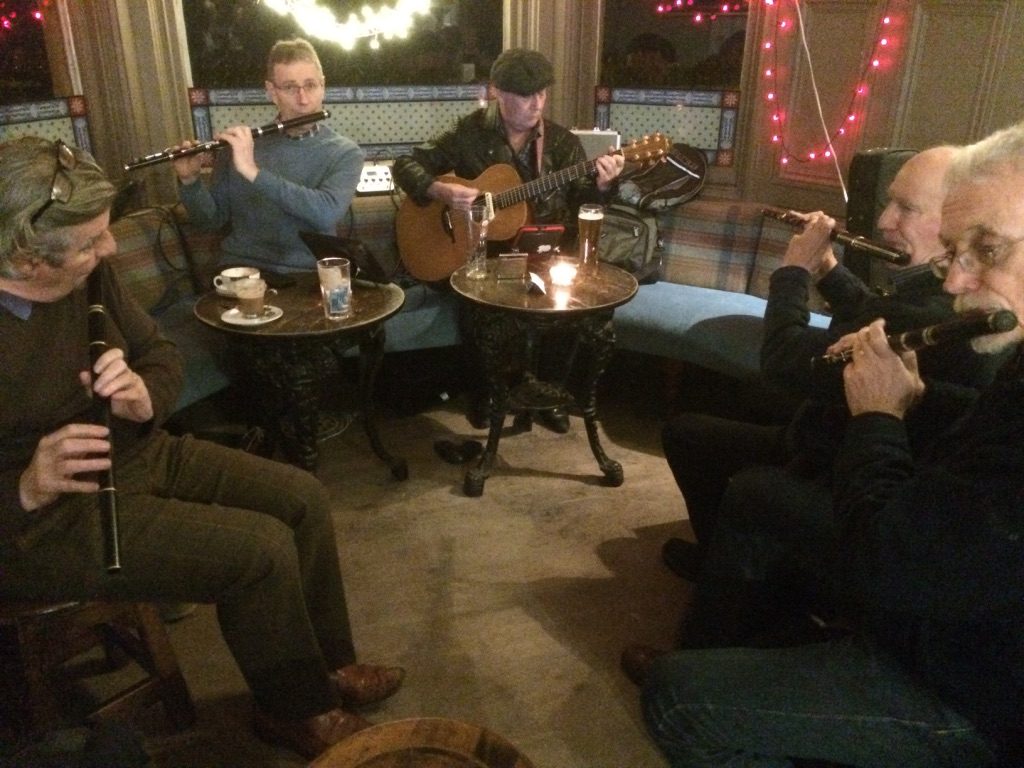
Flutes at The Dalriada: (l-r) John Corbett, Malcolm Reavell, Sean Paul Newman, Kenny Hadden, John Crawford. (c) Gordon Turnbull
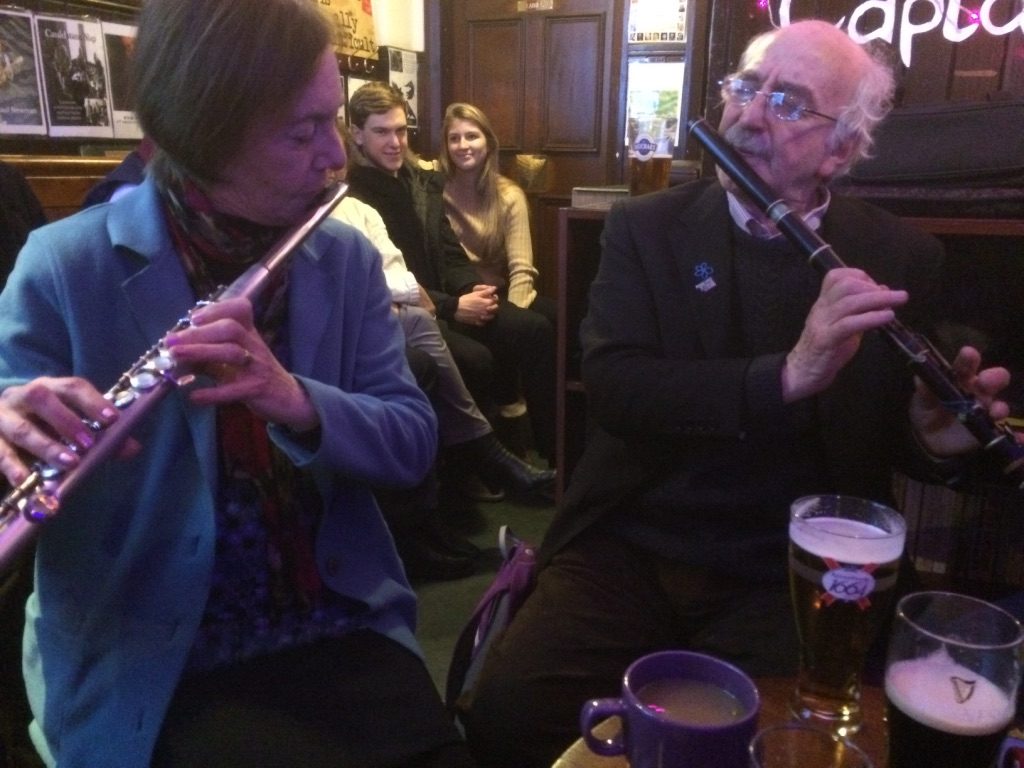
John Crawford and Malcolm Reavell were also there, also from Aberdeen, and we went for a flutey session afterwards at The Dalriada with Sean Paul Newman welcoming as usual and providing accompaniment. Later that evening Sharon Creasey came along with Cathal McConnell to play at The Captain’s Bar. All in all a bit of a mini flute festival.
Sharon Creasey and Cathal McConnell at The Captain’s Bar, Edinburgh
The workshop began with a slow tune to warm up: Caol Muile (The Sound of Mull), the air to a Gaelic song (Youtube link to a version sung at Plockton School). I have a version with some harmony parts and added another myself, so we had some fun trying them out. Grace notes and breathing came up as we added expression.
I followed this up with a reel that seems to be from Donegal and presented problems in pinning down a definitive version. We had one for the day and Kenny and I also had some variations. Scotch Mary can be found in various collections and with various titles. Irish Molly is one, Ireland Green is a title given by PJ Hayes and Martin Hayes too. Flute players John Skelton and Kieran O’Hare recorded it on whistles on their great CD Double Barrelled (link has a clip of the music).
The tune actually exists in three main versions, as two parts: A+B, B+C or three parts: A+B+C. To confuse things, the A and C parts are similar, there are different changes in other versions and key shifts too. The version I taught includes elements of these. Here’s a closely related Donegal version on Youtube played by Paddy, Seamus and Kevin Glackin. It’s the second tune in the set.
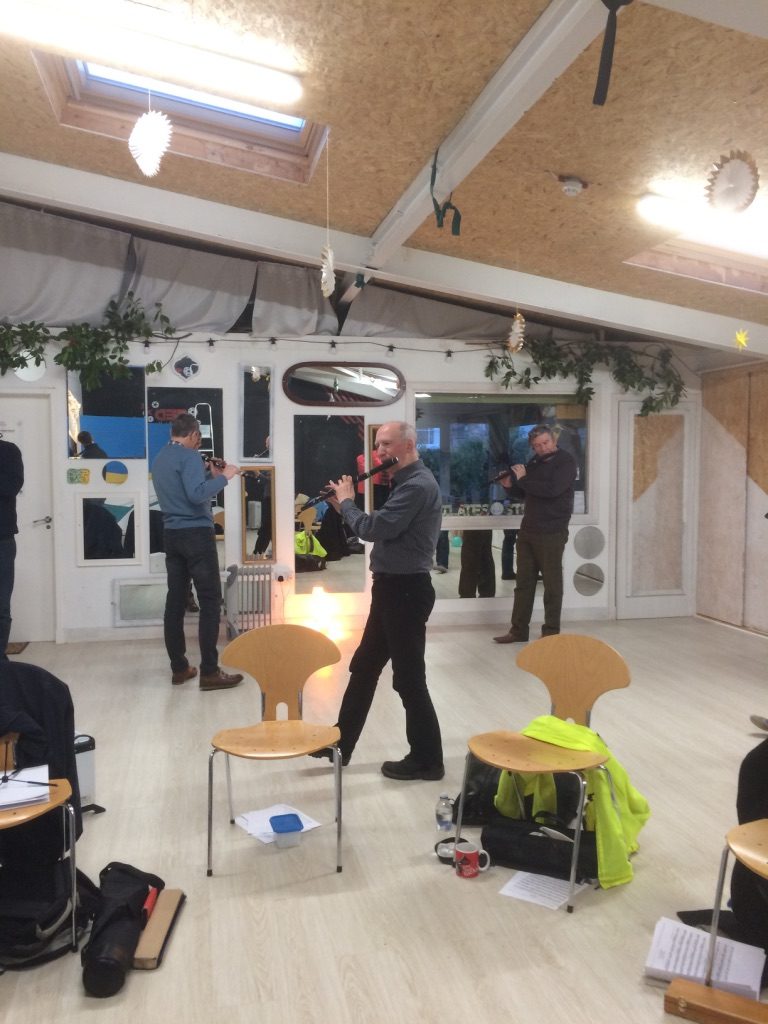
Kenny Hadden with others walking and feeling the rhythm while playing at the December FluteFling workshop.
Kenny took over after the break and kept the festive theme by teaching and sharing some tunes by Johnny Cunningham that were originally for a musical theatre performance on Peter Pan. Johnny and brother Phil studied at local Portobello High School so it was doubly apt for the location.
The first tune, Two is the Beginning of the End, not only had a strange title, but was in an enigmatic scale that served as a useful warm-up piece to get the ears tuned in. As it has actually been a good while since I found myself learning a tune by ear in a workshop, it was good to have the tables turned and be reminded of the experience.
The second tune Kenny introduced was more traditional, but recorded by Johnny Cunningham. The Celtic Society’s Quickstep (music and background can be round at the Traditional Tune Archive) is a dance tune first published in Kerr’s Merrie Melodies of the 1880s, but in existence since at least 1820. A delightful tune with some interesting jumps and straightforward runs that can be played with some bounce. It doesn’t seem to be played very much and could benefit from more exposure.
Resources for the tunes are to be found on the resources page for 2017. Two is the Beginning of the End doesn’t feature for copyright reasons, but those who attended will have something to work with. I will add The Celtic Society’s Quickstep very shortly.
Here’s Johnny’s version of The Celtic Society’s Quickstep, as recorded on Fair Warning:
Kenny has a YouTube channel with some rare archive video and TV footage, particularly of music from Scotland, that is worth exploring.
Finally, a wee plug for the Scottish Flute channel on YouTube, which has evolved out of the FluteFling workshops and sessions. Set up and run by volunteers and supporters in the Aberdeen area, there is some footage from the Aberdeen weekend in November and more can expected both from the archive and as more events occur.