Borve Castle: a highland pipes retreat

October’s FluteFling Edinburgh workshop continued to develop the skills of learning by ear, using the same approach as in May and September.

The tune we focused on was Borve Castle, a retreat march by Donald MacLeod that I first heard on The Cauld Wind recording by Chris Stout and Finlay MacDonald. It’s the opening tune in this set and there are other live versions by them on YouTube:

This recording is slightly faster than previous ones we have been learning from, which made it a little trickier. However, recognising an internal section within the tune that is repeated in both the A and B parts was helpful in unlocking the structure and building confidence.as we sang, moved and played our way to consolidating the tune.

There are two Borve Castles, one in Benbecula, the other in Sutherland, and it isn’t clear which of them the tune title refers to.

I have recorded a flute version of the tune and notated two settings — one with piping decoration from the PDF linked to below, the other with my own decoration from a flute/ whistle perspective. These can be found in the Resources section.

In trying to locate the sheet music for the tune, I came across some interesting sites. First of all, the Celtic Arts Foundation Winter School Music Book Vol V from 2017 has some very fine Highland pipes tunes in this PDF.

Over 7, 000 tunes can be found from the CeolSean website too, scanned from out of copyright tune books.

Donald Macleod’s tune collections can be bought in a number of places, including PipingPal.

Upcoming workshops

The next workshop will be part of the FluteFling Aberdeen Weekend, 17th November, where Dougie Pincock, Sharon Creasey and myself will be be teaching and there will be sessions and performances too. One not to be missed!

Sharon Creasey also has her next Glasgow workshop on 10th November in Partick. By all accounts this has been going very well.

The next Edinburgh workshop will be Saturday 15th December. Dates for 2019 will be announced before soon.


Edinburgh September workshop: Sir John Fenwick’s

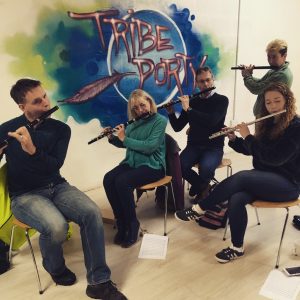
Flutes at the September workshop. (c) Gordon Turnbull

September saw the return of the Edinburgh FluteFling workshops to Tribe Porty, while Glasgow also saw the first of Sharon Creasey’s monthly workshops.

The main focus for Edinburgh’s workshop was on developing our skills in learning by ear, exploring ways to listen and understanding the music.

We looked at a traditional Northumbrian tune in 3/4 time, Sir John Fenwick’s Floo’r Amang Them A’. This delightful, almost stately, tune was new to most of the group and it may be less commonly known than I thought, but it proved to work very well for us.

Sir John Fenwick’s, as it is usually known, has an interesting history (link to history of the tune here and here and also here for background on Sir John Fenwick himself) and may indeed be from 17th Century. It also became known as The Flower of Yarrow and Mary Scott, appearing in early 18thC Scottish collections. Resources (recording, PDF and ABC format) for this can be found in the Resources section.

We began by listening to the tune a few times in order to familiarise ourselves with it. Some time spent singing and moving to the music then helped to deeper internalise the tune before we began to see how this might even fit on the flute.

The process, which was opened up to me by Conal O Gráda when he taught a workshop at Cruinniú na bhFliúit in Ballyvourney earlier this year, follows the natural process of acquiring a tune and it should be straightforward to incorporate into learning from home.

I learned this tune from Newcastle guitarist Sean Paul Newman, basically on stage while performing with Absolutely Legless. His setting is in D and is a little more complex than the older versions in G or D that can be found. However, I have only heard others play this version, so it seems to be popular.

In the workshop we learned the tune from a rehearsal recording from a promising but short lived group in Portobello I was part of. Called Transverse, the trio consisted of Pamela Carr (flute, whistles, concertina), Ann Ward (flute, whistles, concertina) and myself (flutes, whistles) and played just a couple of local performances.

The recording was of a set and the tune that followed was a Breton waltz, which we also had a look at. I learned that waltz from a recording of the band Shegui and Valse de Galorn can be found in previous teaching information herehere and here).

The next Edinburgh workshop will be on Saturday 27 October. You can find out more, book tickets and also learn about the Glasgow workshops on the Workshops page. The 2nd FluteFling Aberdeen weekend will take place 16-18 November. More details and tickets can be found here.

Autumn workshop dates confirmed

FluteFling flutes and whistles in Glasgow, Edinburgh and Aberdeen

Traditional flute workshop with Sharon Creasey at FluteFling Edinburgh Weekend 2018 (c) Gordon Turnbull

If you’ve signed up to the newsletter, you will probably know that the dates and tickets for workshops in Glasgow with Sharon Creasey and in Edinburgh with Gordon Turnbull are up and running.

Be sure to book in advance as spaces are limited and the September events are just a week and two weeks away respectively.

If you’re coming to the Edinburgh events, remember you can get a discount by booking all three in advance.

The 2nd FluteFling Aberdeen Weekend will now take place 16-18 November, with three tutors, including a special guest now confirmed, plus an expanded format that includes whistles. The event last year was very well attended and those on the mailing list will get the details and ticketing opportunity first. There is now a dedicated page for the event, so be sure to check back there for updates.

Whichever events you are interested in, we hope you can make it and look forward to seeing you.

Flutes and whistles in the Autumn

Autumn dates and plans for FluteFling to be announced

The rain may have returned, but it’s still the Summer and the Edinburgh Festival is about to kick off. However, it is a timely nudge for organising Autumn events and I am pleased to say that there will be a few FluteFling things happening. Dates and tickets are still being finalised, but here’s a quick look at what is coming up.

New monthly workshops in Partick

Sharon Creasey begins FluteFling West, a monthly trad flute and whistle workshops in Partick Burgh Hall Lesser Hall on Saturday afternoons 2-4pm. Sharon is still putting together ticketing details but her dates are:

  • 15 September
  • 20 October
  • 10 November

This looks to be is the first workshop of its kind in the Glasgow area and is a great opportunity for anyone in the west looking to work on their music. Sharon’s dates won’t clash with the Edinburgh ones either, so it would be possible to maximise your flute and whistle time and attend both or pick and choose. As soon tickets etc are set up, we will let you know.

Monthly FluteFling workshops in Edinburgh from September

Gordon Turnbull’s monthly Saturday afternoon workshops resume in Portobello, Edinburgh on 22 September, remaining dates tbc at this stage but they will not be the same dates as Sharon’s. These will take place once more on Saturday afternoons 1-4pm at Tribe Porty. Dates so far:

  • 22 September
  • October date tbc
  • November date tbc
  • December date tbc

Tickets to be arranged very soon, once the Aberdeen weekend is finalised. Talking of which…

FluteFling Aberdeen weekend 2018

Aberdeen FluteFling weekend will return for second year, with added whistles. Details to be confirmed at this stage but hopefully early November. Again, an announcement will be made as soon as we have things in place.

Watch out for updates on these events and also more going into 2019. If you haven’t already, sign up for the newsletter to hear the announcements directly. There’s a lot to look forward to. Until then, enjoy your music and the rest of the Summer.

Inside the Fairy Hill: Tomnahurich

Inverness from Charleston North Kessock Black Isle Ross & Cromarty Scotland

This month we looked at ways to learn a tune by ear and focused on Tomnahurich, an evocative slow air by Pipe Major Donald Macleod that was recorded by Calum Stewart and Lauren MacColl on Wooden Flute and Fiddle.

The tune appears in Volume 3 of Pipe Major Donald MacLeod’s Collection and translates as The Hill of the Yew Trees or the Hill of the Fairies. It refers to the distinctive hill by Inverness that was until recently a cemetery, but was traditionally where the Fairy Folk lived. The Fiddlers of Inverness is a tale told about it (see here and here for more).

Update 12 October 2018: flute player Catriona Patience has spotted a resemblance to the song Tha an Crodh-laoigh air Aodann Chorra-bheinn, as archived in this recording at the fabulous  Tobar an Dualchais/ Kist o Riches Scottish oral traditions website.

Learning by ear v sheet music

The tune is deceptively simple, but offers a great way into learning by ear, which is the way most traditional musicians teach and learn. One thing that has become clear to me is that many people find it difficult to play by ear because, while traditional music relies upon this skill, it isn’t emphasised in formal music education. Indeed, many traditional musicians in Scotland rely on sheet music —in ceilidh bands it is not uncommon for example.

Of course, musicians interested in discovering traditional music that have originally learned their instrument in another tradition, for example Classical, have developed skills in sight reading at the expense of trusting and understanding their ears.

This difference struck earlier this year me when I attended the fantastic Cruinniú na bhFliúit (Flutemeet) for the first time. It takes place in County Cork just after Easter and is an inspiration behind the FluteFling Scottish flute and whistle weekends. If you haven’t been, you should go at least once. All the teaching though is by ear and no sheet music is available. You can record the tunes and ABC notation is used, but these are really for use afterwards. It’s the way they do it there and generations of Irish musicians can testify to the way it works.

Flute players in Scotland have different needs as playing by ear is new to many and needs to be supported. So I usually offer sheet music as a back-up option, again for later reference. Recently we had some success in Aberdeen and Edinburgh in sending out some sheet music in advance, but there is a risk that it becomes a distraction and it’s good to get the balance right.

If the aim is to play by ear, at what point do you refer to the sheet music? Sheet music is a representation of music itself. The more information that is represented, the more complex it becomes. However, just as speaking a language comes before reading and writing, so it is with music. Accent, dynamics, emphasis, breathing, articulation/ decoration and expression are immediately accessible through music but a piece of sheet music needs to be interpreted. I’m not against sheet music at all, but for teaching, learning and playing traditional music as well as we can, we need to step away from the paper and develop our ears.

So, to a small class on a sunny May afternoon, I thought I would try an approach used by Conal Ó Gráda at Cruinniú na bhFliúit to teach the Connemara Hornpipe from a recording. As this was intended to build confidence in learning by ear, the recording I chose was Tomnahurich, a much slower tune.

The process is is a simple idea based on very natural processes:

  • Listen to the recording a few times
  • Begin to move, tap feet etc to the tune
  • Lilt the tune, singing along. Before even picking up the flute, this internalises:
    • Rhythm
    • Melody
    • Breathing
    • Phrasing
    • Dynamics
    • “Memory hooks”, for want of a better expression: basically, a social and sensory association of place, time and people that helps anchor the tune when learning it and when recalling it. When I play this tune now, I will have associations not just of the title (and those associations) but also of the original recording, where I heard it, where I learned it and who with, what the day was like, the bright sunlight coming though the white room skylight on a rare warm May afternoon on a long weekend. When thinking of how to play this tune in future, these associations will be there and may help to jog my memory and even inform my performance.

So, preparing ourselves with the tune through familiarisation before even picking up the instrument laid a foundation for our learning. By the time we came to play, we were already inside the tune in a sense. What we were trying to do is match our fingers to our ears and the existing sense of the tune, joining up the processes.

We paused along the way to reflect on how the melody fits into the bagpipe scale and range of A Mixolydian (underlying chord shape here of A-E, no C or C#) and shifts to G shapes (underlying chord shape of G-B-D). Other considerations were, what phrases repeat, where and how do changes occur?

When training the ear in this way, songs are a natural reservoir to turn to – the melody remains mostly constant, but phrasing and dynamics can shift to emphasise meaning. Be aware that many songs can be in other keys, which is where Bb, C and Eb whistles become handy. Learn the fingering on the whistles and then transfer this to the D whistle or flute. This transposes the tune to a friendlier key and you don’t have to think about theory to do so.

Tomnahurich Resources

I have recorded Tomnahurich and the notation is up on the Resources page.

Create time and space for your music

I’m still digesting my time at Cruinniú na bhFliúit with lots of great new tunes and ideas. However at the workshop I also shared some of Paul McGrattan‘s advice on practising an instrument, creating time and space, setting achievable goals, focus, structure, exercises and routines. Lots to think about.

Session etiquette

June will see an end of term session at The Dalriada Bar, basically a slow session for flute and whistle, based upon, but not limited to, the repertoire covered by FluteFling. It will be suitable for beginners and more experienced players alike. Bringing sheet music along is fine, your friends too of course. It’s free, but if you sign up, I can get an idea of numbers.

As it happens, we ended the afternoon with various discussions, including confidence and session etiquette. That’s a whole topic in itself. Nigel Gatherer has some good advice:

In general, the watchwords are courtesy, consideration, sensitivity and patience.

There are other lengthy accounts on the web, but two types of session cropped up. One is organic, much more like a musical conversation and perhaps akin to traditional house ceilidhs or kitchen sessions. This is what I am most used to and understand. Working out what is happening can be tricky to newcomers, but the rules of normal social interaction will stand you in good stead (see those watchwords above). There are quite probably session leaders or a core of regulars and friends, their own core repertoire, stops for conversation and so on.

It isn’t a performance, it’s a social and cultural gathering. Just as in life, some are friendlier and more welcoming than others and you need to be read the situation and signs.

The other type of session is more structured and maybe even quite formal. Here there will a recognised leader and organiser and there will be turn-taking to ensure a sense of fairness when it comes to starting tunes or songs. Beyond this, my experience fails me. I can only add that these seem to lie somewhere between a session as described above and a folk club. In addition, I might add that possibly may tend to be in settings that call on a small pool of musicians and that this structured approach might be seen to be supportive of those musicians.

The Dalriada session in June will definitely be sociable and also supportive!