More tunes: Scottish and Irish jigs

A quick post to say that the remaining tunes for the term have been posted up, rounding off a set of Irish jigs and a set of Scottish jigs. Some of these have been discussed previously.

The new ones are The Jig of Slurs (follows The House of Gray and Drummond Castle) and The Mug of Brown Ale (follows The Killaloe Boat). You can find background information on some of these in previous posts, but all resources for them are now up to date, along with all of the other tunes. The Mug of Brown Ale I wrote about when I taught it at the Scots Music Group. The bonus tune is Dónal na Gréine, which we won’t have time to cover this term, but goes well after The Mug of Brown Ale.

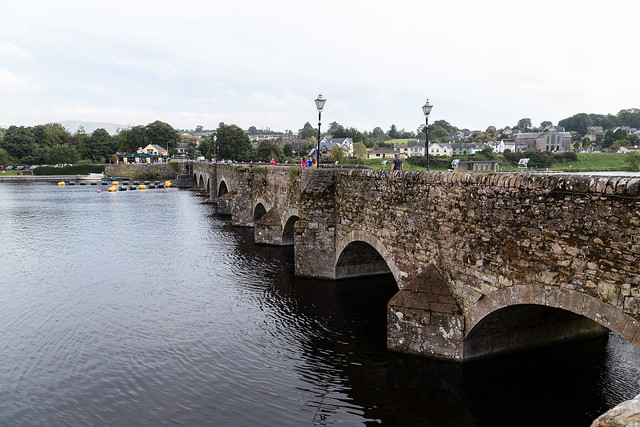
Photo: Killaloe by BillH-GSACC, some rights reserved.


A host of jigs and an engelska

Some new traditional tunes

As we go into the final weeks of the summer term, both group classes are working towards putting sets of jigs together, one Irish, the other Scottish. In addition, we tried our hands at a Swedish tune.

A Swedish Engelska

Portobello friends and neighbours Fun Fiddle have developed and shared their reportoire over a number of years, with some very fine arrangements and we have on occasion joined them for performances. Sweden has a very strong fiddle tradition and the Fun Fiddle 3-part arrangement (PDF link) of Engelska Från Småland presented a chance to try music from another tradition.

An Engelska is an English-style contradance popular in Sweden since the late 19thC. This one is from Småland in southern Sweden and here’s one of a few Youtube renditions of it, complete with flutes:

Henrik Norbeck is a Swedish wooden flute player who has an extensive high-quality resource of Irish tunes in ABC notation. He has also written an essay on Swedish traditional music and another on the flute within it. All are highly recommended.

The nyckelharpa is a type of Swedish fiddle and in Edinburgh, fiddler Gavin Pennycook has explored using it in the Celtic Nyckelharpa Project.

Update: I originally said that this is also a “walking tune”, but I was getting it confused with another tune, so have removed that comment.

A set of Irish jigs

Over the next few weeks the Slow and Steady Group will be putting together some Irish jigs into a set. Music notation for this will be up presently, the first two of these are now available to listen to, The Killaloe Boat (The Lilting Banshee) and The Mug of Brown Ale. We will conclude with Dónal na Gréine (The Leg of the Duck), which I will add in due course.

A set of Scottish jigs

Meanwhile, the Improvers and Beyond class are also doing a set of jigs, these ones from Scotland. The House of Gray has already been blogged and this week we added Drummond Castle. First published in 1734 in the Drummond Castle Manuscript, a version of it also appears in Anderson’s Budget of tunes for the German Flute or Violin of 1820, which Aberdeen flute teacher Kenny Hadden drew my attention to. I’ll be posting up my version of it, but here it is in PDF facsimile from the National Library of Scotland website:
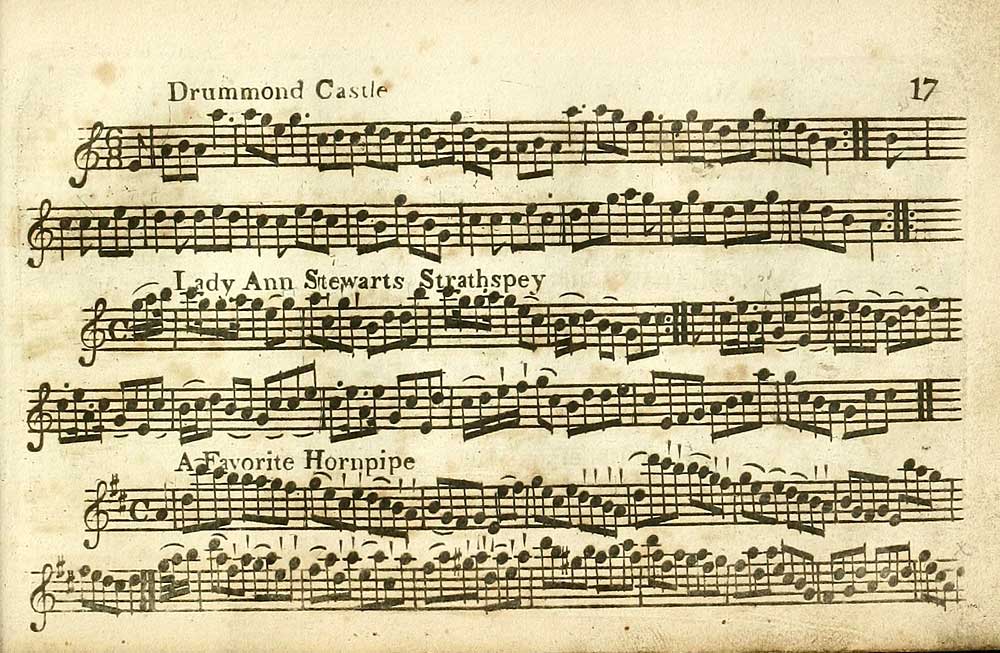
Page 17 of Anderson’s budget of strathspeys, reels & country dances, published by the National Library of Scotland under a Creative Commons Licence.

Incidentally, the “German flute” in question is the transverse wooden flute that we know today, described so in order to distinguish it from end-blown flutes or recorders (flûte à bec in French, Blockflöte in German). For more information on the history of the flute, see Rick Wilson’s Old Flutes site.

We’ll conclude the set with GS McLellan’s The Jig of Slurs. Composed as a challenging pipe jig it concludes the set with a strong, interesting and well-known major key tune. A setting of it is given at Tune Archive, as is some discussion of its background.

The final two parts of that tune have had words put to them by Andy Hunter and I first heard Christine Kydd and Janet Russell sing this in 1990. A version sung by Lizzie Higgins, who knew Andy Hunter can be heard on the Tobar an Dualchais / Kist o Riches web site.

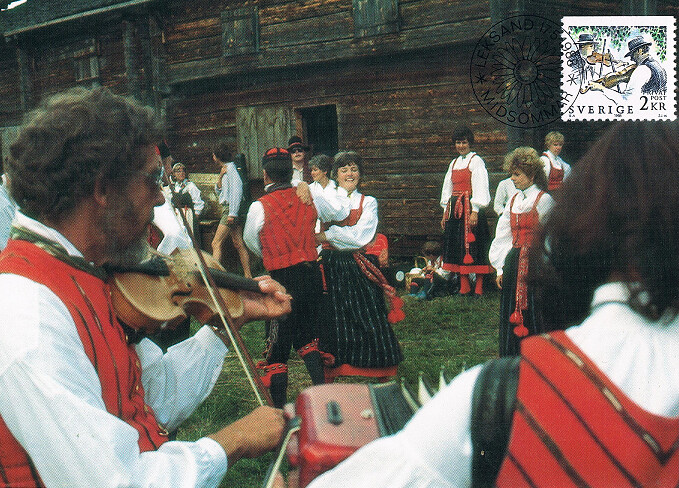
Top image: Maxicard of playing the fiddle on Midsummer, 1988 by Thereshedances, some rights reserved.

A rare Scottish Jig: The House of Gray

After the flute activities of last weekend, it was back to normal this week with the regular FluteFling classes in Portobello. After putting some of the finishing touches to The Braes of Mar (to be revisited), we moved on to a tune that I had in reserve on the FluteFling Scottish Flute Day workshop.

The House of Gray is a tune in A minor that I came across in Kerr’s Merry Melodies some years back and appears to have been largely overlooked in my experience. A quick look online shows no recordings of it, for example.

Besides being a good tune, The House of Gray is useful for developing a few techniques:

  • The A to C’ natural transition at speed, found in many tunes, both Scottish and Irish
  • A decent-sounding C’ natural, which is generally weak and problematic on a simple system flute
  • Playing three C’ naturals at speed together in a tune and what can be done about this (tonguing or gracing for example).
  • Handling syncopation within a tune, a feature of many Scottish tunes

The tune itself leaps about a fair amount and can be regarded as typically Scottish in that regard. Very chordal in structure, some of the phrases are built directly upon arpeggios (broken chords).

The music for the tune can be found on the new Workshops resources page. A recording is on Soundcloud, found via the Resources page for the classes.

I was intrigued to see on Tune Archive that the jig is older than I thought, being first published in Aird’s collection of 1788. Gray House appears to be near Dundee and is currently abandoned and in need of its own revival.

Photo: Gray House © Copyright James Allan and licensed for reuse under this Creative Commons Licence.

A strathspey: The Braes of Mar

This is a four part strathspey that sounds very much like a pipe tune but the fourth part drops below the piping range, suggesting that this may be a fiddle setting.

The Fiddler’s Companion confirms that the itself tune is old, having first appeared in the Drummond Castle Manuscript of 1734 as Sir Alexander McDonald’s Reel and later printed in Bremner’s Collection of 1757 as Sir Alexander McDonald. It has traveled to Canada and Ireland and exists in many forms under different names, including as as fling and as a jig. Some say the Devil’s Dead is a well-known song in Ireland that is set to this tune.

I first learned this as an Irish two-part reel that I later realised was a fling. I then found it was a strathspey and discovered from Edinburgh fiddler Doug Patience (now in Meenross, County Clare) that it had a third part. And finally, years later I learned it had a fourth part. It seems that 2, 3 and 4-part versions are common.

The most frequent decoration here is cuts and casadhs (a late double grace note), but there is an opportunity to roll in the third part on the high E in the opening phrase and later in the 4th part on a low E phrase near the end. Keep a regular pulse throughout with the breath and it’s OK to tongue the shorter parts of the scotch snaps to give them more punch. Look out too for opportunities to put in a brief pause on the longer parts of the snaps.

The resources for the tune can be found on the Resources page for this year’s classes.

Photo: Native pine at Glen Derry, Mar Lodge Estate. Copyright C Mills 2013. Used with kind permisssion.

A Hebridean rowing tune

The new term began last night with one of a handful of rowing tunes that I am aware of. Iomramh eadar Il’as Uist (Rowing from Islay to Uist) was originally published in 1815 in Captain Simon Fraser’s collection — perhaps my favourite of the older collections. If you don’t have it, a PDF of a later edition can be found on the International Music Score Library Project.

The Skye Boat Song is the best known of these tune types (see the interesting history of it on Wikipedia) and the Arran Boat Song is widely played but Rowing from Islay to Uist perhaps less so. I first heard it on Ossian’s St Kilda Wedding (highly recommended) and it has been recorded by others since.

Ossian played it in Am but it fits the whistle and flute well in Bm. It is usually written out in a slow, rocking, 6/8 time and it is often described as a jig due to this. 3/4 makes sense to me but I have adhered to the original time signature. It’s a long way from Islay to Uist, so take your time with this one. The weaker c# notes on our instruments can be bent to good effect.

Resources for the tune can be found on the Resources page for the classes.

Photo: North Uist near Solas by Scot Tares, some rights reserved.