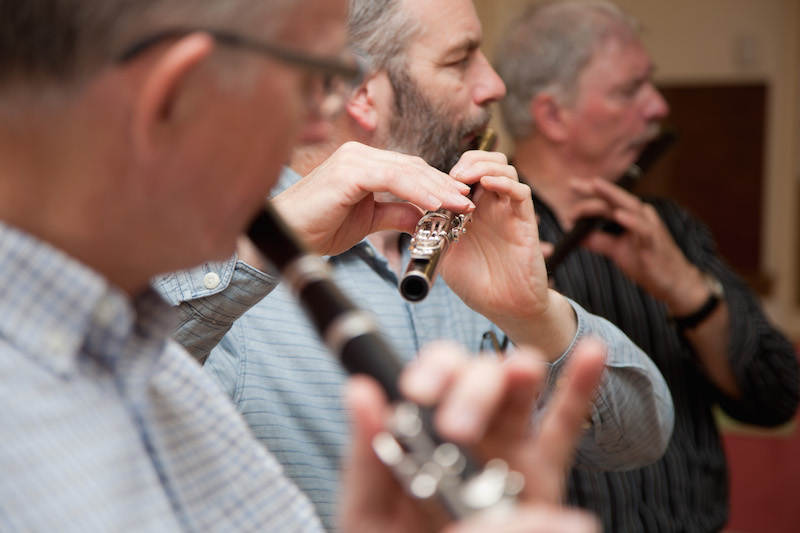
The FluteFling November workshop was surprisingly sold out with as many as fifteen people attending, so firstly my apologies to those who were unable to make it.
It’s only the second of this new monthly series, but it has been well- attended and I am delighted with the level of interest. Plans are already being made for January-April and beyond.
The next FluteFling workshop will take place on Saturday December 17th and you are welcome to join us for a coffee or beer afterwards.
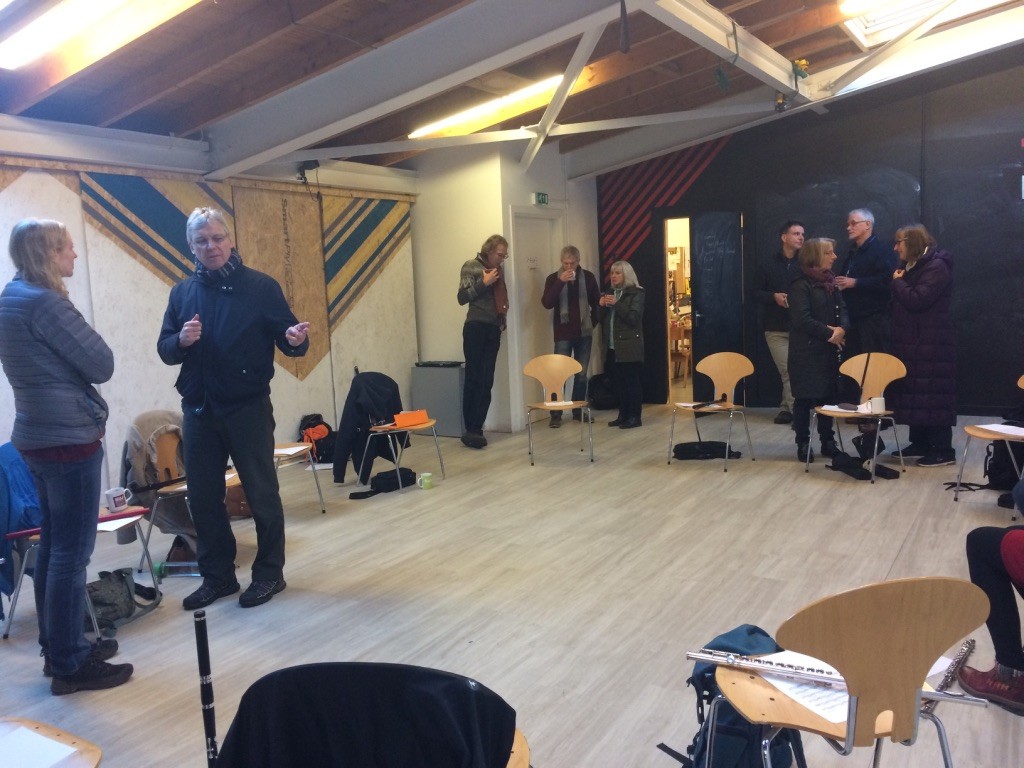
Flute and whistle players take a well-earned break at November’s FluteFling workshop.
Technique
We played long tones to begin with and help us warm up ourselves and the flutes. These tones were based on arpeggios associated with the tunes we were going to look at and get our ears and fingers used to the tonal centres and shapes within the tunes themselves.
An arpeggio is basically a broken chord, meaning the notes of the chord are not all played simultaneously, but one at a time. These arpeggios are to be found within the tune structures of all music genres, including traditional music. When learning by ear it is a useful and important skill to understand that, for example a tune in the key of G will feature phrases that include G, B and D with linking notes and runs of notes. So if your fingers are familiar with the relevant shapes and positions, then the melody can be anticipated and more readily picked up.
If you aren’t familiar with chord structures, then for our purposes all you need to consider is that a chord triad (three notes) consists of the first, third and fifth notes. (There are many permutations, but all we are concerned with here is understanding how a traditional tune may be structured and how we can use that to help us play by ear.) For a tune in G, the G is the root of the chord, or first note, A is the second and not part of it, so B is the third, C the fourth and D the fifth, giving us a pattern of G-B-D.
So for a tune in G, we would expect to hear phrases that incorporate these notes. Furthermore, these notes could be expected to feature prominently. This is useful in learning the tune as we can after listening hear and understand the shape of the phrases and try to translate this to our fingers and breath.
Repertoire
The tunes were the Galician waltz A Bruxa (The Witch) by Antón Seoane, which I had transposed into B minor and hung on B-D-F# and The Sunny Banks (The Flowers of Ballymote), a traditional Irish reel very much in D and hanging on D-F#-A. The sheet music for this can be found here and on the Resources page. Click on the links below for my recordings of the tunes or follow me on Soundcloud and access more that I have done.
We stood up, walked about as we played and felt the movement of the tunes in our legs and at one point had a number of us unconsciously swaying gently together like grasses in the wind. We also has a look at phrasing across parts of the tune, especially with the wistful descending phrases of A Bruxa, giving more air to the opening of the phrases than the conclusions.
Our setting of A Bruxa in B minor has an A# (or Bb) in the final phrase. This is fine with a keyed flute, but we looked at cross-fingering to flatten the B natural on keyless instruments and on the low whistles a half-holing measure was also found to be useful. Although tricky, this was better than a setting in A minor that had many F naturals and a G#. If you’re interested in how that might look or sound, there are versions on The Session web site, along with discussion of the title.
 The original version was recorded by Milladoiro (official web site here), with hurdy gurdy player Antón Seoane being a founder member.
The tune has an Edinburgh history as there are recent musical connections between Edinburgh and both Galicia and Asturias in northern Spain.
The Easy Club recorded the tune in the 1980s, and The Tannahill Weavers did so later on. John Martin played fiddle with the former and has been with the latter for many years. One of the bands which gave rise to Shooglenifty in the late 80s and early 90s was Edinburgh band Miro, who included mandolin player Iain MacLeod, but also fiddler Simon Bradley (who plays with Asturian band Llan de Cubel) and at various times flute players Rebecca Knorr and Niall Kenny; Shooglenifty’s fiddler Angus Grant Jr., who sadly died recently, also appeared with them on occasion.
Another notable recording of A Bruxa is on Senex Puer by Lá Lugh, from Dundalk. You can hear a sample of the tracks on Eithne Ní Uallacháin’s web page and it is worth exploring the rest of the site to learn more about the group’s singer and flute player and her legacy.
The version I taught is here:
Flute player and teacher Kenny Hadden joined us for the second tune, an Irish reel called The Sunny Banks (also generally known as The Flowers of Ballymote and in Bulmer and Sharpley’s collection as The Flying Column).
Again, we looked at arpeggios for the tune and then learned the bare bones. We walked about and found our own acoustic spaces. A discussion then followed about how variations feature in traditional music, in particular in Ireland. The Session web page for The Sunny Banks includes a number of versions that show it is open to interpretation and variation, but it is still the same tune.
As it happens, Kenny Hadden had posted a YouTube clip of The Cheiftain’s playing it, with a Matt Molloy solo for the reel. They precede it with a slip jig (9/8 time) entitled Top it Off, which is a version of the same tune.
Here’s the clip:
Quoting Cathal McConnell, Kenny made the point that once you learn a tune it is yours and you can do what you like with it. Variations are your way of expressing what you enjoy about the tune and for me I would say that exploring variations is like turning the tune around and viewing it from different angles in order to know it better. It embeds it in your mind and you become more comfortable playing it. I would say that a tune existing as both a reel and a slip jig is another example of somebody somewhere and at some time trying out variations, too.
Here are some of my variations:
I generally agree with Kenny that this is more common and accepted in Irish music. However it also exists historically in Scottish music in the form of set variations of tunes published in the 18th and 19th Centuries and in the Highland and Lowland piping repertoires. Fiddler Alasdair Fraser also commonly plays variations on his recordings.