Sleep Soond

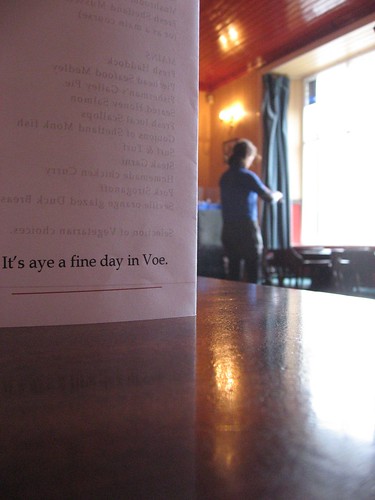
It's aye a fine day in VoeThe latest tune we looked at is a popular Shetland reel called Sleep Soond I’da Mornin’ (Sleep Soundly in the Morning). 

The tune uses a G# in the A part and is good for getting to grips with the challenges of doing this on the flute or whistle. Half-holing (uncovering half of the G hole is a common way of doing it. This takes getting used to in terms of accuracy, but you may find that playing A and placing the F# finger down will produce a good effect. This will of course depend on your instrument and also the octave so it is worth taking the time to experiment.

Resources for this tune have been uploaded.

Fiddle playing is enormously popular in Shetland and it has a very strong and distinctive repertoire and style. Some of this popularity will have been down to the success of The Boys of the Lough, which has featured Shetland fiddler Aly Bain and County Fermanagh flute player, whistler and singer Cathal McConnell.

I mentioned Catriona MacDonald (Shetland), Gavin Pennycook (Celtic nyckelharpa project) and Sarah-Jane Summers (Norwegian hardanger fiddle influence) as people worth listening to and I could have added many more of course. Fiddler’s Bid, both collectively and as solo members are also worth listening to.

In searching around, I found this early edition of Haand Me Down Da Fiddle as an online PDF. This is a definitive collection of Shetland tunes and method for the fiddle and the issue of copyright does occur to me here, so I hope it is OK to share the link that I found via a Google search.

 Photo: It’s aye a fine day in Voe by Duncan Cumming, some rights reserved.

An Dro: a Breton dance

The Slow and Steady class have been enjoying Breton tunes lately and this tune is a nice contrast to the recent Gavotte Ton Double. In keeping with many Breton tunes, this one has no title other than An Dro, which simply translates as The Dance, in other words it is the principal dance form of Brittany.

I found this tune in Dave Shepherd’s Breton Tune Book. There is a discussion of Breton tunes, their titles and a useful list of links on The Session web site.

Music and notation for this tune are up on the Resources page.

Update: Here’s a version of the recent Gavotte, played by Mulberry Bend, who are Susanna Carman & Karl Farren. This replaces the mistakenly placed previous clip, which was not the right tune at all. However, the set is from the playing of Kevin Burke and Mícheál Ó Domhnaill:

And here’s Breton band Barzaz, who arose in discussion. The flute player is Jean-Michel Veillon:

Photo: le musique adoecit les mars by Rachel, some rights reserved.

Another Donegal Highland

Last night the Improvers and Beyond class learned Charlie O’Neill’s No.2, the third and final tune of a set comprising a strathspey and two Donegal highlands. The other tunes are Bidh Eoin and Charlie O’Neill’s No. 1.

The version of the tune I play has come from the playing of regular musical partner Cathy Sharp in Edinburgh sessions and it is a little different from ones I have come across online. Versions have been recorded by Altan and by Cran, that I am aware of. Cran call it Charlie O’Neill’s and I have added the number to distinguish it from the other Charlie O’Neill’s we learned. It may be that both tunes are also known by other titles.

See the Resources page for the music.

Cathy learned it in Donegal, where there are many fiddle workshops and events that reflect the dominance of the instrument in that area. Flutes barely feature at all, although the late Frankie Kennedy was part of Altan for many years and has a festival in his honour.

The Donegal highland is related to the music of Scotland, in particular that of the west coast, where that have been strong cultural links over the centuries. If you’re looking around for examples of Donegal music, this site makes a good introduction and there is a good Wikipedia overview as well.

Photo of James Byrne in Glencolmcille by Rik Walton, some rights reserved.


Dates and a Breton Gavotte

Last night the Slow and Steady class learned a Breton tune that I have since discovered is an untitled Ton Double Gavotte from the playing of fiddler Kevin Burke on his Portland album with guitarist Mícheál Ó’Domhnaill. They also played together in The Bothy Band and made a couple of duet recordings, all of which are highly recommended. He also plays with Celtic Fiddle Festival, a group with fiddlers from different countries.
We also discussed the English band Blowzabella and later I mentioned Ti Jaz to Pierre-Marie. You may also want to check out flute player Jean-Michel Veillon, his work with the groups Kornog and Barzaz and this interview with him. If you are completely new to Breton music, you have to check out Alain Stivell, who first brought the music to the wider world. There is plenty more to explore and lots of links on YouTube of course.

The dots for the tunes will be up presently but recordings of the Gavotte and an An Dro I thought we might also try are available in the Resources section.

In the meantime, you might enjoy this video of people dancing and discussing gavottes:

Dates reminder

It’s October break in Edinburgh so there will be no FluteFling class on Thursday 17th. Classes resume on Thursday 24th with the Improvers class. Slow and Steady resume on Thursday 31st.

Photo: Binou and bombarde players by Ludovic, some rights reserved.

Music from the Western Isles and beyond

At last week’s class we discussed some aspects of Gaelic Mouth Music, psalm singing and Cape Breton fiddling in relation to some of the tunes we have been learning. This quick follow-up post is to share some related links.

Gaelic psalm singing

  • For some background on this unique singing style, there is an introduction at the Education Scotland website:

    Each line of the psalm is ‘put out’ by the precentor or leader. The congregation then joins in gradually and slowly sings those words, but with varying degrees of ornamentation and at varying speeds. Although each singer is singing the same tune, the effect is of a continuous sound with different chordal effects being created. This is known as heterophony.

    Although the music sounds very complicated, the roots of the melodies being sung lie in straightforward Scottish metrical psalm tunes.

  • Gaelic psalms at Back Free Church, Isle Of Lewis- 20/21/oct/2003:
  • The clip is from the church in this recording, Salm vol 2 which the text in the link describes as:

    the congregation singing unrehearsed, unaccompanied Psalms with various precentors.

    This is traditional Gaelic psalm singing in the style of free heterophony – precentor-led singing with the congregation following through. Various precentors lead a large congregation in the most popular psalms.

  • The many field recordings at Tobar an Dualchais/ Kist o Riches website includes this anonymous recording of Salm 133.

Mouth Music

  • We have looked at music associated with Mouth Music a little before. Here’s an example in strathspey time, similar to the Bidh Eoin and the Donegal Highlands we are looking at. Air Do Shlàinte Mhàiri an Dotair is sung by Annie Arnott and was recorded by the great archivist Hamish Henderson.

Cape Breton fiddle

    • We talked about the relationship between the fiddle styles of Cape Breton, the west of Scotland and the type of swing we are trying to put into our playing as flute players. I mentioned Winston “Scotty” Fitzgerald as someone to look out for and there are some related clips on Youtube, but it can also be seen in the opening strathspey by left-handed fiddler  Kimberly Fraser  in this set, accompanied by Mark Simos on guitar.

Highlands

  • Here’s a clip of Duncan Chisolm to compare, playing a strathspey followed by Scottish and Irish reels:

Donegal

  • And here are some links to Donegal. First some fine fiddling from Glencolmcille. The tunes are Casey’s Pig (The Duke of Gordon’s Birthday) and Miss McLeod of Raasay:
  • Here’s a Highland being danced:

Finally

  • Here’s a clip of flute player Calum Stewart astonishing performance of James Scott Skinner’s astonishing variations on Tullochgorum.

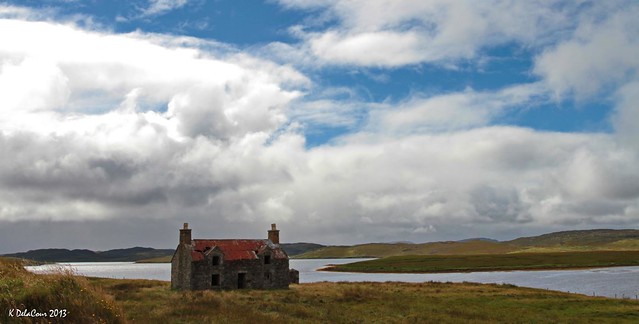
Photo from the Western Isles (CC) Kristian Dela Cour.