A highland tune in a modern style: The Lochaber Badger

Fred Morrison

This week we continued looking at the tunes that Amble Skuse taught in February. There was a big pentatonic theme and we focused on a modern one by the highly-regarded Fred Morrison, who plays various pipes and whistles and writes distinctive tunes.

The Lochaber Badger is a relatively simple reel with modern-sounding, syncopated phrases that come out of the Highland piping tradition. It makes a good introduction to this style of tune, having a hypnotic quality and able to take being played fairly slowly. Where the notes are held across the main beats, you can provide more air on the beat to make it pulse and give it a bit of swing, which is what we did in the class.

Other Fred Morrison tunes are to be found in two collections of his compositions that can be purchased through his website.

I have recorded Lochaber Badger on flute and whistle, but not provided notation, which can be found with some discussion at The Session website (ours is the first one, in Em). My recording of a simplified, slowed down version can be found on the Resources page. Here is Fred Morrison himself playing it with Michael McGoldrick (the second tune in the set):

Photo of Fred Morrison by BedwyrPhoto.com, some rights reserved.

Lucy Farr’s Barndance plus one

This week we caught up with some of Amble’s tunes from when she took the class. Our main focus was Lucy Farr’s Barndance and we followed this with another, Where in the World Would we be Without Women?

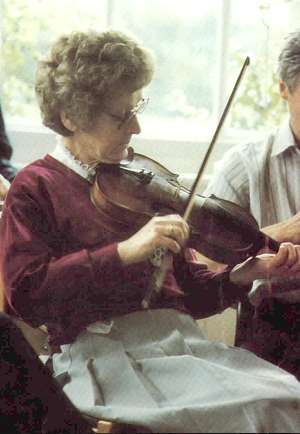
Lucy Farr was a fiddle player from east Galway, who ended up living in London. She featured on the influential 1968 recording Paddy in the Smoke, which was a live recording from the London session scene of the time. There is a great profile of Lucy Farr here. Fetch a cup of tea to have while reading that one as it is as detailed as it is fascinating.

Our barndance is one of two associated with Lucy Farr, who called it The Kilnamona Barndance according to flute player Niall Kenny on this lengthy discussion on The Session. There is also some discussion about it’s identity as a German (Northern Irish dance form) and a 7-step dance (also German, possibly the same dance). I know little about this dance form other than it has a similar musical feel to a barndance, which in itself feels like a little like hornpipe.

Once in a session in Sandy Bell’s, someone from the Western Isles sang in Gaelic to this tune when I played it and told me it was well known and that the song translated as I Saw the Cat. It is worth checking out the recording by fiddler Martin Hayes, from neighbouring east Clare, of a much-slowed down and meditative version of this simple but effective tune.

If We Hadn’t Any Women in the World is a barndance that could follow Lucy’ Farr’s quite nicely. Harry Bradley recorded this on As I Carelessly Did Stray…, but he cites Hammy Hamilton’s recording on Moneymusk as the source. I believe that I may have heard this on an early cassette version of that recording (and have misremembered the title slightly too — Where in the World Would We Be Without Women?). Hammy Hamilton’s fine version is freely available online and I note that he freely switches phrases around, which may also account for my own fluid setting of the tune. Again, many versions and much discussion on The Session website. The tune was first recorded by James Morrison in 1928 according to the sleeve notes.

Dots, ABCs and recordings for both tunes can be found in the Resources section.

Photo of Lucy Farr via Mustrad.


Spoots and Salmon

This week we consolidated the two tunes that Amble Skuse taught the class while I was away. She focused on examples that are built on the pentatonic scale, illustrating with the Shetland reel Spootiskerry and the march/ rant/ polka Salmon Tails Up the Water.

Spootiskerry is so well known that it is easy to forget that it is a modern tune, written by Ian Burns from Shetland and named after his farm. A skerry is a shoal of jaggy rocks usually found offshore protruding out of the water (from the Old Norse language and also found in Gaelic), while a spoot is a razor shell, which can be found and harvested on beaches.

The reel fits the flute and whistle very readiily and has some syncopated phrases that are quite distinctive. My version is a little different from Amble’s, and it may be one that I have developed in order to emphasise that rhythmic play. However, the version that I have recorded is Amble’s.

There is some good discussion on it at The Session, including an intriguing comment from Kenny Hadden who suggests that it fits the whistle in A as well. I haven’t tried that but it is very tempting. Kenny will be teaching again at this year’s Flute Day on 9th May.

Amble’s other tune, Salmon Tails Up The Water, I am less familiar with to play, but I have been aware of it for many years and should have known it. It is one of at least two tunes going by this title and this version is also known as The Banks of Inverness. I have seen it in Scottish collections, (but possibly the other tune with this title) and it feels to me like a march, but I see online it is claimed by Northumberian pipers as a rant, written in the 18thC by piper Jimmy Allen, who sounds like a colourful character.

There is once more some decent discussion on The Session, where it has also been associated with Irish singer and mandolinist Andy Irvine, once of the influential Planxty. It seems that the tune may be part of The Siege of Ennis set of Irish ceili tunes, probably as a polka. Good tunes tend to stick around and gain acceptance in other traditions.

We consolidated the tune and explored a couple of settings of it, one as taught by Amble, the other published by Nigel Gatherer in one of his many fine tune books. I have recorded and provided music for both of these, as well as music for Spootiskerry, on the Resources page for this year. Thanks are due to Amble for teaching these fine tunes and to Sarah and Adelheid for joining me on the recording.

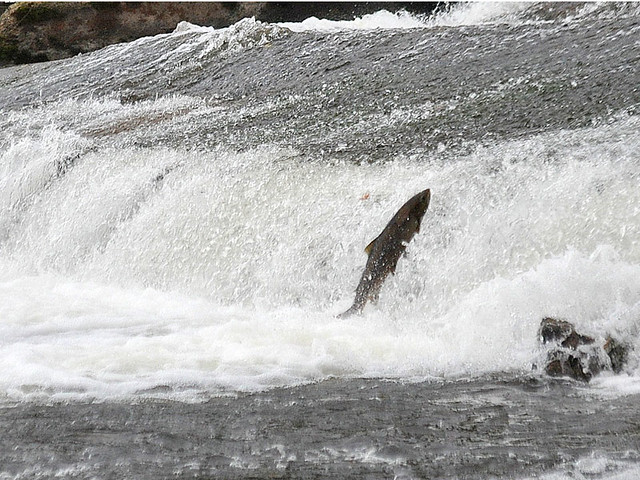
 Photo: Salmon Jumping by Karen Miller, some rights reserved.

The Legacy: a rolling Irish jig

The first two classes of the term have separately focused on technique for flute and whistle ( breathing, tone, phrasing and ornamentation in particular). Both of these lead into the first tune of the year, an Irish jig called The Legacy.

The tune is based on chord structures in G and has a contrasting Em B part before resolving itself back to G. It’s strong and distinctive and offers some opportunity to vary the melody with rolls in a variety of places (G, B, E, D and A). I have attempted to show some of this in the resources that accompany the tune.

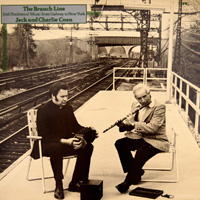
I was surprised to discover that not a great deal is known about the tune. It is associated with Irish-American fiddler Larry Redican (more on him here) and bore his name on some recordings, notably by Bobby Casey (1959) and the Coen brothers’ The Branch Line. No, not the movie makers, but Jack and Charlie from east Galway, playing flute and concertina.

It was first published as The Legacy in Bulmer and Sharpleys’ mid-1970s collections of Irish tunes, but did appear in O’Neill’s Music of Ireland (1903) and also Kerr’s Merrie Melodies (1880s) under other titles (Skiver the Quilt, The Tailor’s Wedding). More detail can be found over at The Fiddler’s Companion website.

I have seen an assertion online that it may be a Scottish tune originally, but no evidence to date, other than the earlier publication date for Kerr’s, which includes Irish and other tunes anyway. Having said that, the strong chordal construction of the jig wouldn’t be out of place in the Scottish repertoire.

By the way, for some ABC settings of the old collections, check out this website.

Winter-Spring term 2015

The new dates for the term can now be found on the Diary page and the Booking form has been updated too.

The term will begin with a couple of instrument technique classes that will allow people to spend some time just focusing on the techniques for their instrument. Low whistle players will find the whistle class more relevant than the flute class.

Another change this term is that Amble Skuse will take the class for a week when I have to be away and she will also be able to take the class over the February break when I will also be away.

So for the first time ever the classes won’t skip a week, which I hope makes for easier planning for everyone. It also means that there is an opportunity for a combined class at the end of the term, for which I have plans.

Photo: Snowdrops by Cams, some rights reserved.